Luffing Jib Load, With and Without Sheave Pulley

Click For Summary
The discussion centers on the tension dynamics of a DIY Luffing Jib Crane, specifically comparing scenarios with and without a sheave pulley. Participants analyze the tension in the red rope when supporting a load at the boom's tip, noting that the tension remains identical in static load conditions for both configurations. Key questions arise regarding the role of the guy in supporting the weight and how its function changes between the two setups. It is concluded that the tension in the red rope is greater in one scenario due to the load being effectively doubled. Understanding these mechanics is crucial for effective crane operation and safety.
Herbid
Messages
14
Reaction score
0
Homework Statement
Problem w/ Luffing Jib Load, With and Without Sheave Pulley
Relevant Equations
F = M x a
Now I am working with a DIY Luffing Jib Crane.

Mys subcon said that:
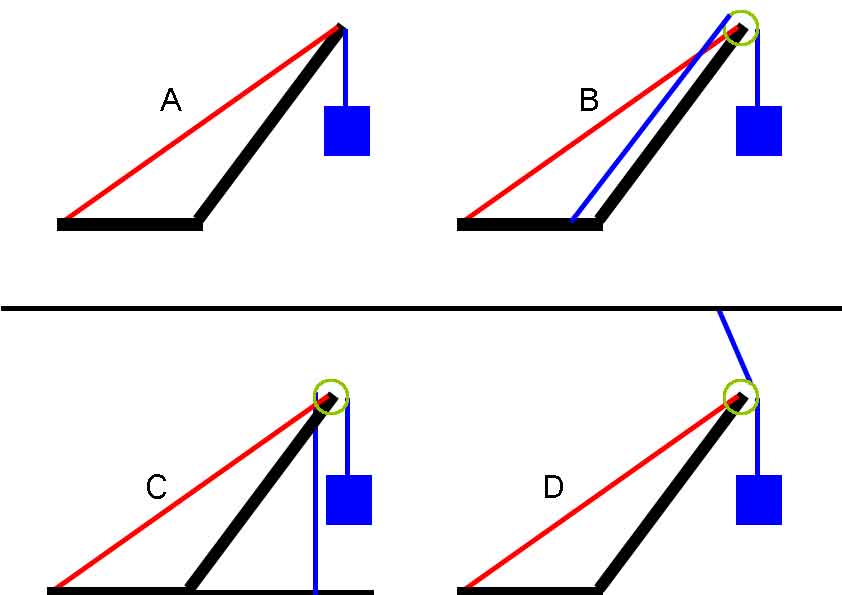
Tension of red rope for hanging a blue box load at the tip of the boom i(A) s as the same as hanging it with pulley and tied to the motor/ground_B (System in a Static Load Condition)..
Blue Rope and Pulley weights are neglected.

I assume by the pic C and D.
241674


Can anybody give me some advicer?
 
Physics news on Phys.org
Herbid said:
I assume by the pic C and D.
What are you assuming by (C) and (D)?

Have you established in your mind why there is identical tension in the red cable in (A) and (B)?
 
Other questions you might consider is what is the function of the guy in A? How does it help support the weight. How is its function changed in B?
 
NascentOxygen said:
What are you assuming by (C) and (D)?

Have you established in your mind why there is identical tension in the red cable in (A) and (B)?
It is indeed in C, the tension of red Rope is bigger the in D, because the load in C is double pulled by load and ground.
CMIIW
 
The book claims the answer is that all the magnitudes are the same because "the gravitational force on the penguin is the same". I'm having trouble understanding this. I thought the buoyant force was equal to the weight of the fluid displaced. Weight depends on mass which depends on density. Therefore, due to the differing densities the buoyant force will be different in each case? Is this incorrect?

Similar threads

  • · Replies 5 ·
Replies
5
Views
2K
  • · Replies 27 ·
Replies
27
Views
10K
  • · Replies 2 ·
Replies
2
Views
6K