Discussion Overview
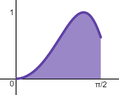
The discussion revolves around finding the volume of a solid generated by revolving the curve defined by \( y = \sin(x^2) \) from \( x = 0 \) to \( x = \frac{\pi}{2} \) about the y-axis. Participants explore the cylindrical shell method and also consider the washer method for calculating the volume.
Discussion Character
- Mathematical reasoning
- Technical explanation
- Debate/contested
Main Points Raised
- One participant proposes using the cylindrical shell method with the integral \( V = \int_0^{\frac{\pi}{2}} 2\pi x \sin(x^2) \, dx \).
- Another participant questions the limits of integration and suggests a correction to the integral form.
- There is a repeated mention of the integrand needing to be corrected after adjusting the limits, indicating some confusion in the setup.
- A later reply provides a corrected integral \( V = \pi \int_0^{\frac{\pi}{2}} \sin(x^2) 2x \, dx \) and evaluates it, leading to a numerical approximation.
- Another participant introduces the washer method as an alternative approach to verify the volume calculation, presenting a different integral setup.
- There is a discussion about distributing constants correctly in the volume expression, indicating a potential oversight in earlier calculations.
Areas of Agreement / Disagreement
Participants do not reach a consensus on the best method for calculating the volume, as different approaches (cylindrical shell method vs. washer method) are presented and debated. There is also uncertainty regarding the correct setup of integrals and limits.
Contextual Notes
Some participants express uncertainty about the correctness of the integrands and limits used in their calculations, indicating that assumptions may not be fully clarified. The discussion reflects ongoing refinements and corrections without resolving the overall approach.
Who May Find This Useful
Readers interested in volume calculations using different methods in calculus, particularly those exploring the cylindrical shell and washer methods, may find this discussion relevant.