Discussion Overview
The discussion revolves around the magnetic field generated by a straight current-carrying wire, specifically addressing the application of the Biot-Savart law. Participants explore the nature of magnetic field lines, their contributions from different segments of the wire, and the implications of integrating these contributions to determine the magnetic field at a specific point.
Discussion Character
- Exploratory
- Technical explanation
- Conceptual clarification
- Debate/contested
Main Points Raised
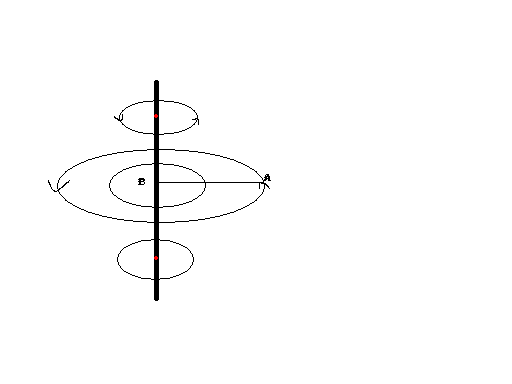
- Some participants assert that the magnetic field lines are concentric circles around a straight wire, questioning the contribution of points above and below a specific point (A) to the magnetic field at that point.
- Others argue that the magnetic field at point A is the sum of contributions from all infinitesimal segments (##dl##) of the wire, necessitating integration across the entire length of the wire for an infinitely long wire or between specific limits for a finite wire.
- A participant expresses confusion about how concentric magnetic field lines can intersect, prompting further clarification on the nature of magnetic field lines and their resultant direction.
- One participant inquires about the magnetic field produced by an infinitely short current segment (##dl##) and whether it would still form concentric rings.
- Another participant emphasizes that magnetic field lines do not intersect and clarifies that the direction of a magnetic field line at any point represents the resultant field at that point.
- A later reply acknowledges a misunderstanding regarding the basics of magnetic fields, suggesting that a small circuit element can exert a magnetic field at every point in its plane, which is perpendicular to that plane.
- One participant points out that a straight line does not define a plane, indicating that there are infinitely many planes containing the current element.
Areas of Agreement / Disagreement
Participants exhibit disagreement regarding the interpretation of magnetic field lines and their contributions to the resultant magnetic field at a point. There is no consensus on the implications of concentric field lines and their intersection.
Contextual Notes
Some assumptions about the nature of magnetic field lines and their contributions from different segments of the wire may be missing or not fully articulated. The discussion also reflects varying levels of understanding of the underlying concepts.