FishStik
- 5
- 0
Magnetic field inside infinitely conductive hollow tube
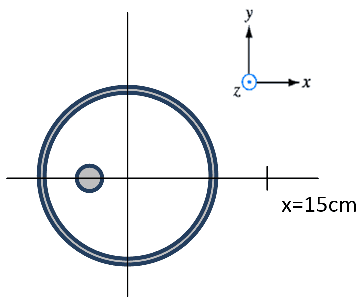
There exists a thin-walled hollow aluminum tube (assume σ=∞) of radius 10 cm centered around the z-axis. A long wire with 5 mm radius has a total current 2 mA in the z-direction and is centered initially at x=-5cm as shown. How does the magnetic field at x=15cm change if the wire is moved to (x,y)=(0,0)?
Magnetic field of an infinitely long current-carrying wire:
[itex]\Large\overrightarrow{B}=\frac{\mu _oI}{2\pi r}[/itex]
where:
μo is the permeability of free space
I is the current in the wire
r is the distance away from the wire
My initial guess was that the infinitely conductive tube has no effect on the magnetic field induced by the current-carrying wire, and the magnetic field can be calculated for the two different wire locations as if the tube was not there. Is this correct, or does the presence of the tube change the induced magnetic field in some way?
Thanks in advance.
Homework Statement
There exists a thin-walled hollow aluminum tube (assume σ=∞) of radius 10 cm centered around the z-axis. A long wire with 5 mm radius has a total current 2 mA in the z-direction and is centered initially at x=-5cm as shown. How does the magnetic field at x=15cm change if the wire is moved to (x,y)=(0,0)?
Homework Equations
Magnetic field of an infinitely long current-carrying wire:
[itex]\Large\overrightarrow{B}=\frac{\mu _oI}{2\pi r}[/itex]
where:
μo is the permeability of free space
I is the current in the wire
r is the distance away from the wire
The Attempt at a Solution
My initial guess was that the infinitely conductive tube has no effect on the magnetic field induced by the current-carrying wire, and the magnetic field can be calculated for the two different wire locations as if the tube was not there. Is this correct, or does the presence of the tube change the induced magnetic field in some way?
Thanks in advance.
Last edited: