Magnetic Field Surrounding a Straight Conductor

Join the discussion
Registration is free. Ask a follow-up in this thread, or start your own.
2 replies · 2K views · last reply
member 731016
Homework Statement
Please see below
Relevant Equations
Please see below
For this problem,
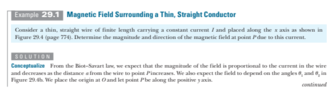
Textbook heading reading "Example 29.1 Magnetic Field Surrounding a Thin, Straight Conductor" followed by a problem statement about a thin straight wire of finite length carrying constant current I along the x axis, asking for the field at point P.

Part of the solution is,
Textbook solution excerpt headed SOLUTION, reading Conceptualize: from the Biot-Savart law the field magnitude is proportional to the current and decreases with distance a from the wire to point P, depending on angles θ1 and θ2 in Figure 29.4b, with origin at O and P along the positive y axis.

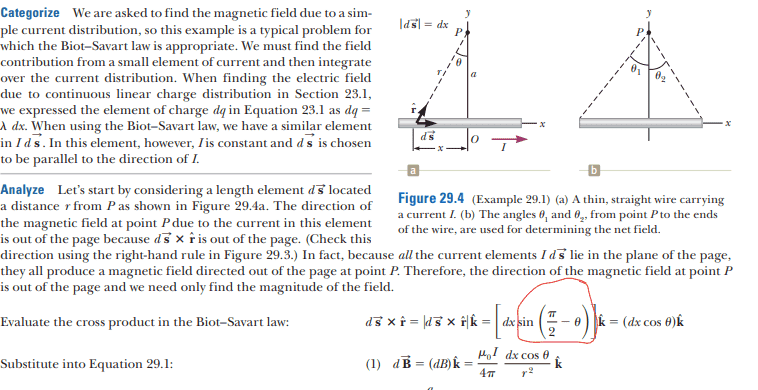
Textbook figure of a thin straight wire carrying current I with diagrams of the angles theta and theta-2 from point P to the wire ends, plus a derivation step with a circled sine term.

However, would someone please tell me where they got the sine function circled in red from?

Many thanks!
 
Attachments
  • Textbook page excerpt: Example 29.1, Magnetic Field Surrounding a Thin, Straight Conductor, with a Solution section beginning with a Conceptualize paragraph about the Biot-Savart law and the field at point P.
    1673658629770.png
    8.2 KB · Views: 169
  • Figure 29.4 with three panels: (a) a thin straight wire carrying current I along the x-axis with a length element ds at distance r from point P; (b) the angles θ1 and θ2 from point P to the wire ends; and the element ds and cross products shown in the derivation below.
    1673658699232.png
    35.2 KB · Views: 157
Physics news on Phys.org
Callumnc1 said:
However, would someone please tell me where they got the sine function circled in red from?
You're working with the cross product ##\vec{ds} \times \hat r##. How is the angle between ##\vec{ds}## and ##\hat r## related to the angle ##\theta## shown in diagram ##a##?
 
  • Like
Likes   Reactions: member 731016
TSny said:
You're working with the cross product ##\vec{ds} \times \hat r##. How is the angle between ##\vec{ds}## and ##\hat r## related to the angle ##\theta## shown in diagram ##a##?
Thank you @TSny ! I see how they got theta now. :) If we call the angle between ds and r hat as theta 2, then from the definition of the cross product:

dxsin(theta 2) = dxsin(pi/2 - theta) where I found theta 2 using angles in a triangle add up to 180 degrees.