Callix
- 106
- 0
Hello! I just need someone to check my work here. I already turned in the homework with my hunch, but now I just want to check my work because it is killing me not knowing 100% :) I am having strong conflicting thoughts on particular parts and thought I'd post it here for clarification. I will post the question and my solution and then ask the question that needs clarification.
1. Homework Statement
A metal bar with a length L has a mass of m. Initially it is placed on an incline θ above the horizontal. There is a magnetic field T that is directed upward around the bar and the metal contacts along the incline allow a current through the bar. If the coefficient of static friction is μ,
a). What are the minimum magnitude and the direction of the current that must pass through the bar to keep it from moving once released?
b). Is there a maximum current that can be used in that same direction that will also hold the bar in place?
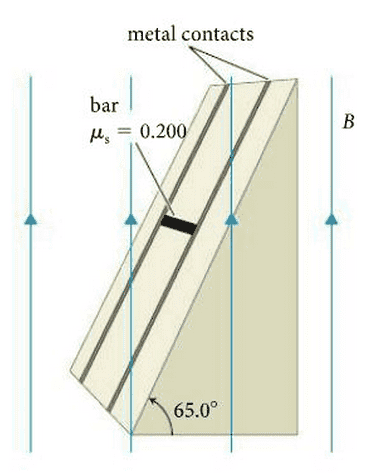
Presented in the solution
The first thing I notice is that B is perpendicular to I. Following the right hand rule, I can determine that F is either into the inclined plane (not up it, but into) or away from the inclined plane depending on the direction of the current. If the current is into the page, then the magnetic force is into the inclined plane. If it is out of the page, then away. I chose the convention that the magnetic force is into the inclined plane. Therefore I can create the following FBD:
*Everything in blue is related to the magnetic field, force, and current.
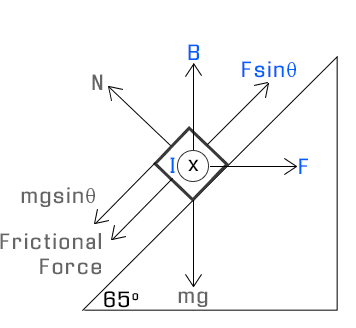
I can check to see if the current, field, and force are correct by doing the right hand rule. And due to the fact that I already know that the current and magnetic field are perpendicular.
Now, I can set up the following equations to solve for the minimum current necessary to create a magnetic force that will keep the bar static.
\sum F= F\sin(\theta)-F_f-mg\cos(\theta)=0
F_{magnetic}=BIL\sin(\phi) \rightarrow \phi=90^o \rightarrow F_{magnetic}=BIL
F_{friction}=\mu mg\cos(\theta)
\sum F=(BIL)\sin(\theta)-\mu mg\cos(\theta)-mg\sin(\theta)=0
\rightarrow BIL\sin(\theta)=\mu mg\cos(\theta)+mg\sin(\theta)
\rightarrow I=\frac{\mu mg\cos(\theta)+mg\sin(\theta)}{BL\sin(\theta)}
Now my question is: Is this equation correct and is it true that the component UP the incline is F\sin(\theta)? Because if it wasn't and it was just F, that would mean that B would have to be perpendicular to the surface of the inclined plane using the right hand rule. Given the diagram in the initial problem, this is not the case. Therefore the force must be either into the plane or away from it depending on the direction of the current.
**Also, for B I'm a bit confused. The maximum value the current would be, would be the force that JUST ALMOST causes the bar to move. As soon as it moves, it would experience kinetic friction. So I could set up the equation using kinetic friction but I don't have kinetic friction. How would I go about determine this?
Thanks for your time and any help would be greatly appreciated!
-Callix
1. Homework Statement
A metal bar with a length L has a mass of m. Initially it is placed on an incline θ above the horizontal. There is a magnetic field T that is directed upward around the bar and the metal contacts along the incline allow a current through the bar. If the coefficient of static friction is μ,
a). What are the minimum magnitude and the direction of the current that must pass through the bar to keep it from moving once released?
b). Is there a maximum current that can be used in that same direction that will also hold the bar in place?
Homework Equations
Presented in the solution
The Attempt at a Solution
The first thing I notice is that B is perpendicular to I. Following the right hand rule, I can determine that F is either into the inclined plane (not up it, but into) or away from the inclined plane depending on the direction of the current. If the current is into the page, then the magnetic force is into the inclined plane. If it is out of the page, then away. I chose the convention that the magnetic force is into the inclined plane. Therefore I can create the following FBD:
*Everything in blue is related to the magnetic field, force, and current.
I can check to see if the current, field, and force are correct by doing the right hand rule. And due to the fact that I already know that the current and magnetic field are perpendicular.
Now, I can set up the following equations to solve for the minimum current necessary to create a magnetic force that will keep the bar static.
\sum F= F\sin(\theta)-F_f-mg\cos(\theta)=0
F_{magnetic}=BIL\sin(\phi) \rightarrow \phi=90^o \rightarrow F_{magnetic}=BIL
F_{friction}=\mu mg\cos(\theta)
\sum F=(BIL)\sin(\theta)-\mu mg\cos(\theta)-mg\sin(\theta)=0
\rightarrow BIL\sin(\theta)=\mu mg\cos(\theta)+mg\sin(\theta)
\rightarrow I=\frac{\mu mg\cos(\theta)+mg\sin(\theta)}{BL\sin(\theta)}
Now my question is: Is this equation correct and is it true that the component UP the incline is F\sin(\theta)? Because if it wasn't and it was just F, that would mean that B would have to be perpendicular to the surface of the inclined plane using the right hand rule. Given the diagram in the initial problem, this is not the case. Therefore the force must be either into the plane or away from it depending on the direction of the current.
**Also, for B I'm a bit confused. The maximum value the current would be, would be the force that JUST ALMOST causes the bar to move. As soon as it moves, it would experience kinetic friction. So I could set up the equation using kinetic friction but I don't have kinetic friction. How would I go about determine this?
Thanks for your time and any help would be greatly appreciated!
-Callix