High School Magnitudes of the sum of two vectors

Click For Summary
The discussion centers around a textbook question regarding the equality of vector magnitudes, specifically whether the equality of the magnitudes of a+b and a+c implies that the magnitudes of b and c are equal. The original poster believes the statement is false, supported by their own diagrams showing differing lengths for vectors b and c despite equal resultant magnitudes. The textbook argues that the equality holds due to the properties of parallelograms formed by the vectors, but participants challenge this reasoning, asserting it is incorrect even in one-dimensional cases. Ultimately, the consensus leans toward the belief that the textbook contains an error. The conversation concludes with a light-hearted acknowledgment of the confusion caused by the question's phrasing.
keroberous
Messages
15
Reaction score
1
This is a question that I saw in a textbook:

"If the magnitude of a+b equals the magnitude of a+c then this implies that the magnitudes of b and c are equal. Is this true or false?"

The textbook says that this statement is true, but I'm inclined to believe it is false. I made a quick sketch to show my thinking visually.
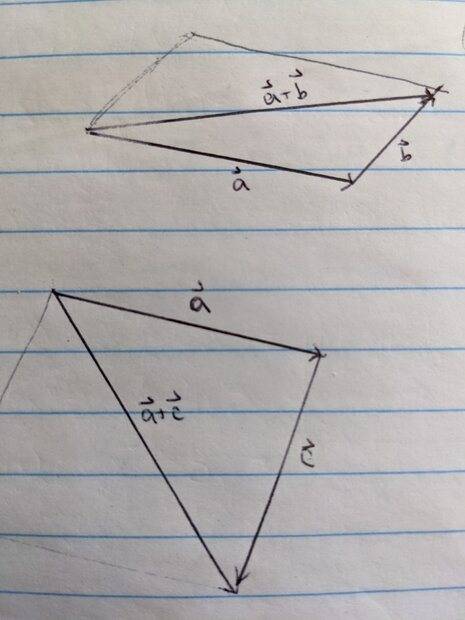
PXL_20210610_180527814.jpg

I drew these diagrams to scale, so vector a is the same in each case and the lengths of a+b and a+c are in fact equal (both 5 cm). It's clear to me that b and c are different lengths/magnitudes here. I'm not sure if the text made an error (not unheard of) or if I made an incorrect assumption somewhere. Thanks!
 
Physics news on Phys.org
20210610_113118~2[1].jpg
 
  • Like
Likes Abhishek11235 and PeroK
Suppose a=(2,0), b=(1,0), c=(-5,0) ...
 
So your diagram isn't all that different than mine, so I take it then that the textbook is incorrect and the statement is false?

Here's the book's entire reasoning:

"true; |a+b| and |a+c| both represent the lengths of the diagonal of a parallelogram, the first with sides a and b and the second with sides a and c; since both parallelograms have a as a side and diagonals of equal length |b|=|c|"
 
keroberous said:
So your diagram isn't all that different than mine, so I take it then that the textbook is incorrect and the statement is false?

Here's the book's entire reasoning:

"true; |a+b| and |a+c| both represent the lengths of the diagonal of a parallelogram, the first with sides a and b and the second with sides a and c; since both parallelograms have a as a side and diagonals of equal length |b|=|c|"
It's hard to think of anything more wrong!

It's not even true in one dimension!
 
  • Like
Likes keroberous
Maybe you should get different textbook?

Edit: Oops. I just noticed this was a question in the book, not a statement. It's just a typo. So - never mind...
 
Last edited:
  • Like
Likes keroberous and PeroK
PeroK said:
It's hard to think of anything more wrong!

It's not even true in one dimension!
I'm glad I wasn't going crazy!

DaveE said:
Maybe you should get different textbook?
If only that was an option. lol

Thanks!
 
  • Like
Likes DaveE

Similar threads

  • · Replies 9 ·
Replies
9
Views
3K
  • · Replies 3 ·
Replies
3
Views
964
  • · Replies 9 ·
Replies
9
Views
4K
  • · Replies 12 ·
Replies
12
Views
3K
  • · Replies 6 ·
Replies
6
Views
2K
  • · Replies 5 ·
Replies
5
Views
2K
  • · Replies 8 ·
Replies
8
Views
2K
  • · Replies 1 ·
Replies
1
Views
4K
  • · Replies 5 ·
Replies
5
Views
2K
  • · Replies 12 ·
Replies
12
Views
2K