Mass for solving the nuclear energy level

Click For Summary
SUMMARY

The discussion focuses on calculating energy levels and wavefunctions for protons in a finite square well potential, specifically for deuteron and the nucleus ##^{48}Ca##. The user initially applies the reduced mass for deuteron, yielding results consistent with literature. However, confusion arises regarding the appropriate mass for ##^{48}Ca##, where using the reduced mass leads to discrepancies with Skyrme Hartree Fock calculations. The user finds seven energy levels instead of the expected two, indicating a fundamental misunderstanding in the application of mass in nuclear models.

PREREQUISITES
  • Understanding of quantum mechanics, particularly finite square well potentials.
  • Familiarity with reduced mass calculations in multi-particle systems.
  • Knowledge of Skyrme Hartree Fock theory for nuclear structure.
  • Basic concepts of nuclear binding energies and Coulomb energy effects.
NEXT STEPS
  • Study the application of reduced mass in nuclear physics, particularly for multi-nucleon systems.
  • Learn about Skyrme Hartree Fock calculations and their implications for nuclear energy levels.
  • Investigate the role of Coulomb energy in nuclear interactions and its impact on energy level calculations.
  • Review graphical methods for solving quantum mechanical problems, focusing on finite square wells.
USEFUL FOR

This discussion is beneficial for nuclear physicists, quantum mechanics students, and researchers involved in nuclear structure calculations, particularly those working with finite square well models and energy level predictions in complex nuclei.

just_mb
Messages
3
Reaction score
0
Hi all,
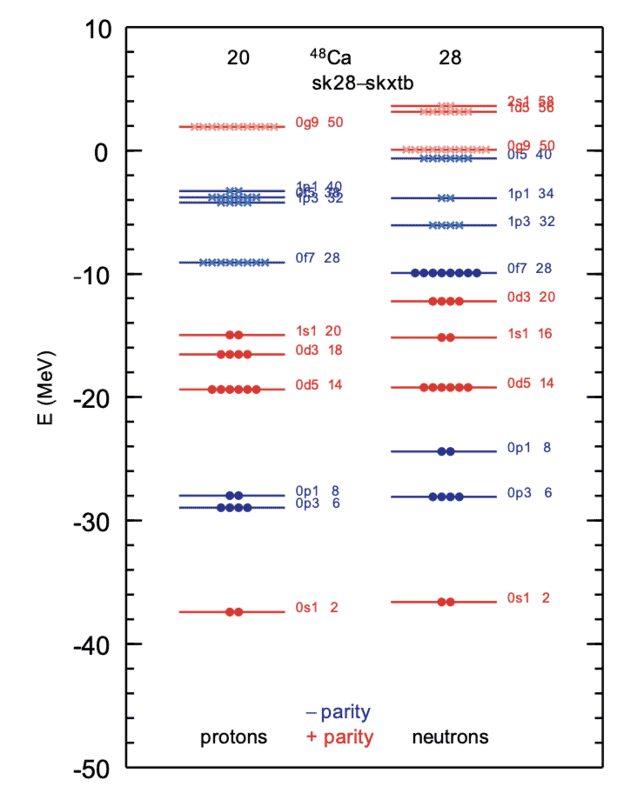
I'm trying to solve a problem of finite square well for the ##s## states graphically. The task is to find energy levels and wavefunctions of proton in a spherically symmetric potential, first for deuteron then ##^{48}Ca##. What makes me confused is the mass. For deuteron, the mass used is the reduced mass because it's a two-masses system. Using that, the energy from my calculation is similar to that from literature. But what about the ##^{48}Ca##, what mass should I use? When I use reduced mass of ##m_{proton}(19 \times m_{proton} + 28 \times m_{neutron})/(20 \times m_{proton} + 28 \times m_{neutron})## which I found from a literature, the energies don't match with realistic Skyrme Hartree Fock calculations (figure attached). When I use the total mass ##(20 \times m_{proton} + 28 \times m_{neutron})##, I found 7 ##s## energy levels as oppose to 2, as shown in the figure. Please help me, I have been searching through tons of books and journals with no luck.
Screen Shot 2019-07-07 at 11.54.03 am.png
 
Last edited:
Physics news on Phys.org
Use the reduced mass, or the proton mass - they are nearly the same for larger nuclei.
It is hard to tell what went wrong if you don't show your results.
 
  • Like
Likes   Reactions: just_mb
mfb said:
Use the reduced mass, or the proton mass - they are nearly the same for larger nuclei.
It is hard to tell what went wrong if you don't show your results.
Thanks. That's what I used and this is the graphical solutions that I got.
246252

where ##\xi## is given by $$\xi = \sqrt{\frac{2m(V_0 - |E|)}{\hbar^2}}a$$ where ##V_0 = 45 \, MeV##, and ##a = ½A^⅓ = 4.36\, fm##. As shown in the graph, the solutions are ##\xi = 2.702## and ##5.298## which according to the equation above correspond to ##E = 1.04\, MeV## and ##13.73\, MeV##. The coulomb energy for ##^{48}Ca## is ##75\, MeV##. If I substract those energies by Coulomb energy, the results are nowhere near those in Skyrme Hartree Fock calculations. What's wrong with my calculation?
 

Attachments

  • 1562501890608.png
    1562501890608.png
    7.3 KB · Views: 315
It is still not very clear what you did, and it is surprising that you only found two solutions.

Is this part of some textbook problem (so you know this approach should give a useful answer)?
 
mfb said:
It is still not very clear what you did, and it is surprising that you only found two solutions.
Only the ##s## states need to be solved so I think there are only two solutions, as suggested by Skyrme Hartree Fock calculations. I am also confused with that solution. In the picture, for example, the ##0s1## state of protons only differ by about 1 MeV from that of neutrons. The difference is caused by Coulomb energy. But from my calculation, the Coulomb energy is 75 MeV. Am I understanding it correctly? Can you please explain this to me?

mfb said:
Is this part of some textbook problem (so you know this approach should give a useful answer)?
No, it's not. But we follow the guides from Quantum Mechanics by Schiff.
 

Similar threads

  • · Replies 14 ·
Replies
14
Views
3K
  • · Replies 1 ·
Replies
1
Views
2K
  • · Replies 28 ·
Replies
28
Views
3K
  • · Replies 1 ·
Replies
1
Views
2K
  • · Replies 2 ·
Replies
2
Views
2K
  • · Replies 11 ·
Replies
11
Views
4K
  • · Replies 4 ·
Replies
4
Views
2K
  • · Replies 15 ·
Replies
15
Views
4K
  • · Replies 4 ·
Replies
4
Views
2K
  • · Replies 2 ·
Replies
2
Views
3K