Mastering a Tricky Equivalent Resistance Problem for the Physics C Exam

Click For Summary

Homework Help Overview

The discussion revolves around a problem related to equivalent resistance in a circuit, specifically in the context of preparing for the Physics C exam. Participants are exploring the complexities of applying delta-wye transformations and the behavior of current through resistors in a specific configuration.

Discussion Character

  • Exploratory, Assumption checking, Conceptual clarification

Approaches and Questions Raised

  • Participants discuss the potential application of delta-wye transformations and question the behavior of current in relation to a middle resistor. There are inquiries about the textbook's coverage of the topic and whether certain assumptions about current flow are valid.

Discussion Status

The discussion is active, with participants offering various insights and questioning the assumptions made about current flow. Some suggest that a delta-wye transformation may not be necessary, while others emphasize the importance of understanding the circuit's symmetry.

Contextual Notes

There is mention of the problem being presented in a textbook that may not adequately cover the delta-wye transformation, leading to confusion among participants. The original poster expresses uncertainty about the relevance of the problem to their exam preparation.

jaredvert
Messages
61
Reaction score
0
Please don't say this is homework because it is not. I am simply studying problems for the physics c exam and I can't figure out this textbook problem. Please show me how to do this! The equivalent resistance part in the most depth because I don't understand. Is it right to say no current runs through the middle r because it would be repelled by the other current? And if that's the case this problem becomes easy but in not sure that's the case... Thanks
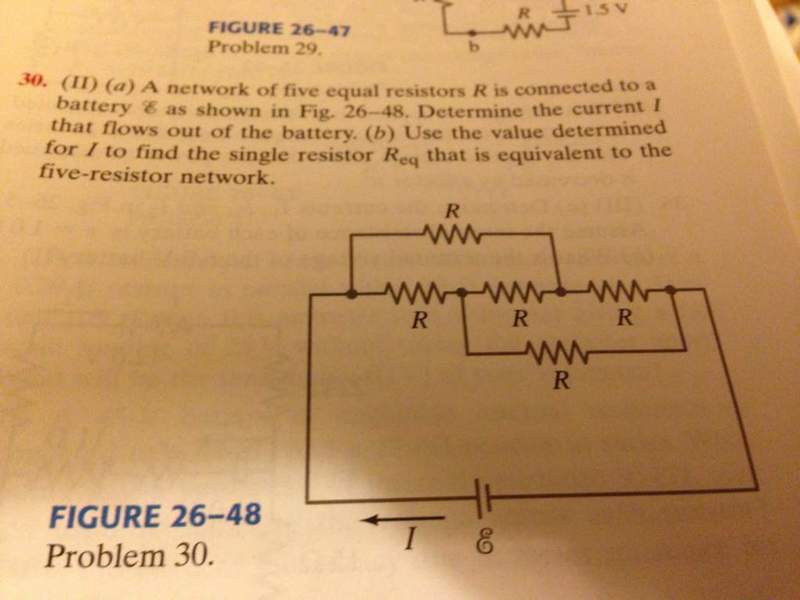
ImageUploadedByPhysics Forums1399781902.319976.jpg
.
 
Last edited:
Physics news on Phys.org
Even thought its not "real" homework, it can still go in the homework section because its of that format.

Anyway, looks like it might be a case of the ol' delta-wye. Does that mean anything to you?
https://en.wikipedia.org/wiki/Y-Δ_transform

Your tried and true series and parallel addition formulas won't work here as you have found. The delta-wye formulas can be derived, or just blindly used, depending on what you want.
 
This is a homework style question and as such should be posted in the homework section of the forums per PF rules.
 
Drakkith said:
This is a homework style question and as such should be posted in the homework section of the forums per PF rules.
Ok van u just tell me why the current wouldn't go through the middle resistor and then I will delete it. I had no other way of conveying this question
 
You can use a Y-Delta transformation to simplify the network: http://www.allaboutcircuits.com/vol_1/chpt_10/13.html
 
jaredvert said:
Ok van u just tell me why the current wouldn't go through the middle resistor and then I will delete it. I had no other way of conveying this question

Current will go through all those resistors.
 
UltrafastPED said:
You can use a Y-Delta transformation to simplify the network: http://www.allaboutcircuits.com/vol_1/chpt_10/13.html
Guys this was in my textbook that says absolutely nothing about delta y transformation or anything of the sort. Can you think of anything else? They wouldn't put something in the problems at the back if it wasn't applicable to the knowledge learned through the book and this obviously wo t come up on the ap exam but I still am curious and would like to know
 
I would guess that there is a small section on delta-wye in there. My second guess is that the book editor just messed up. It happens sometimes.
 
ModusPwnd said:
I would guess that there is a small section on delta-wye in there. My second guess is that the book editor just messed up. It happens sometimes.
Giancoli physics for scientists and engineers vol 2. I read the whole chapter and nothing on delta wye? How do u know when to use delta wye?
 
  • #10
I consider it when I can't figure out how to use parallel or series addition. :-p The resistors are not in parallel or series with any other resistor.

UltrafastPED's link is good. You can see the basic geometry of the delta and they wye, they literally look like a delta and a wye. (Of course your wires may be aranged differently making it hard to see. Practice is needed)

Using the formulas in that link you can turn one into another as needed and then, hopefully, use your parallel and series rules to reduce the circuit.
 
  • #11
ModusPwnd said:
I consider it when I can't figure out how to use parallel or series addition. :-p The resistors are not in parallel or series with any other resistor.

UltrafastPED's link is good. You can see the basic geometry of the delta and they wye, they literally look like a delta and a wye. (Of course your wires may be aranged differently making it hard to see. Practice is needed)

Using the formulas in that link you can turn one into another as needed and then, hopefully, use your parallel and series rules to reduce the circuit.
K thanks dudio
 
  • #12
Closed because it's in the wrong section (since moved) and doesn't use the template.
 
  • #13
Just to add an important comment: you do not need a Y-Delta transformation. This is way beyond the scope of your homework.

You can draw the setup in a different way to see how symmetric it is, and then you can see why there is no current in the middle resistor. Afterwards it is easy to continue.
 
  • Like
Likes   Reactions: 1 person

Similar threads

  • · Replies 6 ·
Replies
6
Views
3K
  • · Replies 6 ·
Replies
6
Views
3K
  • · Replies 2 ·
Replies
2
Views
2K
  • · Replies 7 ·
Replies
7
Views
23K
Replies
30
Views
4K
Replies
1
Views
3K
  • · Replies 7 ·
Replies
7
Views
4K
Replies
18
Views
4K
Replies
5
Views
5K
  • · Replies 1 ·
Replies
1
Views
3K