Math Trouble in Physics Land: Logarithms

Join the discussion
Registration is free. Ask a follow-up in this thread, or start your own.
15 replies · 3K views
Chrono G. Xay
Messages
91
Reaction score
3
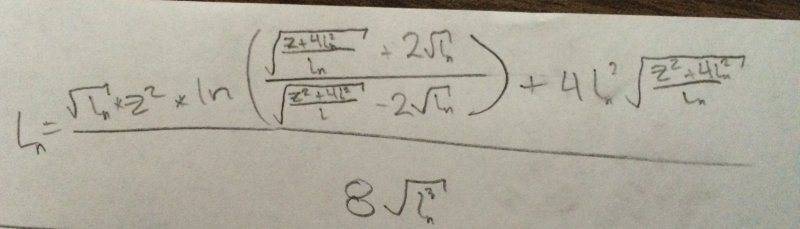
Working on a personal music project, I would like to pull 'z' out of the logarithm below if I can help it, but am having trouble:
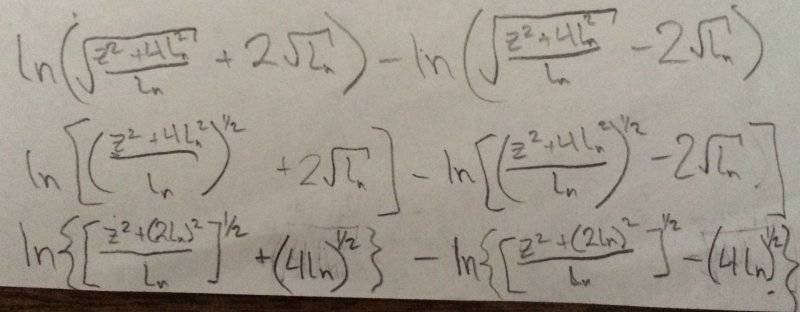
image.jpg


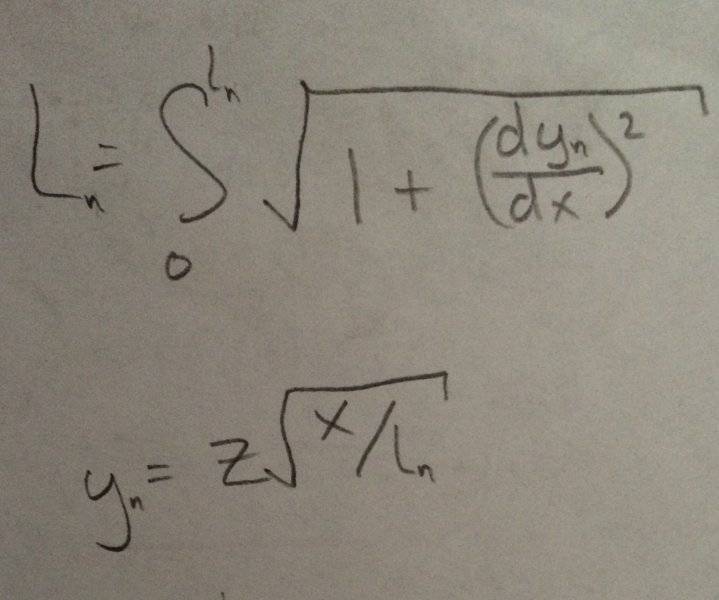
It's a portion taken from this:

image.jpg


Which evolved from...

image.jpg


image.jpg


image.jpg


image.jpg


However, this is only the mathematical modeling of the object. The actual *physics* aspect is much more simple, and has already been worked out from a linear model I developed before it. The above quadratic model is more realistic.

Anyway, my hope is that if I can pull 'z' out of the logarithms I can pull it all the way out of the second integral (theta). If not- I'll just have to see what I can do. (I don't have my spiral with me to check.)
 
Mathematics news on Phys.org
What do you mean by "pull z out of the logarithm"?
You don't have an equation to solve for z.

But even if you have, it is quite likely that there is no way to solve it algebraically.
 
Ok. I expected that was the case, but not having that much 'collegiate experience' in math I wanted to ask, anyway. Thank you.
 
You can't remove ##z## completely from the logarithm expression, but you can solve for it:
##S = \ln\Big(\sqrt{\frac{z^2+(2L_n)^2}{2L_n}}+2\sqrt{L_n}\Big)-\ln\Big(\sqrt{\frac{z^2+(2L_n)^2}{L_n}}-2\sqrt{L_n}\Big)\\
=2\ln(\sqrt{z^2+(2L_n)^2}+2L_n)-2\ln(z)=2\ln\Big(\sqrt{1+(\frac{2L_n}{z})^2}+\frac{2L_n}{z}\Big)=2\operatorname{arsinh}\Big(\frac{2L_n}{z}\Big)\\
\Rightarrow z=\frac{2L_n}{\sinh(S)}.##​
 
  • Like
Likes   Reactions: nasu
suremarc said:
##\Rightarrow z=\frac{2L_n}{\sinh(S)}.##
My bad--that should be ##z=\frac{2L_n}{\sinh(\frac{S}{2})}.##
 
The reason I was hoping I'd be able to factor 'z' to where it occurred only once in the equation and was multiplied by everything else (held inside a likely large parentheses) was so I could use it as the spring displacement in the equation for spring force, where, obviously, everything else was the spring constant (of a circular membrane) in a mass-spring-damper system. Then again, how does one go about mathematically describing such a system when the mass is, itself, the spring?
 
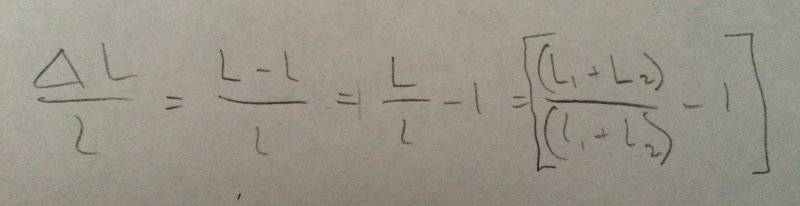
You have some very strange things in your posts. In your fifth image you have
[tex]\frac{\Delta L}{L}= \frac{L- L}{L}= \frac{L}{L}- 1= \frac{L_1- L_2}{L}- 1[/tex]
None of that makes any sense at all!
 
ΔL / L_0 = ( L_f - L_0 ) / L0 = ( L_f / L_0 ) - ( L_0 / L_0 ) = ( L_f / L_0 ) - 1

What's strange about that? It's the equation for strain, ε.
 
Last edited:
Okay- I think I see the problem here. I expressed 'L_0' as a lowercase 'l' for the sake of minimizing the use of subscripts, and as such I made sure to make the curve at the bottom of the 'l' pronounced.
 
Last edited:
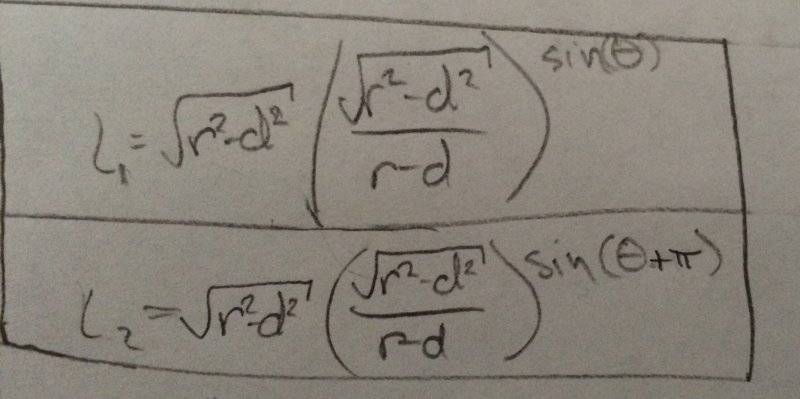
As for l_1 and l_2, I was adding two distinct initial chord segments (not to be confused with chord lengths, as c=2*sqrt(r^2-d^2) can be expanded to equal the sum of two line segments, sqrt(r^2-d^2)+sqrt(r^2-d^2) ). L_1 and L_2 are the initial segments, being deformed and, thus, stretched to a final length.
 
HallsofIvy said:
You have some very strange things in your posts. In your fifth image you have
[tex]\frac{\Delta L}{L}= \frac{L- L}{L}= \frac{L}{L}- 1= \frac{L_1- L_2}{L}- 1[/tex]
None of that makes any sense at all!
##L_n, l_n## and##\ ln## present an inscrutable mix in modified-cursive handwritten font!

I see it as ##\frac{\Delta L}{l} = \frac{L - l}l##
 
I feel confused by your reply... I never used "l_n" or "L_n"... I used l_1 and l_2, and L_1 and L_2... natural log was always written as 'ln(x)'...

L ( AKA "L_f" ) = L_1 + L_2
l ( AKA "L_0" ) = l_1 + l_2
 
Looking back still farther, I think I see what you were referring to (which I interpreted to be "z * sqrt( x / l_n )" ). Yeah, I saw how that could be perceived as ambiguous. I still wanted to try to minimize subscripts to make it more visually intuitive, especially considering the type of system being described.