Matrix Representations of the Poincare Group

Click For Summary
SUMMARY

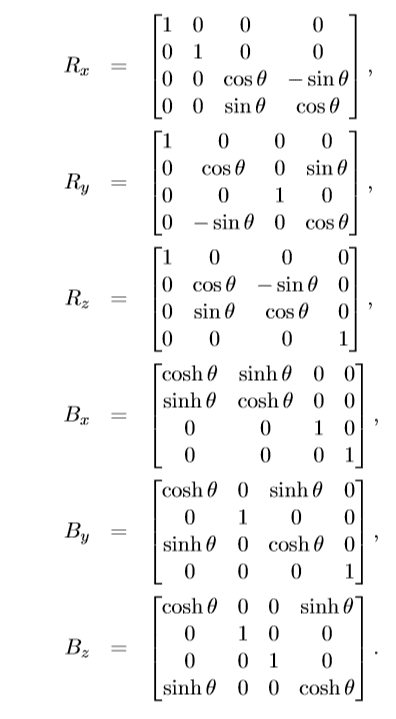
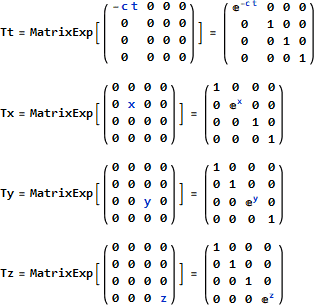
The discussion focuses on the generators of the Poincaré Group, which consists of 10 generators: 6 Lorentz generators for rotations and boosts, and 4 generators corresponding to translations in ℝ1,3. The Lorentz generators are represented by specific 5x5 matrices for rotations (R_x, R_y, R_z) and boosts (B_x, B_y, B_z). The translation generators are represented by matrices T_t, T_x, T_y, and T_z. The key insight is that the matrices provided represent 1-parameter groups, and the actual generators are obtained by taking derivatives of these matrices at zero.

PREREQUISITES
  • Understanding of the Poincaré Group and its structure
  • Familiarity with Lorentz transformations and their matrix representations
  • Knowledge of semidirect products in group theory
  • Basic calculus for differentiating matrix functions
NEXT STEPS
  • Study the derivation of generators from 1-parameter groups in Lie groups
  • Explore the mathematical properties of the Poincaré Group in quantum field theory
  • Learn about the role of the Poincaré Group in special relativity
  • Investigate applications of Lorentz transformations in physics simulations
USEFUL FOR

The discussion is beneficial for theoretical physicists, mathematicians studying group theory, and anyone interested in the mathematical foundations of quantum mechanics and relativity.

cuallito
Messages
94
Reaction score
1
I'm trying to 'see' what the generators of the Poincare Group are. From what I understand, it has 10 generators. 6 are the Lorentz generators for rotations/boosts, and 4 correspond to translations in ℝ1,3 since PoincareGroup = ℝ1,3 ⋊ SO(1,3).

The 6 Lorentz generators are easy enough to find in the literature. They are:
lorentz generators.PNG

I cannot find the ℝ1,3 generators explicitly stated anywhere. My naive guess is that since the other four generators correspond to translations in ℝ1,3, we get the other 4 generators by exponentiating the 4 translation matrices for ℝ1,3.
translations.png


Is that correct?
 
Physics news on Phys.org
To get the Poincare group you need to take a semidirect product with the translation group. This means that you get a 5-dimensional representation by 5x5 matrices ##\pmatrix{A & t \cr 0 & 1}##, where ##A## is a Lorentz transformation and ##t## a translation vector. The relevant orbit of this matrix action is the set of 5D vectors
##\pmatrix{x \cr 1}##, where ##x## is a point in Minkowski space.
 
  • Like
Likes   Reactions: PeroK, dextercioby, vanhees71 and 2 others
Thanks Prof. Neumaier, so would the generators then be the six rotations/boosts

$$
R_x = \begin{pmatrix}
1 & 0 & 0 & 0 & 0\\
0 & 1 & 0 & 0 & 0\\
0 & 0 & cos \theta & -sin \theta & 0\\
0 & 0 & sin \theta & cos \theta & 0\\
0 & 0 & 0 & 0 & 1
\end{pmatrix}

~
R_y = \begin{pmatrix}
1 & 0 & 0 & 0 & 0\\
0 & cos\theta & 0 & sin\theta & 0\\
0 & 0 & 1 & 0 & 0\\
0 & -sin\theta & 0 & cos\theta & 0\\
0 & 0 & 0 & 0 & 1
\end{pmatrix}

~
R_z =
\begin{pmatrix}
1 & 0 & 0 & 0 & 0\\
0 & cos\theta & -sin\theta & 0 & 0\\
0 & sin\theta & cos\theta & 0 & 0\\
0 & 0 & 0 & 1 & 0\\
0 & 0 & 0 & 0 & 1
\end{pmatrix}

$$
$$

B_x =
\begin{pmatrix}
cosh \theta & sinh \theta & 0 & 0 & 0\\
sinh \theta & cosh \theta & 0 & 0 & 0\\
0 & 0 & 1 & 0 & 0\\
0 & 0 & 0 & 1 & 0\\
0 & 0 & 0 & 0 & 1
\end{pmatrix}

~
B_y = \begin{pmatrix}
cosh \theta & 0 & sinh \theta & 0 & 0\\
0 & 1 & 0 & 0 & 0\\
sinh \theta & 0 & cosh \theta & 0 & 0\\
0 & 0 & 0 & 1 & 0\\
0 & 0 & 0 & 0 & 1
\end{pmatrix}

~
B_z = \begin{pmatrix}
cosh \theta & 0 & 0 & sinh \theta & 0\\
0 & 1 & 0 & 0 & 0\\
0 & 0 & 1 & 0 & 0\\
sinh \theta & 0 & 0 & cosh \theta & 0\\
0 & 0 & 0 & 0 & 1
\end{pmatrix}

$$

Plus the four the translations represented like this?

$$ T_t = \begin{pmatrix}1 & 0 & 0 & 0 & -c t\\ 0 & 1 & 0 & 0 & 0\\ 0 & 0 & 1 & 0 & 0\\ 0 & 0 & 0 & 1 & 0\\ 0 & 0 & 0 & 0 & 1\end{pmatrix}

T_x = \begin{pmatrix}
1 & 0 & 0 & 0 & 0\\
0 & 1 & 0 & 0 & x\\
0 & 0 & 1 & 0 & 0\\
0 & 0 & 0 & 1 & 0\\
0 & 0 & 0 & 0 & 1
\end{pmatrix}
~
T_y = \begin{pmatrix}
1 & 0 & 0 & 0 & 0\\
0 & 1 & 0 & 0 & 0\\
0 & 0 & 1 & 0 & y\\
0 & 0 & 0 & 1 & 0\\
0 & 0 & 0 & 0 & 1
\end{pmatrix}
~
T_z = \begin{pmatrix}
1 & 0 & 0 & 0 & 0\\
0 & 1 & 0 & 0 & 0\\
0 & 0 & 1 & 0 & 0\\
0 & 0 & 0 & 1 & z\\
0 & 0 & 0 & 0 & 1
\end{pmatrix}

$$
 
Last edited:
cuallito said:
would the generators then be the six rotations/boosts
Plus the four the translations represented like this?
Generators have no free parameters left but each of your matrices contains such a parameter.

What you wrote down is not describing generators but the 1-parameter groups they are generating. Taking the derivatives at zero gives the generators.
 
  • Like
Likes   Reactions: vanhees71 and cuallito
Thanks professor, like a true scientist, I'm always happy to know when I'm wrong 👍🤪👍
 

Similar threads

  • · Replies 0 ·
Replies
0
Views
2K
  • · Replies 27 ·
Replies
27
Views
3K
  • · Replies 10 ·
Replies
10
Views
3K
  • · Replies 1 ·
Replies
1
Views
1K
  • · Replies 31 ·
2
Replies
31
Views
5K
Replies
27
Views
4K
  • · Replies 1 ·
Replies
1
Views
2K
  • · Replies 9 ·
Replies
9
Views
2K
  • · Replies 87 ·
3
Replies
87
Views
8K
  • · Replies 17 ·
Replies
17
Views
2K