Matura exam results wrong ? (probabiltity of shooting the target)

  • Context: Undergrad 
  • Thread starter Thread starter Дьявол
  • Start date Start date
  • Tags Tags
    Exam
Click For Summary
SUMMARY

The discussion centers on the correct calculation of the probability that all shooters miss a target divided into three concentric zones. The user correctly calculates the probability of missing the target as P(¬A ∩ ¬B ∩ ¬C) = P(¬A) * P(¬B) * P(¬C) = (1-0.16) * (1-0.24) * (1-0.17). In contrast, the incorrect solution presented by the exam suggests using 1 - (P(A) + P(B) + P(C)), which can lead to negative probabilities if the sum exceeds 1. The user confirms their understanding of the problem and the inaccuracies in the provided solution.

PREREQUISITES
  • Understanding of basic probability concepts, including independent events.
  • Familiarity with notation such as P(A), P(¬A), and union/intersection of events.
  • Knowledge of how to calculate probabilities for multiple independent shooters.
  • Ability to interpret probability problems involving multiple outcomes.
NEXT STEPS
  • Review the principles of independent events in probability theory.
  • Study the concept of complementary events and their calculations.
  • Learn about the union of probabilities and its implications in probability theory.
  • Explore real-world applications of probability in scenarios involving multiple trials or shooters.
USEFUL FOR

Students preparing for exams in probability theory, educators teaching probability concepts, and anyone interested in understanding the intricacies of calculating probabilities in multi-event scenarios.

Дьявол
Messages
365
Reaction score
0
matura exam results wrong !? (probabiltity of shooting the target)

Hello!
I got one task that I seem to solved it correctly. But the matura exam results are different then my solution.

Here is the task:
There is one target which is divided on three concentric zones. Here is picture of it:
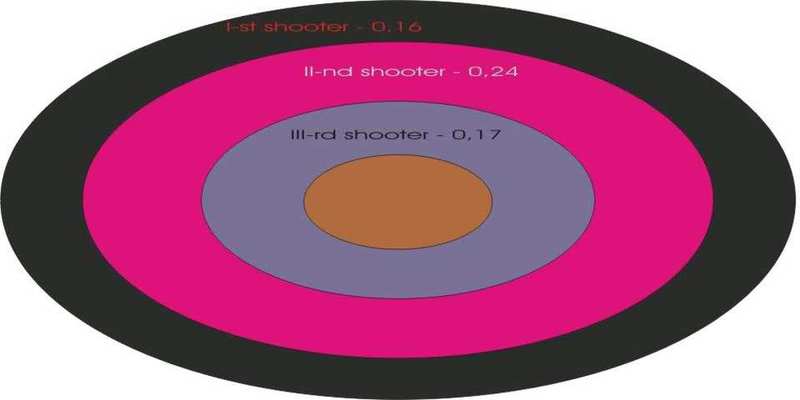
2hmj4ma.jpg


So the whole target is not the center of the darts, but the whole surface of the darts.

The task is to find the probability that the target will be missed by all of the shooters.


I find it like:

A - the Ist shooter hits the target

B - the IInd shooter hits the target

C- the IIIrd shooter hits the target

[tex]P(\bar{A} \cap \bar{B} \cap \bar{C}) = P(\bar{A})*P(\bar{B})*P(\bar{C})=(1-0,16)*(1-0,24)*(1-0,17)[/tex]

And their solution is 1- P(A U B U C) which they wrote it like 1 - (P(A)+P(B)+P(C)).

Which solution is correct?

Mine or theirs?

Thanks in advance.
 
Physics news on Phys.org


I find the picture very confusing. It is divided into three areas and each area has a different probability but apparently those probabilities are the probabilities a specific shooter will hit the entire target. The three areas are irrelevant.
If P(A) is the probability that the first shooter will hit the target, P(B) the probability the second shooter will, and P(C) the probability the third shooter will hit the target, then what you give is correct.

What "they" give is incorrect. [itex]1- (A\cup B\cup C)[/itex] is the probability they do NOT all hit the target- the probability that at least one misses.
(And, by the way, [itex]1- (A\cup B\cup C)[/itex] is NOT 1- (P(A)+ P(B)+ P(C)). In fact, if P(A)+ P(B)+ P(C)> 1, which is quite plausible, that would give a negative probability! The probability of [itex]1- (A\cup B\cup C)[/itex] is 1- P(A)*P(B)*P(C).


HallsofIvy said:
I find the picture very confusing. It is divided into three areas and each area has a different probability but apparently those probabilities are the probabilities a specific shooter will hit the entire target. The three areas are irrelevant.
If P(A) is the probability that the first shooter will hit the target, P(B) the probability the second shooter will, and P(C) the probability the third shooter will hit the target, then what you give is correct.

What "they" give is incorrect. [itex]1- (A\cup B\cup C)[/itex] is the probability they do NOT all hit the target- the probability that at least one misses.
(And, by the way, [itex]1- (A\cup B\cup C)[/itex] is NOT 1- (P(A)+ P(B)+ P(C)). In fact, if P(A)+ P(B)+ P(C)> 1, which is quite plausible, that would give a negative probability! The probability of [itex]1- (A\cup B\cup C)[/itex] is 1- P(A)*P(B)*P(C).

Thanks for the reply HallsofIvy.

I also find the task very confusing. We have already discussed in other thread about this problem, and I already understood it.

I also realized that P(A)+ P(B)+ P(C) can be >1 and their solution is incorrect.

Here is their solution:

33usxed.jpg


D: the target is being hit

[tex]\bar{D}[/tex]: the target is not being hit.

The other thing is all the same.

Thanks again for confirming.

Regards.
 

Similar threads

  • · Replies 30 ·
2
Replies
30
Views
4K
  • · Replies 20 ·
Replies
20
Views
4K
  • · Replies 67 ·
3
Replies
67
Views
17K
  • · Replies 2 ·
Replies
2
Views
8K