Prime and Maximal Ideals in PIDs ... Rotman, AMA Theorem 5.12

  • Context: Undergrad 
  • Thread starter Thread starter Math Amateur
  • Start date Start date
  • Tags Tags
    Prime Theorem
Click For Summary

Discussion Overview

The discussion centers around understanding the proof of Theorem 5.12 from Joseph J. Rotman's "Advanced Modern Algebra," specifically regarding the implications of an irreducible element in a principal ideal domain (PID) and its relationship to prime ideals and maximal ideals.

Discussion Character

  • Technical explanation
  • Conceptual clarification
  • Debate/contested

Main Points Raised

  • Peter seeks clarification on why the condition ##a|p## leads to either ##a## and ##p## being associates or ##a## being a unit, referencing the irreducibility of ##p##.
  • Peter reflects that since ##p## is irreducible, if ##p = ra## for some ##r##, then one of ##a## or ##r## must be a unit, leading to the conclusion about associates.
  • Another participant explains that since ##a|p## implies ##p=ba## for some ##b##, and using the properties of prime ideals, either ##a## or ##b## must belong to the ideal, leading to the conclusion about units and associates.
  • A later reply acknowledges the reasoning of the previous participant, noting the different approaches taken but suggesting that both are valid and connected to the proof of a related proposition.

Areas of Agreement / Disagreement

Participants generally agree on the validity of the reasoning presented, though they explore different routes to arrive at similar conclusions. No consensus is reached on a singular approach, as multiple perspectives are offered.

Contextual Notes

The discussion involves assumptions about irreducibility and the properties of prime ideals in PIDs, which may not be universally applicable without further context or definitions.

Math Amateur
Gold Member
MHB
Messages
3,920
Reaction score
48
I am reading Joseph J. Rotman's book: Advanced Modern Algebra (AMA) and I am currently focused on Section 5.1 Prime Ideals and Maximal Ideals ...

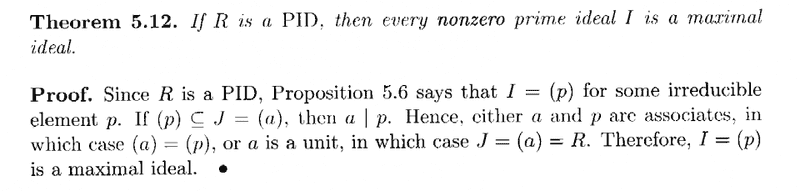
I need some help with understanding the proof of Theorem 5.12 ... ...Theorem 5.12 reads as follows:
?temp_hash=61cd73afb237213fbd511810f1e3a61d.png

In the above text Rotman writes the following:" ... ... If ##(p) \subseteq J = (a)##, then ##a|p##. Hence either ##a## and ##p## are associates, in which case ##(a) = (p)##, or ##a## is a unit, in which case ##J = (a) = R##. ... ... ... "My question is as follows:Rotman argues, (as I interpret his argument), that ##a|p## implies that either ##a## and ##p## are associates ... or ... ##a## is a unit ...Can someone please explain (slowly and clearly
smile.png
) why this is the case ... ... ?Hope someone can help ... ...

Peter
 

Attachments

  • Rotman - AMA - Theorem 5.12    ....png
    Rotman - AMA - Theorem 5.12 ....png
    15.1 KB · Views: 617
Physics news on Phys.org
I have been reflecting on my question and believe the answer is something like the following:Firstly ... we are given that ##p## is irreducible ...

Now ... ##p## irreducible

##\Longrightarrow p## is non-zero and ##p## not a unit ... and ... where ##p## equals a product,

say, ##p = ra## ... then one of ##a## and ##r## is a unit ...Now, ##a|p \Longrightarrow p = ra## for some ##r \in R##

So then we have that:

##p## irreducible and ##p = ra \Longrightarrow## one of ##a## and ##r## is a unit ...

If ##r## is a unit then ##a## and ##p## are associates ... ...

... otherwise ##a## is a unit ...
Can someone confirm that this is correct ... or alternatively point out shortcomings and errors in the analysis ...

Peter
 
We have ##a|p## so ##p=ba## for some ##b##. Since ##p\in I=(p)## and ##I## is a prime ideal, it must be the case that either ##a## or ##b## is in ##I##.

If ##a\in I## we have ##p|a## which, together with the earlier-observed ##a|p## makes ##p,a## associates.

If ##a\not\in I## then ##b\in I## in which case ##b=pc## for some ##c##. So ##p=pca##. We write this as
$$0=p-pca=p(1-ca)$$
and since ##p\neq 0## and a PID is an Integral Domain, we must then have ##1-ca=0##, whence ##ca=1## so ##a|1##, making ##a## a unit.
 
  • Like
Likes   Reactions: Math Amateur
Math Amateur said:
Can someone confirm that this is correct ... or alternatively point out shortcomings and errors in the analysis ...
That reasoning looks sound to me. It's a different route from mine, as yours explicitly uses the irreducibility of ##p## whereas mine uses the primeness of the ideal ##I##. I suspect the connection between the two lies in the proof of Proposition 5.6. But either one will suffice.
 
  • Like
Likes   Reactions: Math Amateur
Thanks Andrew ... your posts were REALLY helpful ...

Appreciate your help on this issue ...

Peter
 

Similar threads

  • · Replies 3 ·
Replies
3
Views
2K
  • · Replies 3 ·
Replies
3
Views
2K
  • · Replies 6 ·
Replies
6
Views
2K
  • · Replies 3 ·
Replies
3
Views
5K
  • · Replies 3 ·
Replies
3
Views
2K
  • · Replies 1 ·
Replies
1
Views
3K
  • · Replies 5 ·
Replies
5
Views
2K
Replies
2
Views
2K
  • · Replies 3 ·
Replies
3
Views
2K
  • · Replies 7 ·
Replies
7
Views
4K