Maxwell and The distribution of velocities in a gas

Click For Summary
SUMMARY

This discussion centers on Feynman's presentation of Maxwell's distribution of molecular velocities in gases, specifically addressing the derivation of the 1/√N deviation in expected particle counts. The central limit theorem (CLT) is crucial, as it states that for N identically distributed random variables, the average approaches a normal distribution with a standard deviation of σ/√N. Participants clarify that the number of molecules in a velocity range follows a binomial distribution, leading to a standard deviation of √(Np(v)Δv), which increases with √N. This highlights the importance of understanding statistical distributions in gas kinetics.

PREREQUISITES
  • Understanding of Maxwell's distribution of velocities
  • Familiarity with the central limit theorem (CLT)
  • Knowledge of binomial distributions and Bernoulli trials
  • Basic concepts of statistical mechanics
NEXT STEPS
  • Study the implications of the central limit theorem in statistical mechanics
  • Explore Maxwell-Boltzmann statistics in detail
  • Learn about the derivation of standard deviation in binomial distributions
  • Investigate the relationship between molecular velocity distributions and thermodynamic properties
USEFUL FOR

Students and professionals in physics, particularly those focused on statistical mechanics, thermodynamics, and molecular dynamics, will benefit from this discussion.

Aleoa
Messages
128
Reaction score
5
In the first volume of his lectures (cap 6-4) Feynman presents Maxwell's distribution of velocities of the molecules in a gas.
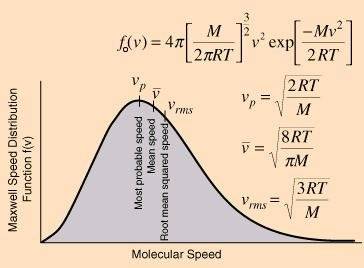
I13-23-BoltzmannEq4.jpg
And, referring to the PDF graph he says:

"If we consider the molecules in a typical container (with a volume of, say, one
liter), then there are a very large number N of molecules present (N ≈ 10^{22}).
Since p(v) ∆v is the probability that one molecule will have its velocity in ∆v,
by our definition of probability we mean that the expected number <∆N> to be
found with a velocity in the interval ∆v is given by: &lt;\Delta N&gt;=Np(v)\Delta v.
[...]
Since with a gas we are usually dealing with large numbers of molecules,
we expect the deviations from the expected numbers to be small (like 1/√N), so
we often neglect to say the “expected” number
"

I have not understand this part, how it's possible to derive this 1/√N deviation ( or a value the gives the idea of what Feynman is saying) ?
Thanks for your support
 

Attachments

  • I13-23-BoltzmannEq4.jpg
    I13-23-BoltzmannEq4.jpg
    13.4 KB · Views: 1,604
Physics news on Phys.org
Aleoa said:
I have not understand this part, how it's possible to derive this 1/√N deviation ( or a value the gives the idea of what Feynman is saying) ?
This is the central limit theorem. If you have N identically distributed random variables with mean μ and variance σ2, the average of the variables will approach a normal distribution for large N with mean μ and variance σ2/N. The standard deviation will be \frac {\sigma}{\sqrt N}. The average speed of the molecules is such a set of random variables, but you can also use a variable that is 1 if the speed is in a certain range, and 0 if it is not, and you can use this to calculate the standard deviation for the number of molecules in a certain velocity range,
 
  • Like
Likes   Reactions: Aleoa
willem2 said:
This is the central limit theorem. If you have N identically distributed random variables with mean μ and variance σ2, the average of the variables will approach a normal distribution for large N with mean μ and variance σ2/N. The standard deviation will be \frac {\sigma}{\sqrt N}. The average speed of the molecules is such a set of random variables, but you can also use a variable that is 1 if the speed is in a certain range, and 0 if it is not, and you can use this to calculate the standard deviation for the number of molecules in a certain velocity range,

I'm not able to understand which is , in this case, the average random variable that is subjected to CLT ...
How does the bold phrase in the main post concern to the distribution of sample mean ?
 
Last edited:
I think there's a step missed out (assumed), and a slight error. If the probability of a single molecule having a velocity in the range v → v + Δv is p(v)Δv, then for N molecules, the number with a velocity in that range follows a binomial distribution, with a mean (expectation value) of Np(v)Δv and a variance of Np(v)Δv(1-p(v)Δv), which is approximately Np(v)Δv if p(v)Δv << 1. So the standard deviation is √(Np(v)Δv); note that this increases as √N (the error in the statement above). The fraction of molecules with velocities in the range Δv has an expectation value Np(v)Δv/N = p(v)Δv, and a standard deviation of √(p(v)Δv/N). This is the "deviation that goes like 1/√N".
 
Aleoa said:
I'm not able to understand which is , in this case, the average random variable that is subjected to CLT ...
Assume each of ##N## particles has a independent probability of ##p(v_1) dv## of having (at a given time) its velocity in ##I_1## and probability of ##1 - p(v_1)dv## of having its velocity in some other interval. Whether a particle has a velocity in ##I## is a Bernoulli random variable with probability of success equal to ##p(v_1)dv##.

The number of particles (at a given time) that have their velocities in ##I_1## is a binomial random variable ##B_1## . The random variable ##B_1## is the sum of ##N## identical independent Bernoulli random variables.

Feynman's remark says that (at a given time) the number of particles that have their velocities in ##I_1## has a high probability of being close to the mean of ##B_1##, which is ##N p(v_1) dv##.

There are some technicalities to consider.

1. Does "close" mean close in the absolute sense - e.g. within plus or minus 2? Or does "close" mean in the sense of a percentage - e.g. within plus or minus 2% of ##N##?

2. The analysis for one interval ##I_1## is a not joint result about what happens for two different intervals ##I_1,I_2##. Whether a particle has a velocity in ##I_1## is not independent of whether it has a velocity in ##I_2##.
Feynman's claim is that (jointly) for each interval ##I_j## the number of particles with velocities in that interval has a high probability of being ##Np(v_j) dv##.

Of course, physicists don't always worry about mathematical technicalities!
 
Last edited:

Similar threads

  • · Replies 10 ·
Replies
10
Views
3K
  • · Replies 1 ·
Replies
1
Views
2K
  • · Replies 0 ·
Replies
0
Views
2K
  • · Replies 3 ·
Replies
3
Views
3K
  • · Replies 3 ·
Replies
3
Views
2K
  • · Replies 0 ·
Replies
0
Views
2K
  • · Replies 6 ·
Replies
6
Views
2K
  • · Replies 15 ·
Replies
15
Views
2K
  • · Replies 14 ·
Replies
14
Views
4K
  • · Replies 8 ·
Replies
8
Views
2K