Mean Occupation Number of Non-interacting quantum fluids

  • Context: Graduate 
  • Thread starter Thread starter unscientific
  • Start date Start date
  • Tags Tags
    Fluids Mean Quantum
Click For Summary

Discussion Overview

The discussion centers on the mean occupation number of non-interacting quantum fluids, specifically examining two expressions derived from the grand partition function as presented in the book "Concepts in Thermal Physics." Participants explore the apparent contradiction between the two expressions for the mean occupation number.

Discussion Character

  • Debate/contested

Main Points Raised

  • One participant notes a contradiction between two sections of the book regarding the mean occupation number, highlighting different forms of differentiation applied to the grand partition function.
  • Another participant provides the definition of the grand partition function as a product involving energy levels and chemical potential, which may relate to the expressions in question.
  • A later reply asserts that the first expression should indeed involve the natural logarithm of the partition function, suggesting it is an error in the book and referencing an errata.

Areas of Agreement / Disagreement

Participants do not reach a consensus on whether the book contains an error, as one participant claims it is an error while others have not explicitly agreed or disagreed with this assertion.

Contextual Notes

The discussion does not clarify the assumptions or definitions that might affect the interpretation of the expressions for the mean occupation number.

unscientific
Messages
1,728
Reaction score
13
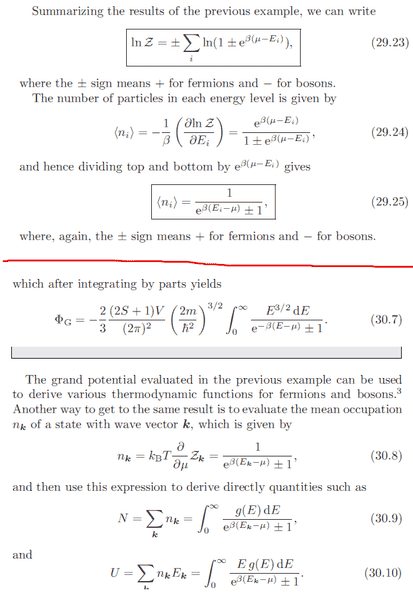
Hi, I get two contradicting sections of the book "Concepts in Thermal Physics":

Earlier in the section they used the grand partition function to derive the mean occupation number ##<n_i> = -\frac{1}{\beta}\frac{\partial ln Z}{\partial E_i}##

Later in the section, they said ##<n_k> = \frac{1}{\beta}\frac{\partial Z_k}{\partial \mu}##

Why does the first expression take the differential of ##ln Z## and the second expression simply takes the differential of ##Z##?
mbu0yf.png
 
Physics news on Phys.org
If it helps, it was earlier defined that ##Z = \Pi_i\left( 1 \pm e^{\beta(\mu - E_i)}\right)^{\pm 1}##
 
bumpp
 
It should be ln Z, it's just an error in the book. And the author is aware of it already, see this errata.
 
  • Like
Likes   Reactions: 1 person

Similar threads

  • · Replies 1 ·
Replies
1
Views
2K
  • · Replies 9 ·
Replies
9
Views
2K
  • · Replies 2 ·
Replies
2
Views
2K
  • · Replies 19 ·
Replies
19
Views
3K
  • · Replies 5 ·
Replies
5
Views
2K
  • · Replies 1 ·
Replies
1
Views
2K
  • · Replies 1 ·
Replies
1
Views
2K
  • · Replies 3 ·
Replies
3
Views
2K
Replies
1
Views
2K
  • · Replies 1 ·
Replies
1
Views
4K