Meaning of having powerful signal near to 0Hz

Click For Summary
SUMMARY

The discussion centers on the interpretation of powerful signals near 0 Hz in the context of Fourier transforms applied to accelerometer data using Python's SciPy library. A strong signal near 0 Hz indicates a significant DC component, which may arise from voltage offsets or gravitational acceleration. Participants highlight the importance of pre-analysis steps, such as removing DC components by subtracting the mean or fitting a cubic polynomial. Additionally, it is clarified that the highest frequency in a Fast Fourier Transform (FFT) is half the sampling frequency, necessitating a sampling rate of at least 200 Hz to capture frequencies up to 100 Hz effectively.

PREREQUISITES
  • Understanding of Fourier transforms, specifically using SciPy's rfft function.
  • Knowledge of signal processing concepts, including DC components and power spectral density.
  • Familiarity with wavelet transforms and their application in signal reconstruction.
  • Basic principles of sampling theory and the Nyquist theorem.
NEXT STEPS
  • Learn how to implement signal preprocessing techniques in Python, such as mean subtraction and polynomial fitting.
  • Explore the use of power spectral density for analyzing signal efficiency and characteristics.
  • Investigate advanced wavelet transform techniques for signal denoising and reconstruction.
  • Study the implications of sampling rates on FFT results and how to choose appropriate rates for different applications.
USEFUL FOR

This discussion is beneficial for data scientists, signal processing engineers, and researchers working with accelerometer data or similar time-series signals, particularly those interested in frequency analysis and signal optimization techniques.
ramesses
Messages
16
Reaction score
0
Hello
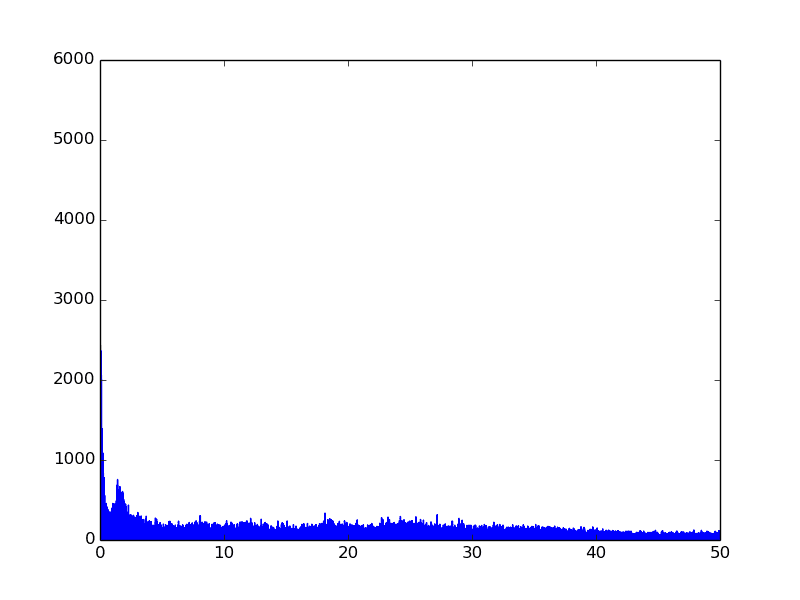
I computed, with python scipy.rfft, the Fourier transform of signal coming from an accelerometer.
I don't understood what this is the meaning of having a powerful signal near to 0 Hz ?
2Cn90YwiS1U5.png
 
Engineering news on Phys.org
It means that there is a strong DC (or near DC) component to the signal. It may just be a voltage offset, or it may be the acceleration of gravity. It depends on how the signal is coupled and how the circuit is adjusted.

When we analyze many different data sets for the oscillatory components (temperature, tides, sounds) we often take a pre-analysis step to remove the DC or near DC components. Sometimes, it is just subtracting the mean of the whole signal. Other times it may be fitting to a cubic polynomial and then subtracting the cubic polynomial from the original signal and then taking the Fourier transform of the oscillatory components.

In any case, graphs are easier to understand if care is taken to preserve the proper units on both the horizontal and vertical axes (frequency in Hz and acceleration in m/s/s, for example).
 
  • Like
Likes   Reactions: berkeman and donpacino
thank you :)
My last question is about band. My sensor frequency is about 100 Hz
Why do I have to use 0~50 Hz in fft ? Why not to use 0~100 Hz ?
 
ramesses said:
thank you :)
My last question is about band. My sensor frequency is about 100 Hz
Why do I have to use 0~50 Hz in fft ? Why not to use 0~100 Hz ?

The highest frequency in an fft is 1/2 the sampling frequency.

If your sensor is sensitive to 100 Hz, you can increase your sampling rate to 200-1000 Hz and see higher frequencies.
 
I have a sampling of 30 minutes with my sensor with 100 Hz. and I want to reduce eliminate signal in [25~100] Hz.
So what I do is :
I apply for each 100 samples a wavelet of second level.
I put 0 in details, and reconstruct the signal.
Now to see the efficiency, what do I need ?
Is the power spectral density useful in my case ?
 

Similar threads

  • · Replies 7 ·
Replies
7
Views
2K
  • · Replies 7 ·
Replies
7
Views
821
  • · Replies 13 ·
Replies
13
Views
4K
Replies
26
Views
7K
  • · Replies 4 ·
Replies
4
Views
2K
  • · Replies 4 ·
Replies
4
Views
4K
Replies
3
Views
611
Replies
3
Views
2K
Replies
37
Views
6K
Replies
6
Views
4K