Measurable Functions .... Lindstrom, Proposition 7.3.7 .... ....

  • Context: Undergrad 
  • Thread starter Thread starter Math Amateur
  • Start date Start date
  • Tags Tags
    Functions Measurable
Click For Summary
SUMMARY

The forum discussion centers on the proof of Proposition 7.3.7 from Tom L. Lindstrom's book "Spaces: An Introduction to Real Analysis," specifically regarding the measurability of the sum of two measurable functions, f and g. The key point established is that the set {x ∈ X | (f + g)(x) < r} can be expressed as a countable union of measurable sets, which is crucial for proving measurability. The discussion emphasizes the necessity of using the density of rational numbers in the real numbers to select appropriate values for q, ensuring that the proof holds for all x in X.

PREREQUISITES
  • Understanding of measurable functions as defined in Lindstrom's Definition 7.3.1.
  • Familiarity with the concept of countable unions in measure theory.
  • Knowledge of the density of rational numbers in real analysis.
  • Basic proficiency in LaTeX for mathematical notation.
NEXT STEPS
  • Study the properties of measurable functions in detail, focusing on Lindstrom's definitions.
  • Learn about the implications of countable unions of measurable sets in measure theory.
  • Explore the concept of density in real analysis, particularly regarding rational numbers.
  • Practice writing and formatting mathematical proofs using LaTeX.
USEFUL FOR

Mathematicians, students of real analysis, and anyone interested in understanding the properties of measurable functions and their proofs in measure theory.

Math Amateur
Gold Member
MHB
Messages
3,920
Reaction score
48
TL;DR
I need help with Tom Lindstrom's proof that if f and g are measurable then so is f + g ...
I am reading Tom L. Lindstrom's book: Spaces: An Introduction to Real Analysis ... and I am focused on Chapter 7: Measure and Integration ...

I need help with the proof of Proposition 7.3.7 ...

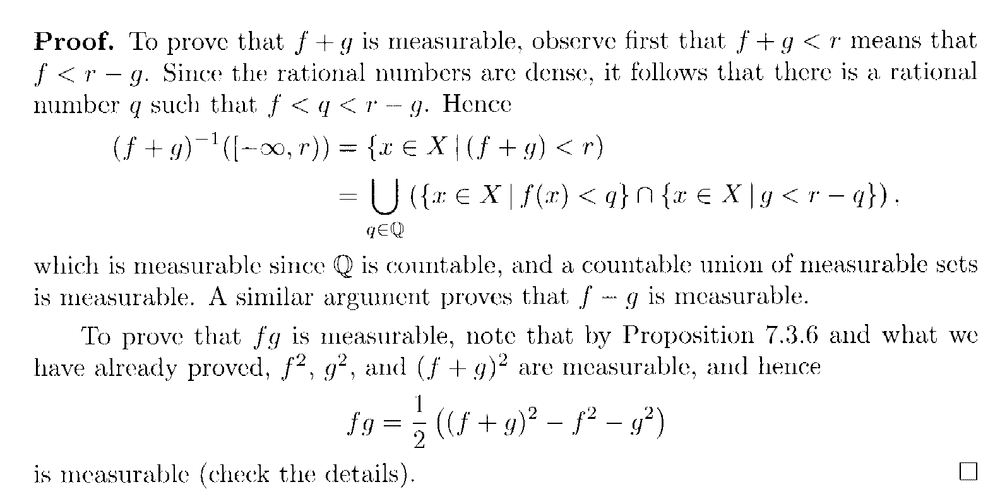
Proposition 7.3.7 and its proof read as follows:

Lindstrom - 1 - Proposition 7.3.7 ... PART 1 .png

Lindstrom - 2 - Proposition 7.3.7 ... PART 2 .png
In the above proof by Lindstrom we read the following:

" ... ... ##(f + g)^{ -1} ( [ - \infty , r ) ) = \{ x \in X | (f + g) \lt r \}##

## = \bigcup_{ q \in \mathbb{Q} } ( \{ x \in X | f(x) \lt q \} \cap \{ x \in X | g \lt r - q \} ) ## ... ... "Can someone please demonstrate, formally and rigorously, how/why ...

##\{ x \in X | (f + g) \lt r \} = \bigcup_{ q \in \mathbb{Q} } ( \{ x \in X | f(x) \lt q \} \cap \{ x \in X | g \lt r - q \} )## ... ...
Help will be much appreciated ...

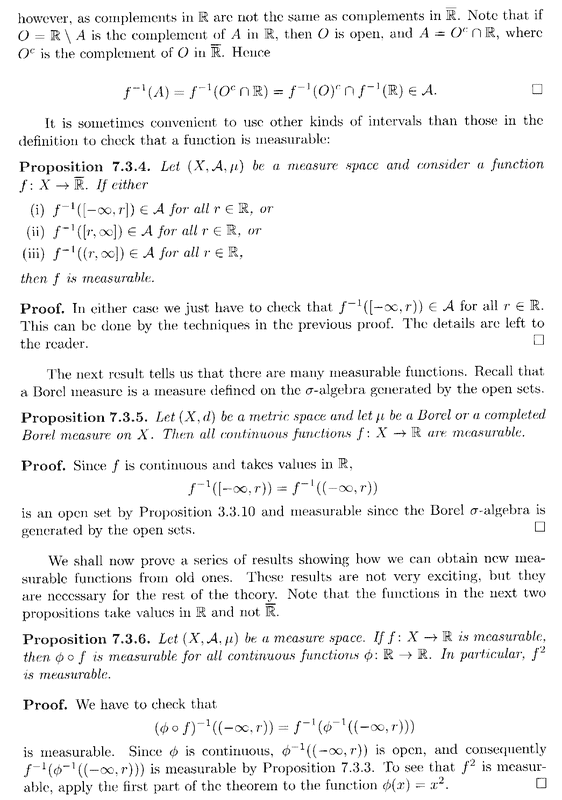
Peter=============================================================================================================Readers of the above post may be assisted by access to Lindstrom's introduction to measurable functions (especially Lindstrom's definition of a measurable function, Definition 7.3.1) ... so I am providing access to the relevant text ... as follows:

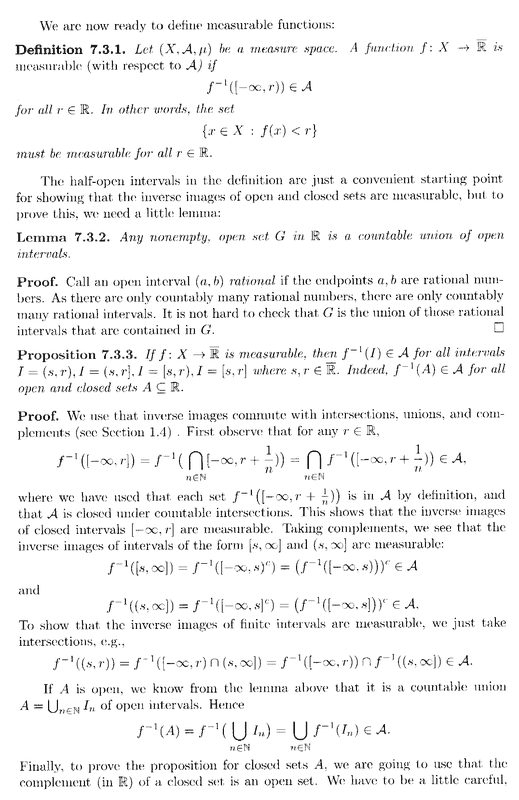
Lindstrom - 1 - Section 7.3 ... Measurable Functions ... Part 1 .png

Lindstrom - 2 - Section 7.3 ... Measurable Functions ... Part 2 .png

Lindstrom - 3 - Section 7.3 ... Measurable Functions ... Part 3 .png

Hope that helps ...

Peter
 
Last edited:
Physics news on Phys.org
##\subseteq##

Given ##f(x)+g(x)< r##, use density of the rational numbers in the real numbers to choose ##q\in \mathbb{Q}## with ##f(x)< q < r- g(x)##.

##\supseteq##

Is trivial.
 
Sorry ... but i don't follow ... not completely anyway ...

Apologies for being a bit slow ...

Peter
 
Math Amateur said:
Sorry ... but i don't follow ... not completely anyway ...

Apologies for being a bit slow ...

Peter

Refresh the page ( I made an edit). What don't you understand?
 
  • Like
Likes   Reactions: Math Amateur
Hmmm ... we require ##\{ x \in X | (f + g) (x) \lt r \}## to be measurable for all ##r \in \mathbb{R}## ... ... surely this is true because ##(f + g)(x) = f(x) + g(x)## and ##f## and ##g## are measurable ...

So why do we have to invoke the density of the rationals ...

Can you try to make more clear what is going on ...?

Peter

EDIT ... cannot understand what has gone wrong with my Latex code
 
Math Amateur said:
Hmmm ... we require ##\{ x \in X | (f + g) (x) \lt r \}## to be measurable for all ##r \in \mathbb{R}## ... ... surely this is true because ##(f + g)(x) = f(x) + g(x)## and ##f## and ##g## are measurable ...

So why do we have to invoke the density of the rationals ...

Can you try to make more clear what is going on ...?

Peter

That's another question than the one you asked!

However, you are exactly trying to prove that ##f+g## is measurable when ##f## and ##g## are. To check measurability, you have to show that (note my superior notation) ##\{f+g < r\}## is a measurable set for all ##r##. The proof then writes ##\{f +g < r\}## as a countable union of measurable sets, to deduce that ##\{f+g< r\}## is measurable. For this, the hypothesis that ##f## and ##g## are measurable is used. This countable aspect is very important: the uncountable union of measurable sets need not be measurable.
 
Note however, there is an alternative proof. You can prove that addition ##+: \mathbb{R}^2 \to \mathbb{R}## is measurable (because it is continuous) and you can also quickly prove that composition of measurable functions is measurable. Hence, if ##f,g## are measurable, then so is ##f+g = + \circ (f,g)##.

Also, there seems to be some bugs with the Latex code for me as well. Try to refresh the pages when you are done editing.
 
Thanks ... can definitely see the point about countability ... and also that f < q < r - g implies that ... f < q and (intersect) g < r - q is the case ...

Peter
 
Math Amateur said:
Thanks ... can definitely see the point about countability ... and also that f < q < r - g implies that ... f < q and (intersect) g < r - q is the case ...

Peter

Then is your problem solved or are there any other issues left?
 
  • #10
Still reflecting on things ... but think issues are resolved ...

Most grateful for your help ...

Thanks again ...

Peter
 
  • Like
Likes   Reactions: member 587159
  • #11
I have been reflecting further on proving that ##f+ g## is measurable when ##f## and ##g## are measurable ... and I need to clarify an issue ... ...

I need to understand exactly what is wrong with the following argument ... something surely is wrong because the proof doesn't involve ranging over ##\mathbb{Q}## ...

... ... ... the argument follows ... ...First note that ##f + g \lt r##

##\Longrightarrow## there exists ##q \in \mathbb{Q}## such that ##f \lt q \lt r - g##

##\Longrightarrow f \lt q## and ##g \lt r - q##

##\Longrightarrow## for all ##x \in X## we have ##f(x) \lt q## and ##g(x) \lt r - q##

Thus ##\{ x \in X \ | \ (f + g) \lt r \} = \{ x \in X \ | \ f(x) \lt q \} \cap \{ x \in X \ | \ g(x) \lt r - q \}##Can someone please clarify what is wrong with the above argument ...
Help will be much appreciated ...

Peter
 
Last edited:
  • #12
Math Amateur said:
First note that ##f + g \lt r##

##\Longrightarrow## there exists ##q \in \mathbb{Q}## such that ##f \lt q \lt r - g##

This isn't right (and I'll admit the given proof glosses over this point a little bit), because ##f## and ##g## are functions. For example, suppose ##f(x)=x## and ##g(x)=-x## and let ##r=1.## Then ##0=f(x)+g(x)<1=r## is true for all ##x##, but there is no ##q## such that ##f(x)<q## for all ##x##.

A little more conceptually: the given proof is saying that for every ##x##, there is some ##q\in\mathbb{Q}## (depending on ##x##) such that ##f(x)<q## and ##g(x)<r-q##. That ##q## may need to depend on ##x## is why a union over all rationals is needed. You are trying to escape the dependence on ##x##.
 
  • Like
Likes   Reactions: Math Amateur
  • #13
Infrared said:
This isn't right (and I'll admit the given proof glosses over this point a little bit), because ##f## and ##g## are functions. For example, suppose ##f(x)=x## and ##g(x)=-x## and let ##r=1.## Then ##0=f(x)+g(x)<1=r## is true for all ##x##, but there is no ##q## such that ##f(x)<q## for all ##x##.

A little more conceptually: the given proof is saying that for every ##x##, there is some ##q\in\mathbb{Q}## (depending on ##x##) such that ##f(x)<q## and ##g(x)<r-q##. That ##q## may need to depend on ##x## is why a union over all rationals is needed. You are trying to escape the dependence on ##x##.


Thanks for the help Infrared ...

I can see ##q## may depend on ##x## ... but cannot see why a union over all \mathbb{Q} resolves this issue ...

... why are we justified in taking a union over all ##\mathbb{Q}## ...

Can you explain further ...

Peter
 
  • #14
Let's formally show that $$\{f+g < r\}= \bigcup_{q \in\mathbb{Q}}\{f < q\} \cap \{g < r-q\}$$
Suppose that ##x \in \{f+g < r\}##. Thus ##f(x) + g(x) < r##, so ##f(x) < r-g(x)##. By density of ##\mathbb{Q}## in ##\mathbb{R}##, we can pick ##q(x) \in \mathbb{Q}## (note the ##x##-dependency) such that ##f(x)< q(x) < r-g(x)##. Then clearly we have ##x \in \{f< q(x)\}\cap \{g < r-q(x)\} \subseteq \bigcup_{q \in \mathbb{Q}} \{f < q\}\cap \{g< r-q\}##. This shows
$$\{f+g < r\}\subseteq \bigcup_{q \in \mathbb{Q}} \{f< q\}\cap \{g < r-q\}$$
Next, suppose ##x \in \bigcup_{q \in \mathbb{Q}} \{f< q\}\cap \{g < r-q\}##. Then there is ##q(x) \in \mathbb{Q}## with ##f(x)< q(x)## and ##g(x) < r-q(x)##. Then ##f(x) + g(x) < q(x) + r-q(x) = r## and thus ##x \in \{f+g < r\}##. This shows
$$\bigcup_{q \in \mathbb{Q}} \{f< q\}\cap \{g < r-q\}\subseteq \{f+g < r\}$$
 
  • Like
Likes   Reactions: Math Amateur
  • #15
Hi Math_QED ...

Thank you for an exceedingly clear and helpful post ...

That resolves all issues ...

Thanks again ...

Peter
 

Similar threads

  • · Replies 8 ·
Replies
8
Views
2K
  • · Replies 6 ·
Replies
6
Views
2K
Replies
4
Views
2K
Replies
2
Views
2K
  • · Replies 5 ·
Replies
5
Views
3K
  • · Replies 4 ·
Replies
4
Views
2K
  • · Replies 3 ·
Replies
3
Views
2K
  • · Replies 3 ·
Replies
3
Views
3K
  • · Replies 1 ·
Replies
1
Views
2K
  • · Replies 2 ·
Replies
2
Views
2K