Measure the distance to a star using magnitude and extinction

Click For Summary
SUMMARY

The discussion centers on calculating the distance to a type A3 star located near the center of the Milky Way, with an observed magnitude of m_v = 25 and an extinction of 1 magnitude per kpc. The correct distance calculation involves using the formula NSolve[25-2.0 == 5*Log10[d/10]+d/1000, d], which yields a distance of approximately 8 kpc. The participants clarify that extinction increases with distance due to dust absorption, and they discuss the reddening law in the H-band, A_H = 0.591 E_{B-V}, to determine the reddening effect.

PREREQUISITES
  • Understanding of astronomical magnitudes and distance calculations
  • Familiarity with extinction and reddening concepts in astrophysics
  • Knowledge of the spectral classification of stars, specifically type A3
  • Proficiency in using logarithmic equations for distance measurements
NEXT STEPS
  • Research the absolute magnitude of type A3 stars and its implications
  • Learn about the effects of interstellar extinction on observed brightness
  • Study the reddening law and its application in different wavelengths, particularly in the H-band
  • Explore the relationship between color indices (B-V) and extinction in stellar astrophysics
USEFUL FOR

Astronomy students, astrophysicists, and anyone interested in stellar distance measurements and the effects of interstellar medium on light propagation.

Mikkel
Messages
26
Reaction score
1
Homework Statement
Measure distance using magnitude and extinction
Relevant Equations
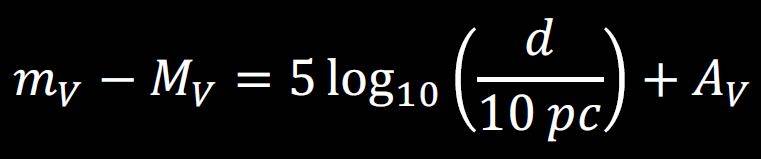
m - M = 5log_{10}(d/10 pc) + 10^{-3}
Hello, I'm struggling with this question
  • A star is observed close to the center of the Milky Way and from its spectrum we find that it is a type A3 star. Its observed magnitude is m_v = 25. There is only a diffusive gas between us and the star, so we can assume an extinction, of 1 magnitude per 1 kpc.
  • How far away is the star and what is its (un-redded) magnitude?
  • In the H-band, which is 1.63 , the reddening law is . How big is the reddening in the H-band?

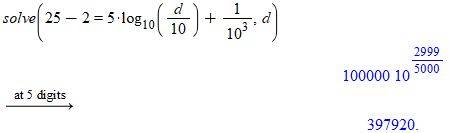
I think I got the generel idea right for this problem, but I must be messing up my SI units somewhere. I use the distance formula when working with magnitudes and extinction. I look up the absolute magnitude for a type A3 star, which is roughly 2. I solve for d and end up with a distance of 398kpc, which doesn’t make sense, as the star is at the center of the Milky Way.
I use this formula and I divide A by 10^3 to get units of pc.
Udklip.JPG

Udklip.JPG


I hope someone can spot my mistake o_O
 
Physics news on Phys.org
The last term should be d/1000, not 1/1000.
NSolve[25-2.0 == 5*Log10[d/10]+d/1000, d] gives d -> 8383. About 8 kpc.
 
  • Like
Likes   Reactions: Mikkel
Thanks for your fast reply!
Why should I multiply by d when considering the extinction term?
 
Mikkel said:
Thanks for your fast reply!
Why should I multiply by d when considering the extinction term?

The extinction is 1 magnitude per kpc. So the farther away the star is, the more it's brightness is diminished. This is because you are looking through dust that absorbs the light from the star. The farther away the star is, the more dust is between you and the star, and the more light is absorbed. The way you had it, the extinction would be the same regardless of how far away the star is.
 
Last edited:
phyzguy said:
The extinction is 1 magnitude per kpc. So the farther away the star is, the more it's brightness is diminished. The way you had it, the extinction would be the same regardless of how far away the star is.
Ahh yea that makes sense, thank you very much!
Do you perhaps have a clue for the other question as well?
 
Mikkel said:
Ahh yea that makes sense, thank you very much!
Do you perhaps have a clue for the other question as well?
Y ou should be able to find the unreddened magnitude. The last question isn't complete.
 
whoops.. sorry

  • In the H-band, which lies in 1.63 μm , the reddening law is A_H = 0.591 E_{B-V}. How big is the reddening in the H-band?
I'm not sure that the "reddening" is in terms of symbol? Not sure how to list it.
 
Well, you should be able to look up (B-V) for an A3 star. I'm not sure what E is in this context. Also, what are the units here. Is it also magnitudes/kpc?
 
phyzguy said:
Well, you should be able to look up (B-V) for an A3 star. I'm not sure what E is in this context. Also, what are the units here. Is it also magnitudes/kpc?
YEs, that's what I'm in doubt of. I don't know which units it is and don't know what symbol it is represented by, but I will try and look up (B-V) for an A3 star. I think it is written as E(B-V) = A, but I'm not able to find a correct formula in my book.
 

Similar threads

Replies
7
Views
2K
  • · Replies 2 ·
Replies
2
Views
1K
  • · Replies 8 ·
Replies
8
Views
1K
Replies
0
Views
1K
Replies
10
Views
3K
  • · Replies 6 ·
Replies
6
Views
2K
Replies
1
Views
1K
  • · Replies 3 ·
Replies
3
Views
2K
  • · Replies 3 ·
Replies
3
Views
4K
  • · Replies 6 ·
Replies
6
Views
2K