Measuring Motion: What STAY Knows About TRAVEL

Click For Summary
SUMMARY

This discussion centers on the knowledge that STAY possesses about TRAVEL in the context of special relativity. Key points include that STAY can determine TRAVEL's proper time, speed, and distance, but lacks information about TRAVEL's clock/calendar synchronization. The conversation confirms that STAY's knowledge is limited to observable parameters at specific points (B and C) and emphasizes that STAY cannot ascertain future events beyond B1. Additionally, the discussion touches on the implications of red/blue shifts in understanding TRAVEL's characteristics.

PREREQUISITES
  • Understanding of special relativity concepts, particularly proper time and speed.
  • Familiarity with the implications of relativistic motion on distance measurements.
  • Knowledge of redshift and blueshift phenomena in astrophysics.
  • Basic grasp of timekeeping systems and their synchronization issues in relativistic contexts.
NEXT STEPS
  • Research the implications of proper time in special relativity.
  • Study the effects of relativistic speeds on distance and time measurements.
  • Learn about redshift and blueshift and their significance in astrophysical observations.
  • Examine timekeeping systems and synchronization challenges in relativistic physics.
USEFUL FOR

Students and professionals in physics, particularly those studying special relativity, astrophysicists, and anyone interested in the implications of relativistic motion on time and distance measurements.

Stephanus
Messages
1,316
Reaction score
104
Dear PF Forum,
I'm sorry if I ask the basic question here again. Just need confirmation.
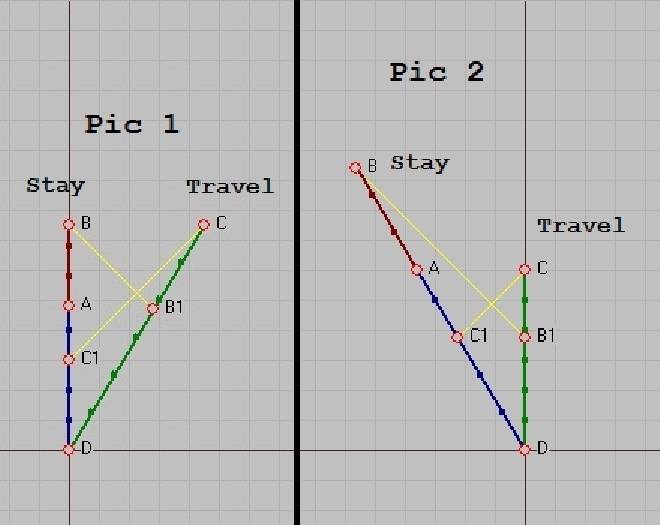
ST-Zoom.jpg

V = 0.6; Gamma = 1.25
TRAVEL travels at 0.6c. STAY stays.
Pic 02 is Pic 01 boosted -V.
1. All STAY knows about TRAVEL is:
Proper Time
Speed
Is this true? And mutually for TRAVEL
2. At B (and C) all STAY knows about TRAVEL proper distance is the distance at B1 (and C1 distance for C).
3 . At B, STAY never knows about C. And C never knows about B. Is this true?
4. It is not relevant for STAY to calculate TRAVEL clock/calendar
For example:
At B, supposedly 1st January 2015; 10:00 AM, there's no need for STAY to calculate when is B1, because there is no certainity/assurance that at start STAY and TRAVEL clocks were synchronized.
------------------------------------------------------------------------------------------------------------------------------------
In short what STAY knows about TRAVEL?
A. Proper Time
B. Speed
C. Distance (late by the time that light takes to travel from TRAVEL to STAY, for example B can only calculate proper distance from B1 to STAY. STAY's X coordinate always zero, right)
D. Red/Blue shifted. But it's already known right. How can we know proper time and speed if we don't know about Red/Blue shifted.
E. Anything else?

Thanks for any answers.
 
Physics news on Phys.org
Stephanus said:
1. All STAY knows about TRAVEL is:
Proper Time
Speed
Is this true? And mutually for TRAVEL
It can also know the crew size of the spacecraft , and many other things. In other words: do you expect knowledge to be limited somehow?

Stephanus said:
2. At B (and C) all STAY knows about TRAVEL proper distance is the distance at B1 (and C1 distance for C).
All they can observe up to that point: right.
Stephanus said:
3 . At B, STAY never knows about C. And C never knows about B. Is this true?
What do you mean with "never"? They can observe that at some point in the future.
Stephanus said:
At B, supposedly 1st January 2015; 10:00 AM, there's no need for STAY to calculate when is B1, because there is no certainity/assurance that at start STAY and TRAVEL clocks were synchronized.
If you don't know the timekeeping system of someone else, you cannot say which time someone else has in this timekeeping system, but that is trivial: I don't know which year the Chinese calendar is in, even without relative motion.
 
  • Like
Likes   Reactions: Stephanus
mfb said:
It can also know the crew size of the spacecraft , and many other things. In other words: do you expect knowledge to be limited somehow?
Come on, I like to make sense the basic SR here :smile:.
mfb said:
Stephanus said:
2. At B (and C) all STAY knows about TRAVEL proper distance is the distance at B1 (and C1 distance for C).
All they can observe up to that point: right.
Thanks. I suspected that much. But I need confirmation to know that I'm on the right track. Now I know I am. Thanks.
mfb said:
What do you mean with "never"? They can observe that at some point in the future.
In the future, yes. And that implies that but at B STAY knows nothing after B1. Thanks.
mfb said:
If you don't know the timekeeping system of someone else, you cannot say which time someone else has in this timekeeping system,
So proper time only. Yes.
mfb said:
but that is trivial: I don't know which year the Chinese calendar is in, even without relative motion.
:oldlaugh:
newyear.jpg

It's 2566. And it always advanced by 551 years from Julian calendar. But Islamic calendar is faster 1/33 to Julian calendar. I think somewhere between the year of 15.000 the Islamic calendar will catch up Julian calendar.
 

Similar threads

  • · Replies 51 ·
2
Replies
51
Views
4K
  • · Replies 42 ·
2
Replies
42
Views
2K
  • · Replies 14 ·
Replies
14
Views
2K
  • · Replies 55 ·
2
Replies
55
Views
4K
  • · Replies 25 ·
Replies
25
Views
5K
  • · Replies 6 ·
Replies
6
Views
2K
  • · Replies 11 ·
Replies
11
Views
2K
  • · Replies 114 ·
4
Replies
114
Views
10K
  • · Replies 28 ·
Replies
28
Views
2K
  • · Replies 32 ·
2
Replies
32
Views
3K