- 13,926
- 16,805
@Leepappas is correct in posts #25 and #28 that I made a mistake in my diagrams. It changes nothing about the conclusions.
The first diagram I posted is correct:
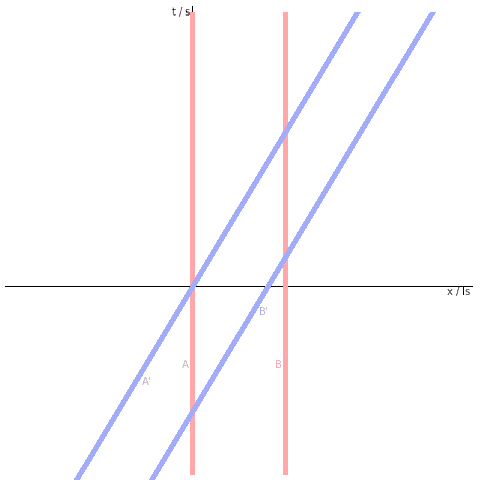
I've added labels for the ends A and B of the red rod and A' and B' of the blue rod. The next diagram was where the error began - "State 1" and "State2" are correct, but "State 3" is when the B and B' lines cross. The corrected diagram is:
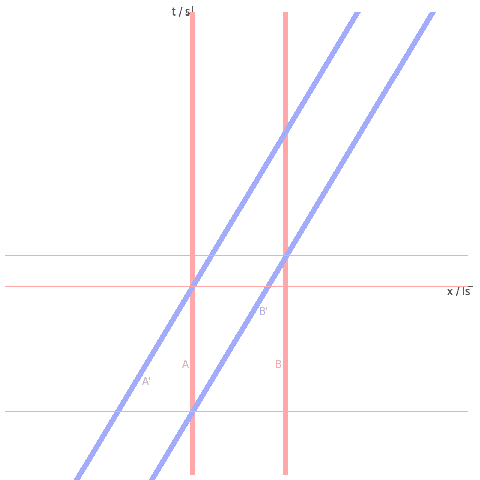
As before, the definition of simultaneity in the primed frame yields sloped lines in this frame:
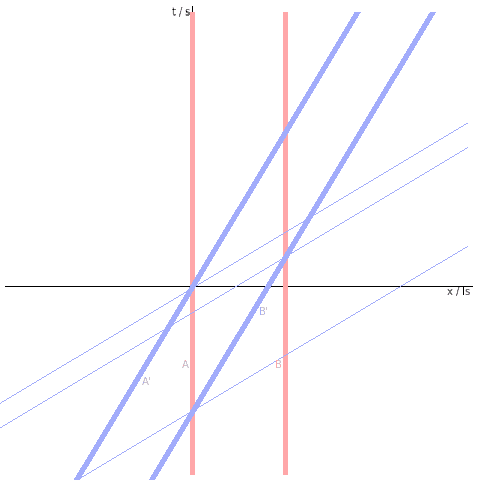
Note that, in the primed frame, "State 2" is after "State 3"! This is the relativity of simultaneity striking - the definitions of the states are anchored to spacelike separated events, and the ordering of spacelike separated events is frame-dependent.
Again we can transform this last diagram into the primed frame:
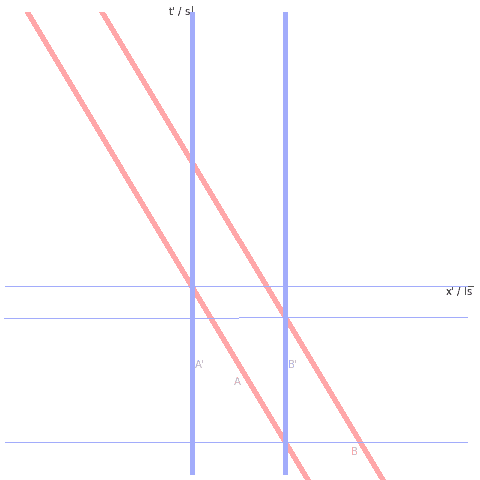
And again, we can switch back to the original unprimed frame and add a green line showing the time ##\Delta t_2/\gamma## that corresponds to what that frame calls "during" the gap between "State 2" and "State 3":
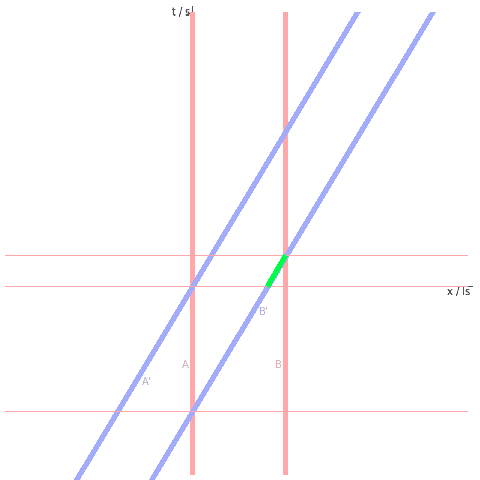
And again we can show that in the primed frame:
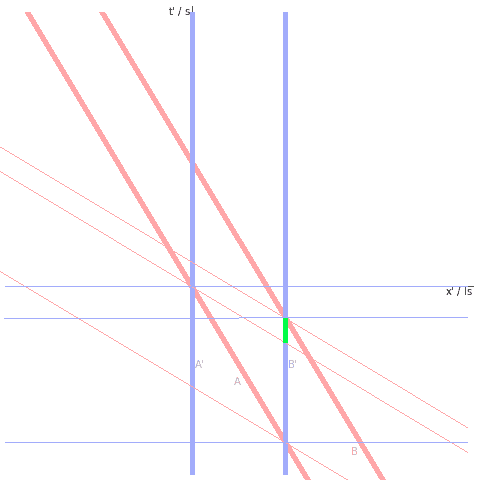
And again, we can see that the green line does not correspond to the gap between any pair of fine blue lines. The relativity of simultaneity cannot be ignored.
Does the green line still not show the interval you were thinking of? It doesn't matter. None of the intervals match up once you take into account the relativity of simultaneity, and this "proof" needs some of them to match up.
This is a rookie mistake. Most of us have made it at some point early in our learning, and understanding why it's a mistake is one of the big steps in developing insights into relativity.
The first diagram I posted is correct:
I've added labels for the ends A and B of the red rod and A' and B' of the blue rod. The next diagram was where the error began - "State 1" and "State2" are correct, but "State 3" is when the B and B' lines cross. The corrected diagram is:
As before, the definition of simultaneity in the primed frame yields sloped lines in this frame:
Note that, in the primed frame, "State 2" is after "State 3"! This is the relativity of simultaneity striking - the definitions of the states are anchored to spacelike separated events, and the ordering of spacelike separated events is frame-dependent.
Again we can transform this last diagram into the primed frame:
And again, we can switch back to the original unprimed frame and add a green line showing the time ##\Delta t_2/\gamma## that corresponds to what that frame calls "during" the gap between "State 2" and "State 3":
And again we can show that in the primed frame:
And again, we can see that the green line does not correspond to the gap between any pair of fine blue lines. The relativity of simultaneity cannot be ignored.
Does the green line still not show the interval you were thinking of? It doesn't matter. None of the intervals match up once you take into account the relativity of simultaneity, and this "proof" needs some of them to match up.
This is a rookie mistake. Most of us have made it at some point early in our learning, and understanding why it's a mistake is one of the big steps in developing insights into relativity.