gocomando
- 1
- 0
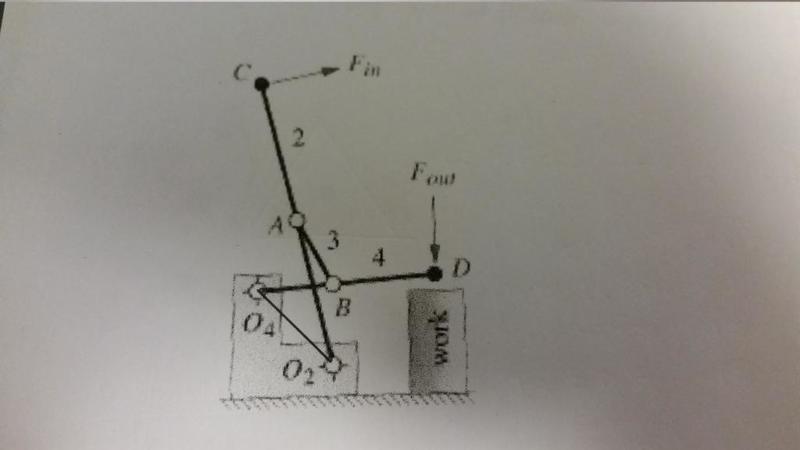
Alright, the problem at a glance is rather simple: find the mechanical advantage at two given values of θ2.
Given:
rO2A = r2
r02C = rin
rAB = r3
rO4B = r4
rO4D = rout
rO2O4 = r1
θ1 = 135°
Find:
Mechanical advantage when θ2 is equal to 104°, and when θ2 is equal to 91°.
Equations to use:
Mech advantage = (rin/rout) * (ωin/ωout) (I think this is the one I'm supposed to use)EDIT: Turns out we're allowed to simply measure the actual angle provided in the problem. Now, since this 4-bar is inverted, how exactly do I measure the angle θ3 andθ4?
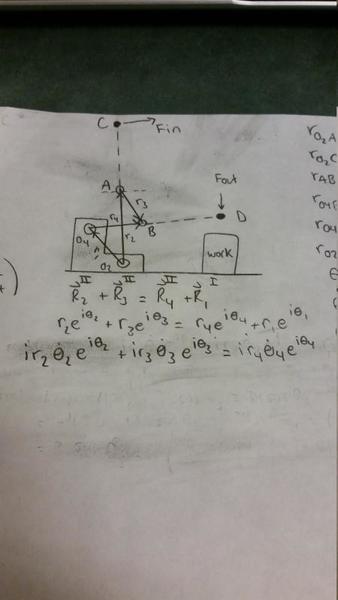
EDIT: I believe I'm supposed to measure from the positive x-axis counterclockwise until I get to the link. Using this, I got θ3= -57 and θ4 = 187. From here though, how might I find (ωin/ωout)? I have the vector loop equation R2 + R3 = R4 + R1, and when I get the corresponding velocity equations, R4 is in there making things complicated.
Given:
rO2A = r2
r02C = rin
rAB = r3
rO4B = r4
rO4D = rout
rO2O4 = r1
θ1 = 135°
Find:
Mechanical advantage when θ2 is equal to 104°, and when θ2 is equal to 91°.
Equations to use:
Mech advantage = (rin/rout) * (ωin/ωout) (I think this is the one I'm supposed to use)EDIT: Turns out we're allowed to simply measure the actual angle provided in the problem. Now, since this 4-bar is inverted, how exactly do I measure the angle θ3 andθ4?
EDIT: I believe I'm supposed to measure from the positive x-axis counterclockwise until I get to the link. Using this, I got θ3= -57 and θ4 = 187. From here though, how might I find (ωin/ωout)? I have the vector loop equation R2 + R3 = R4 + R1, and when I get the corresponding velocity equations, R4 is in there making things complicated.
Last edited: