Michelson Morley experiment: relativistic explanation

Click For Summary
SUMMARY

The discussion centers on the relativistic explanation of the Michelson-Morley experiment using special relativity concepts such as time dilation and length contraction. Participants analyze the time taken for light rays in a moving Michelson interferometer, specifically addressing the equations for the paths taken by the rays. The key conclusion is that despite the apparent differences in path length due to the motion of the apparatus, the time taken for both rays remains equal, confirming the principles of special relativity.

PREREQUISITES
  • Understanding of special relativity principles, including time dilation and length contraction.
  • Familiarity with the Michelson interferometer setup and its function.
  • Basic knowledge of light speed and its invariance in different reference frames.
  • Ability to interpret mathematical equations related to physics, specifically those involving Lorentz transformations.
NEXT STEPS
  • Study the derivation of the Lorentz transformation equations.
  • Explore the implications of time dilation in practical scenarios.
  • Investigate the historical context and significance of the Michelson-Morley experiment in the development of modern physics.
  • Learn about the applications of interferometry in contemporary physics experiments.
USEFUL FOR

Physics students, educators, and anyone interested in the foundational concepts of special relativity and their implications in experimental physics.

crick
Messages
39
Reaction score
4
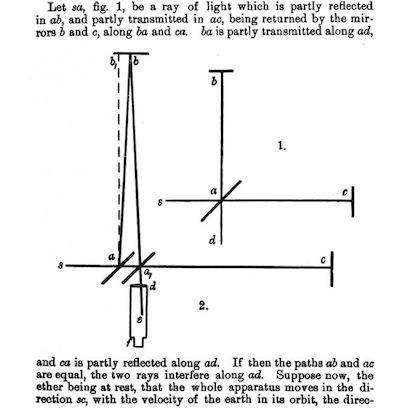
I don't uderstand how, using special relativity theory (time dilatation and length contraction), one can explain why in the Michelson interferometer there is no delay between the two rays in the reference frame where the interferometer is moving. Consider the picture ##2.##
michelson_fig_1.jpg
Setting ##ab_1=ac=L## and ##\gamma=\frac{1}{\sqrt{1-\frac{v^2}{c^2}}}## (##v## is the velocity of the interferometer), the time taken for path ##aba_1## should be
$$t_1=\frac{2L}{c}\gamma$$For the other ray the path length should be ##aca## (but it's contracted), therefore

$$t_2=\frac{2L}{c}\frac{1}{\gamma}$$How can possibly be ##t_1=t_2##?
 
Physics news on Phys.org
In the second case you are missing the fact that the time taken is not the length divided by c. The apparatus is moving!
 
  • Like
Likes   Reactions: crick
crick said:
For the other ray the path length should be aca (but it's contracted)
Dont forget that the mirrors are moving, so the path length is different from the apparatus length.
 
  • Like
Likes   Reactions: crick
This animation might help:
length_con2.gif
 
  • Like
Likes   Reactions: crick

Similar threads

  • · Replies 9 ·
Replies
9
Views
3K
  • · Replies 6 ·
Replies
6
Views
3K
  • · Replies 23 ·
Replies
23
Views
2K
  • · Replies 14 ·
Replies
14
Views
3K
  • · Replies 20 ·
Replies
20
Views
3K
Replies
3
Views
1K
  • · Replies 131 ·
5
Replies
131
Views
12K
  • · Replies 25 ·
Replies
25
Views
5K
  • · Replies 7 ·
Replies
7
Views
2K
  • · Replies 3 ·
Replies
3
Views
2K