Mobius Band as a Quotient Topology

  • Context: Graduate 
  • Thread starter Thread starter Math Amateur
  • Start date Start date
  • Tags Tags
    Band quotient Topology
Click For Summary
SUMMARY

The discussion centers on Example 5.55 from Martin Crossley's book, Essential Topology, specifically regarding the Mobius Band as a quotient topology. Participants analyze the equivalence relation defined as (x,y) ∼ (x',y') if either (x,y) = (x',y') or x = 1 - x' and y - y' = ±1. The necessity of including both conditions in the relation is debated, with emphasis on the properties of equivalence relations such as reflexivity and symmetry. The discussion clarifies that the full relation is essential for accurately representing the Mobius Band's topology.

PREREQUISITES
  • Understanding of equivalence relations in topology
  • Familiarity with quotient topologies
  • Basic knowledge of the Mobius Band structure
  • Experience with mathematical notation and proofs
NEXT STEPS
  • Study the properties of equivalence relations in depth
  • Explore quotient topology concepts further, particularly in relation to surfaces
  • Investigate the construction and properties of the Mobius Band
  • Review Examples 5.53 and 5.54 in Essential Topology for additional context
USEFUL FOR

Mathematicians, students of topology, and educators looking to deepen their understanding of quotient topologies and the Mobius Band.

Math Amateur
Gold Member
MHB
Messages
3,920
Reaction score
48
I am reading Martin Crossley's book, Essential Topology.

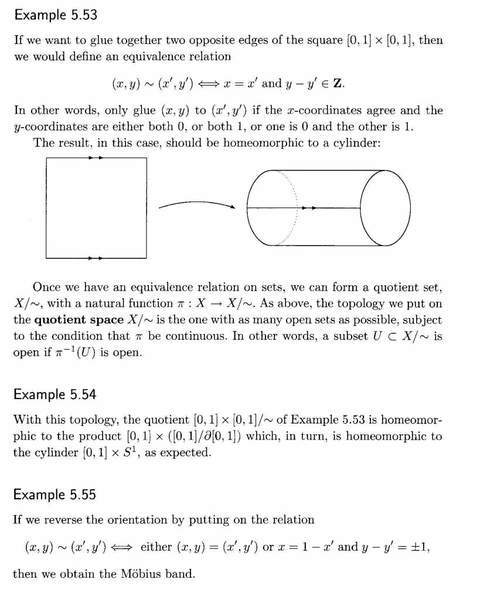
I am at present studying Example 5.55 regarding the Mobius Band as a quotient topology.

Example 5.55 Is related to Examples 5.53 and 5.54. So I now present these Examples as follows:
attachment.php?attachmentid=68070&stc=1&d=1395984295.jpg
I cannot follow the relation (x,y) \sim (x', y') \Longleftrightarrow \text{ either } (x,y) = (x', y') \text{ or } x = 1 - x' \text{ and } y - y' = \pm 1Why do we need (x,y) = (x', y') in the relation? Indeed, why do we need y - y' = \pm 1?Surely all we need is (x,y) \sim (x', y') \Longleftrightarrow x = 1 - x' \text{ and } y - y' = -1Can anyone explain how the relation (x,y) \sim (x', y') \Longleftrightarrow \text{ either } (x,y) = (x', y') \text{ or } x = 1 - x' \text{ and } y - y' = \pm 1 actually works to produce the Mobius Band?Peter
 

Attachments

  • EX 5.5 & Previous Examples.jpg
    EX 5.5 & Previous Examples.jpg
    35.7 KB · Views: 1,238
Last edited:
Physics news on Phys.org
Math Amateur said:
I cannot follow the relation (x,y) \sim (x', y') \Longleftrightarrow \text{ either } (x,y) = (x', y') \text{ or } x = 1 - x' \text{ and } y - y' = \pm 1Why do we need (x,y) = (x', y') in the relation? Indeed, why do we need y - y' = \pm 1?Surely all we need is (x,y) \sim (x', y') \Longleftrightarrow x = 1 - x' \text{ and } y - y' = -1Can anyone explain how the relation (x,y) \sim (x', y') \Longleftrightarrow \text{ either } (x,y) = (x', y') \text{ or } x = 1 - x' \text{ and } y - y' = \pm 1 actually works to produce the Mobius Band?Peter
Well, it's an equivalence relation, so it has to be reflexive by definition. Thus, if ##(x,y)=(x',y')##, then we must have ##(x,y)\sim(x',y')##.

Equivalence relations are symmetric as well, so if ##(x,y)\sim(x',y')##, then we must have ##(x',y')\sim(x,y)##. If ##y-y'=1##, then ##y'-y=-1##.
 
  • Like
Likes   Reactions: 1 person

Similar threads

  • · Replies 5 ·
Replies
5
Views
1K
  • · Replies 6 ·
Replies
6
Views
3K
  • · Replies 8 ·
Replies
8
Views
3K
  • · Replies 15 ·
Replies
15
Views
3K
  • · Replies 1 ·
Replies
1
Views
2K
  • · Replies 0 ·
Replies
0
Views
2K
  • · Replies 3 ·
Replies
3
Views
2K
Replies
2
Views
1K
  • · Replies 10 ·
Replies
10
Views
2K
  • · Replies 2 ·
Replies
2
Views
2K