Modeling mathematically a rotary flexible beam

Click For Summary
The discussion focuses on mathematically modeling the rotation of a rotary flexible beam, specifically one that differs from the typical fixed-free models found in existing literature. The user has identified the beam's behavior as resembling a free-free beam up to the third mode, but is uncertain about higher modes. They aim to reduce free vibration at the beam's tip after rotation, having developed an equation of motion, but face challenges with boundary conditions that affect generalized mass and mode participation factors. Suggestions for using Finite Element Analysis tools like ANSYS or COMSOL were made, but the user has not pursued this option yet. Clarification on suitable boundary conditions is essential for progressing with the modeling.
Ben9622111222
Messages
31
Reaction score
0
Hi,

I am trying to mathematically model the rotation of a rotary flexible beam. There are numerous papers which study this topic but all of them are considering the beam as a fixed-free one. My case is different.
upload_2015-10-9_7-44-44.png

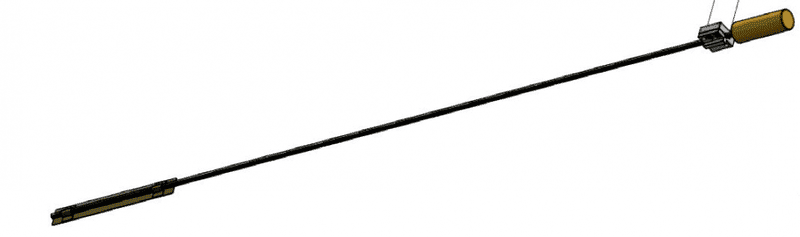
This is the beam I am trying to model. The motor axis is at the square portion towarsd the right end of the beam. The part marked in gold is the counter weight so that motor can be given low current when system is at rest.

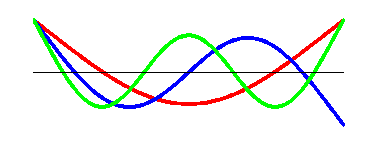
I have tested the modes of vibration and found that it shows the nature of a free-free beam upto third mode, but for higher modes it was not clear. Only if I know how the beam behaves, can I go futher with the modeling.
upload_2015-10-9_7-50-16.png

Also one node was always at the motor axis position.
Can anyone suggest me how I should go forward to understand the beam model and mathematically model it.
Thanks.
 
Engineering news on Phys.org
Mech_Engineer said:
Have you considered doing a modal analysis using a Finite Element Analysis tool like ANSYS or COMSOL?
I have not done a modal analysis. Because the test setup already showed me the nature of vibration upto 12 modes and also the mode frequencies. My ultimate aim is to reduve the free vibration at the tip when it is stopped after a rotation. For this I have developed an equation of motionj. The problem is the terms generalized mass and mode participation factor depend on what boundary condition is selected. And this is dependent on the beam fixation.

So I am confused which boundary condition suits.

The attached figure shows a close approximation. Will this do?
 

Attachments

  • figure.png
    figure.png
    7.3 KB · Views: 444
Had my central air system checked when it sortta wasn't working. I guess I hadn't replaced the filter. Guy suggested I might want to get a UV filter accessory. He said it would "kill bugs and particulates". I know UV can kill the former, not sure how he thinks it's gonna murder the latter. Now I'm finding out there's more than one type of UV filter: one for the air flow and one for the coil. He was suggesting we might get one for the air flow, but now we'll have to change the bulb...

Similar threads

Replies
15
Views
2K
  • · Replies 1 ·
Replies
1
Views
4K
  • · Replies 6 ·
Replies
6
Views
2K
Replies
2
Views
2K
  • · Replies 10 ·
Replies
10
Views
3K
  • · Replies 1 ·
Replies
1
Views
2K
  • · Replies 2 ·
Replies
2
Views
1K
  • · Replies 6 ·
Replies
6
Views
812
  • · Replies 1 ·
Replies
1
Views
2K
  • · Replies 22 ·
Replies
22
Views
6K