Modeling Quantum State Evolution with Schrodinger's Equation

  • Thread starter LCSphysicist
  • Start date
  • Tags Tags
    Evolution
3 replies · 2K views · last reply
LCSphysicist
Messages
644
Reaction score
163
Homework Statement
.
Relevant Equations
.
I am a little confused about how to solve it, probably it is easy but i didn't get it.
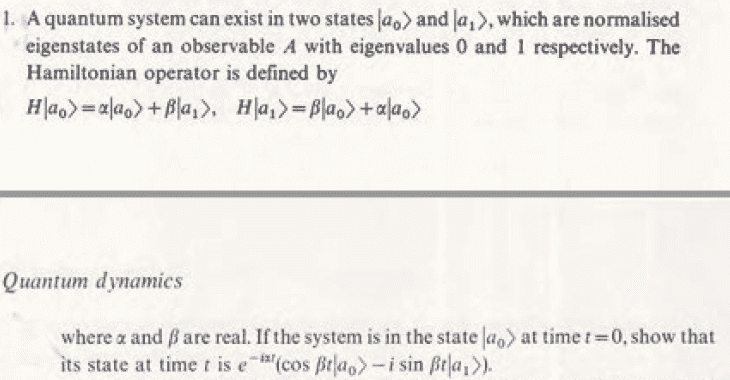
Printed textbook problem: a two-state quantum system with eigenstates |a0> and |a1> of observable A (eigenvalues 0 and 1), Hamiltonian H|a0> = alpha|a0> + beta|a1>, H|a1> = beta|a0> + alpha|a0>, and the task to show the time-evolved state under quantum dynamics.


I thought that would be a good idea to work with ##\psi = \alpha |a_{0}\rangle + \beta |a_{1}\rangle## in the Schrödinger equation with time involved, so that we get a system of differential equations. $$d\alpha/dt = \alpha*a + \beta*b$$$$d\beta/dt = \alpha*r$$$$ \beta(0) = 0$$
(simplifying the notation, throwing the i and h to the other side, a b r constants)

But i am not sure if this is the best way, and if this is right. And the wolframalpha's solution of the system was not an easy one to manipulate, so i think i am wrong.
 
Attachments
  • Printed textbook problem on quantum mechanics: a two-state system with normalised eigenstates |a0> and |a1> of observable A (eigenvalues 0 and 1), Hamiltonian action H|a0> = alpha|a0> + beta|a1>, H|a1> = beta|a0> + alpha|a0>, and a dynamics part about state evolution and a second measurement at t = 2T.
    1610876407121.png
    65.4 KB · Views: 180
I would try ##| \psi(t)> = e^{-i\frac H h t}|a_0>## then play around with some Taylor expansion for the exponential and the trigonometric functions. Not sure it's the easiest way. It looks promising to me because you gat all this nested terms like ##H|a_0>##, ##HH|a_0> = H(\alpha|a_0> + \beta |a_1)## ecc...
 
Last edited:
LCSphysicist said:
Homework Statement:: .
Relevant Equations:: .

I am a little confused about how to solve it, probably it is easy but i didn't get it.

View attachment 276389

I thought that would be a good idea to work with ##\psi = \alpha |a_{0}\rangle + \beta |a_{1}\rangle## in the Schrödinger equation with time involved, so that we get a system of differential equations. $$d\alpha/dt = \alpha*a + \beta*b$$$$d\beta/dt = \alpha*r$$$$ \beta(0) = 0$$
(simplifying the notation, throwing the i and h to the other side, a b r constants)

But i am not sure if this is the best way, and if this is right. And the wolframalpha's solution of the system was not an easy one to manipulate, so i think i am wrong.
First, ##\alpha, \beta## are already given as constants, so you can't use them as ##\psi(t)##.

Second, are you using ##\hbar = 1## in this text?

Third, let's see the SDE for this system.

PS There's a typo in the question. It should be ##H|a_1 \rangle = \beta |a_0 \rangle + \alpha | a_1 \rangle##
 
Last edited:
With the above corrections, it all works out: using the SDE gives coupled first-order differential equations, solve (e.g. using second-order equations), apply initial conditions, gives the quoted solution.