Undergrad Module Over a Division Ring - Blyth Theorem 1.1, Part 4

Click For Summary
SUMMARY

The discussion centers on proving a specific aspect of Theorem 1.1, Part 4 from T. S. Blyth's "Module Theory: An Approach to Linear Algebra." The theorem states that for a division ring \( R \), if \( \lambda x = 0_M \), then either \( \lambda = 0_R \) or \( x = 0_M \). Participants clarify that if \( \lambda \neq 0_R \) and \( x \neq 0_M \), it follows that \( \lambda = 0_R \). The use of contrapositive reasoning is emphasized as a key method to approach the proof.

PREREQUISITES
  • Understanding of division rings and their properties
  • Familiarity with module theory and linear algebra concepts
  • Knowledge of logical reasoning, particularly contraposition
  • Ability to interpret mathematical proofs and theorems
NEXT STEPS
  • Study the implications of Blyth's Theorem 1.1 in greater detail
  • Learn about the properties of division rings and their applications in module theory
  • Explore logical reasoning techniques in mathematical proofs, focusing on contraposition
  • Review additional examples of proofs involving modules and vector spaces
USEFUL FOR

Mathematicians, students of abstract algebra, and anyone studying module theory or linear algebra who seeks to deepen their understanding of theorems related to division rings and their implications.

Math Amateur
Gold Member
MHB
Messages
3,920
Reaction score
48
I am reading T. S. Blyth's book "Module Theory: An Approach to Linear Algebra" ... ... and am currently focussed on Chapter 1: Modules, Vector Spaces and Algebras ... ...

I need help with an aspect of Theorem 1.1 part 4 ...

Theorem 1.1 in Blyth reads as follows:
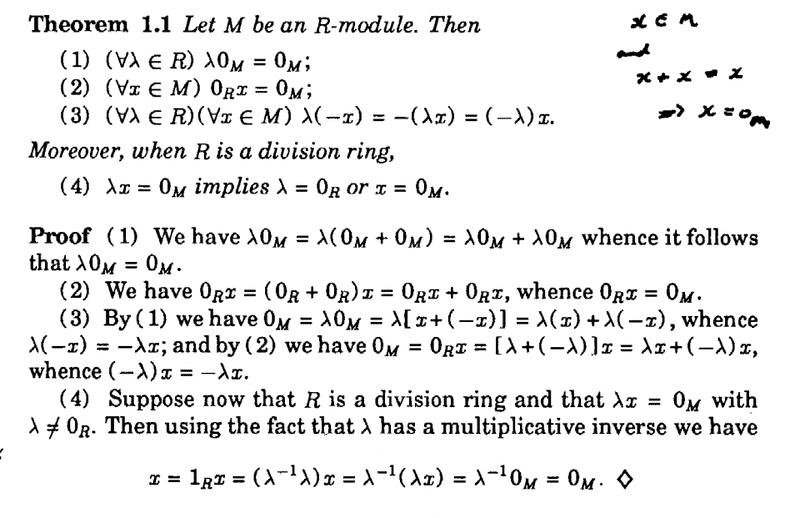
?temp_hash=130091d5b5e518dfcff28c7ba4b6c3d1.png


In the above text, in part 4 of the Theorem we read:" ... ... when ##R## is a division ring

(4) ##\lambda x = 0_M## implies ##\lambda = 0_R## or ##x = 0_M## ... ... "Blyth proves that if ##R## is a division ring and ##\lambda x = 0_M## with ##\lambda \neq 0_R## then we have that ##x = 0_M## ... ...But ... ... Blyth does not show that if ##R## is a division ring and ##\lambda x = 0_M## with ##x \neq 0_M## then we have that ##\lambda = 0_R## ... ...Can someone please help me to prove this ...

Peter
 

Attachments

  • Blyth - Theorem 1.1.png
    Blyth - Theorem 1.1.png
    53.4 KB · Views: 1,291
Physics news on Phys.org
Contrapositive.
 
micromass said:
Contrapositive.

Sorry Micromass ... I do not follow you ...

Can you explain what you mean more explicitly ... ?

My apologies for not following you ...

Peter
 
Math Amateur said:
Hi Micromass ... I understand the meaning of "contrapositive" ... but fail to see exactly how it applies to the problem that I posed ...

Can you be more explicit in what you mean regarding the specific problem ...

Peter
 
Come on, think a bit about it. You answered merely 6 minutes after me. I'm not here to spoonfeed you the answer.
 
Proof of (4).
Case 1: ##\lambda = 0_R## ##\checkmark## by (2)
Case 2: ##\lambda \neq 0_R## - see Blyth's proof
 
  • Like
Likes Math Amateur
fresh_42 said:
Proof of (4).
Case 1: ##\lambda = 0_R## ##\checkmark## by (2)
Case 2: ##\lambda \neq 0_R## - see Blyth's proof
Well ... thanks fresh_42 ... that is an easy resolution to the issue ...

BUT ... still reflecting and wondering about Case 1 ...

... indeed ... does ##( 0_R x = 0_M )## ...

... imply (or mean) that ...

##( \lambda x = 0_M \text{ and } x \neq 0_M \Longrightarrow \lambda 0_R )##

is true ...But why exactly ... ?(Not quite sure why this logic bothers me ...)

Peter
 
Last edited:
  • #10
Thanks for th
Math Amateur said:
Well ... thanks fresh_42 ... that is an easy resolution to the issue ...

BUT ... still reflecting and wondering about Case 1 ...

... indeed ... does ##( 0_R x = 0_M )## ...

... imply (or mean) that ...

##( \lambda x = 0_M \text{ and } x \neq 0_M \Longrightarrow \lambda 0_R )##

is true ...But why exactly ... ?(Not quite sure why this logic bothers me ...)

Peter

micromass said:
Contrapositive.

micromass said:
Contrapositive.
Thanks for the hint, micromass ...

in (4) Blyth has shown the following:

##( \lambda x = 0_M \text{ and } \lambda \neq 0_R ) \longrightarrow (x = 0_M)## ... ... ... (1)

So ... contrapositive of (1) is as follows:

##\neg ( x = 0_M) \longrightarrow \neg ( \lambda x = 0_M \text{ and } \lambda \neq 0_R )##

But ... how do I progress from here ...

Can someone help further ...?

Peter
 
  • #11
We have ##\lambda x = 0_M## as a fact.
(2) is needed to show that ##\lambda = 0_R## is a solution at all.
Since there are only the two possibilities for ##\lambda## - either being zero or not - and the first solves the condition according to (2), it is sufficient to consider the other case, ##\lambda \neq 0_R##.

You may write the whole thing as:

##[\lambda x = 0_M] ##
##= \; (\lambda x = 0_M) \, ∧ \, \text{ (true) }##
##= \; (\lambda x = 0_M) \, ∧ \, [(\lambda = 0_R)\, ∨ \, (\lambda \neq 0_R)]##
##= \; [(\lambda x = 0_M) \, ∧ \, (\lambda = 0_R)] \, ∨ \, [(\lambda x = 0_M) \, ∧ \, (\lambda \neq 0_R)]##

→ (now I use (2), i.e. if ##\lambda = 0_R## is true then ##\lambda x = 0_M## is also true)

##= \; (\lambda = 0_R)\, ∨ \, [(\lambda x = 0_M) \, ∧ \, (\lambda \neq 0_R)]##

Therefore if ##(\lambda = 0_R) = \text{ (true) }## we are done and we may ask when ##[(\lambda x = 0_M) \, ∧ \, (\lambda \neq 0_R)]## will be true without ##(\lambda = 0_R)## being true, i.e. ##(\lambda \neq 0_R)##. Now Blyth has shown

$$[(\lambda x = 0_M) = \text{ (true) }] \,⇔\, [(\lambda = 0_R)=\text{ (true) }]\, ∨ \, [((\lambda x = 0_M) \, ∧ \, (\lambda \neq 0_R)) \,=\, \text{ (true) }]\, \overset{Blyth}⇒\, [(\lambda = 0_R)=\text{ (true) }]\, ∨ \, \; [(x=0_M) \,=\, \text{ (true) }]$$
 
Last edited:
  • Like
Likes Math Amateur
  • #12
Thanks for that fresh_42 ... most helpful ...

Much appreciate your assistance ...

Peter
 

Similar threads

  • · Replies 2 ·
Replies
2
Views
2K
  • · Replies 2 ·
Replies
2
Views
1K
  • · Replies 3 ·
Replies
3
Views
2K
Replies
1
Views
1K
Replies
2
Views
2K
  • · Replies 2 ·
Replies
2
Views
2K
  • · Replies 2 ·
Replies
2
Views
2K
  • · Replies 3 ·
Replies
3
Views
2K
  • · Replies 3 ·
Replies
3
Views
1K
Replies
2
Views
1K