Moment of inertia of a cone -- Why do we divide the equation dI = dm*r^2 by two?

Click For Summary

Homework Help Overview

The discussion revolves around the calculation of the moment of inertia of a cone, specifically addressing the reasoning behind dividing the equation dI = dm*r^2 by two when considering the cone's symmetry axis.

Discussion Character

  • Conceptual clarification, Problem interpretation

Approaches and Questions Raised

  • Participants explore the general equation for moment of inertia and its application to a cone, questioning the division by two in the context of disk elements. Some participants attempt to relate the moment of inertia of a disk to the cone's calculation.

Discussion Status

The discussion includes attempts to clarify the reasoning behind the division in the moment of inertia formula. Some participants express confusion about their approaches, while others provide insights into the method of summing the contributions from individual disks.

Contextual Notes

There are indications of misunderstanding regarding the treatment of disk elements versus point masses in the calculation, as well as the specific application of the moment of inertia formula in this context.
LCSphysicist
Messages
644
Reaction score
163
Homework Statement
Moment of inertia of a cone
Relevant Equations
I = dmr2/2
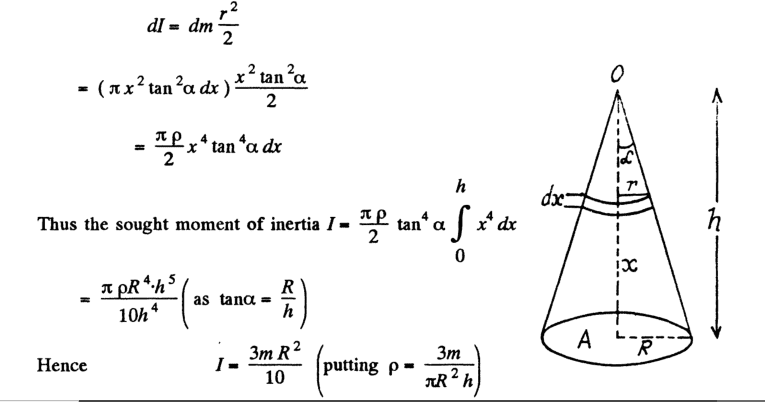
Why we divide the equation dI = dm*r^2 by two when we calcule the moment of inertia of a cone relative to its symmetry axis?
1588364864154.png
 
Last edited by a moderator:
Physics news on Phys.org
What's the moment of inertia of a disk?
 
  • Like
Likes   Reactions: LCSphysicist and etotheipi
PeroK said:
What's the moment of inertia of a disk?
mr^2/2

but i tried a approach different, i will post:
 
1588365610114.png

I can't see where i am wrong :C
 

Attachments

  • 1588365614112.png
    1588365614112.png
    153.8 KB · Views: 271
LCSphysicist said:
View attachment 261891
I can't see where i am wrong :C
You used mr2 instead of half that for the MoI of your disc element.
 
  • Like
Likes   Reactions: LCSphysicist
The equation ##dI=r^2dm## is the general one, where ##r## represents the perpendicular distance of a point to the axis of rotation. In this exercise, however, we notice that we can divide our cone into disks, find the moment of inertia of each disk, and then sum all of them, hence for each disk of thickness ##dx\equiv\Delta x\to0##, its contribution to the total moment of inertia is ##dI=\frac12r^2(x)dm##, where ##r(x)## represents the radius of a given disk.
 
  • Like
Likes   Reactions: LCSphysicist
I see, i tried to calc dividing the cone in disk, but i haven't see that i was summing the inertia moment of elemntary disks, i continued the sum like the disk were little points.
 
  • Like
Likes   Reactions: archaic

Similar threads

Replies
52
Views
5K
Replies
8
Views
2K
  • · Replies 13 ·
Replies
13
Views
3K
Replies
11
Views
4K
  • · Replies 28 ·
Replies
28
Views
2K
  • · Replies 40 ·
2
Replies
40
Views
6K
Replies
2
Views
2K
  • · Replies 4 ·
Replies
4
Views
2K
  • · Replies 2 ·
Replies
2
Views
1K
  • · Replies 4 ·
Replies
4
Views
3K