Momentum Physics Problem: Two astronauts throw billiard balls that collide

  • Thread starter Thread starter in33dphysicshelp
  • Start date Start date
  • Tags Tags
    Momentum conservation
Click For Summary

Homework Help Overview

The discussion revolves around a physics problem involving momentum and collisions, specifically focusing on two astronauts throwing billiard balls at each other in a zero-gravity environment. The problem explores concepts of elastic and inelastic collisions, as well as the conservation of momentum.

Discussion Character

  • Mixed

Approaches and Questions Raised

  • Participants discuss the nature of the collision, questioning whether it is elastic or inelastic, and explore the implications of energy conservation. There are attempts to apply momentum conservation principles in two dimensions, with some participants expressing uncertainty about their calculations and the correctness of their angles.

Discussion Status

Participants are actively engaging with the problem, providing updates on their calculations and questioning each other's reasoning. Some guidance has been offered regarding the need for two momentum equations and the proper use of LaTeX for formatting. There is an ongoing exploration of the assumptions made in the problem setup.

Contextual Notes

There is a mention of the problem being set in a zero-gravity environment, which raises questions about common misconceptions regarding gravity in space. Participants are also navigating the challenges of formatting their work according to forum guidelines.

in33dphysicshelp
Messages
4
Reaction score
0
Homework Statement
Two astronauts, George and Erin, throw two identical billiard balls at each other in space, far from any gravitational influence. George’s ball is initially traveling at 4.2 m/s, while Erin’s ball is traveling at 3.5 m/s. The balls collide and George’s ball is determined to be deflected by 35° with respect to the original direction. Its speed after the collision is 3.4 m/s.
a) What is the speed and direction of Erin’s ball?
b) Determine whether this is an elastic or inelastic collision. Motivate your answer.
Relevant Equations
pi=pf
m1v1+m2v2=m1v1+m2v2 (Final)
and KEi=KEf
My attempt is shown below.
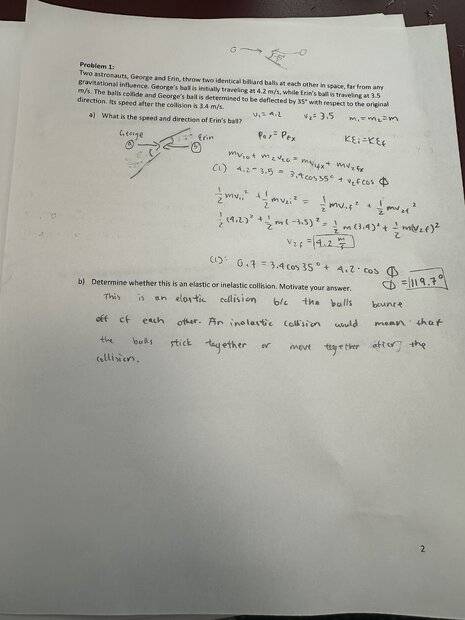
IMG_9227.jpeg
 
Last edited by a moderator:
Physics news on Phys.org
Here is a better photo:
Screenshot 2024-02-29 at 1.33.43 PM.png
 
Welcome to PF!

1709231776530.png


The collision can be inelastic even if the balls don't stick together. Inelastic simply means that total KE is not conserved.

If the balls stick together, the collision is often called "completely inelastic".

Please type in your work using LaTeX if possible rather than posting pictures of your handwritten work. Regulations and suggestions concerning the posting of homework questions can be found here.
 
Okay, thank you so much for telling me!
I just tried to write LaTeX, I clicked preview and nothing happened to the text so I don't believe I'm writing it correct.
here is my work though:
pi=pf
mv1(initial) + mv2(initial) = mv1 (final) + mv2 (final)
so substitute the values im given:
4.2-3.5=3.5cos35 + v2cosx (i think it's subtraction since Erin's ball in this case is being thrown in the opposite direction)
In an elastic collision the KE is conserved so KEi=KEf
1/2mv1^2 (initial) + 1/2mv2^2 (initial) = 1/2mv1^2 (final) + 1/2mv2^2 (final)
plugging all the information in I find that v2 is 4.2 m/s.
i substitute the value i found for v2 into the first equation and i get that 0.7=3.4cos35 + 4.2cosx
so therefore I use the inverse cosine function and i calculate x to be an angle of 119.7 degrees.
i'm not sure if this is right or not because i was trying to imagine the scenario in my head but 119 degrees doesn't seem right.
 
in33dphysicshelp said:
In an elastic collision the KE is conserved so KEi=KEf
1/2mv1^2 (initial) + 1/2mv2^2 (initial) = 1/2mv1^2 (final) + 1/2mv2^2 (final)
plugging all the information in I find that v2 is 4.2 m/s.
You are assuming the collision is elastic. This is not justified.

For help with LaTeX, see this guide. Also, there are some formatting tools available on the toolbar at the top of the input window that you can use to help format mathematical expressions.
 
In addition to what has already been said about energy conservation, your momentum conservation is incomplete. This is a two-dimensional collision which means that you need to write two momentum conservation equations, one in the direction of the original motion and one perpendicular to it.
 
Okay this is what I updated.
I split the momentum into x and y components.
i did 4.2-3.5=3.4cos35 + v2fcosx
0=3.4sin35 + v2f sinx
i did v2fsinx/v2fcosx and got tanx = 2.09/1.95 so i did the inverse of tan, got that the angle was about 46.98 degrees.
then to calculate for v2f i just plugged in 46.98 degrees into one of the momentum equations and i got that v2f is -3.06 m/s.
 
in33dphysicshelp said:
Okay this is what I updated.
I split the momentum into x and y components.
i did 4.2-3.5=3.4cos35 + v2fcosx
0=3.4sin35 + v2f sinx
OK

in33dphysicshelp said:
i did v2fsinx/v2fcosx and got tanx = 2.09/1.95
Check this. Are the numbers in the right place on the right side?
 
in33dphysicshelp said:
Homework Statement: Two astronauts, George and Erin, throw two identical billiard balls at each other in space, far from any gravitational influence.
Why do so many physics teachers think there is no gravity in space?
 

Similar threads

  • · Replies 13 ·
Replies
13
Views
1K
Replies
14
Views
3K
Replies
6
Views
1K
  • · Replies 4 ·
Replies
4
Views
2K
  • · Replies 13 ·
Replies
13
Views
1K
Replies
10
Views
3K
  • · Replies 19 ·
Replies
19
Views
3K
  • · Replies 12 ·
Replies
12
Views
2K
Replies
2
Views
1K
  • · Replies 60 ·
3
Replies
60
Views
4K