ToXic_Knight
- 5
- 0
1. Problem - Notes Jumbled, do not know if I am missing variables or not needed to answer the questions?
Disclaimer: I am good at maths, fine with algebra and derivations, I just forget the formulae and units, especially when I haven't practiced things a lot, such as this topic (other subjects getting in the way...)
Diagram:
http://imgur.com/mDBqZN5
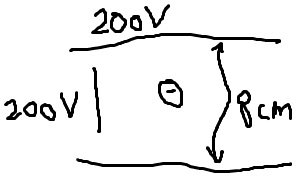
The variables I am given are d = 8cm cm, and V = 200 V, m = 2.86E-16. I have access to the mass and charge of an electron/ proton.
Here are the ten questions I need to be able to answer:
* The equations of motion.
* Electrostatic equations, such as E = V / d, E = F / q, V = w / q, Work done = Fd = qV = qED.
3. My attempt at a solution
My apolegies, I was confused about numerous things, some are solved now, but I haven't done much since I started, but I still don't understand what other proton particles are being referred to.
Edit: Okay.
1. Gravitational strength? How is Gravity taking place here?
2. F = Eq but E = V / d
F = qV / d
= 1.6E-31 * 200 / 0.08
F = 4E-28 N
But I don't get the diagram, is that halfway, so it's 0.04? I know it's my diagram, but I thought this would be a common question.
3. E = V / d [?]
E = 200 / 0.08 [or is it 400 or 0.04 or both?]
E = 2500 N.C^-1 [Is this an overly high value?]
4. What object?.. I have a feeling this is my rubbish note-taking's fault. Maybe it wasn't an electron, in fact, I just realized the mass is about 10^15 times higher than an electron... I'm lost.
Disclaimer: I am good at maths, fine with algebra and derivations, I just forget the formulae and units, especially when I haven't practiced things a lot, such as this topic (other subjects getting in the way...)
Diagram:
http://imgur.com/mDBqZN5
The variables I am given are d = 8cm cm, and V = 200 V, m = 2.86E-16. I have access to the mass and charge of an electron/ proton.
Here are the ten questions I need to be able to answer:
- Gravitational force on the particle
- Electrical force on the particle
- Electric field strength between... plates?
- The charge of the object
- Number of excess proton particles
- Power difference - changed to 201V: The new field strength
[*]The new electric force
[*]The net force
[*]The acceleration
[*]The time it will take from...
Homework Equations
* The equations of motion.
* Electrostatic equations, such as E = V / d, E = F / q, V = w / q, Work done = Fd = qV = qED.
3. My attempt at a solution
My apolegies, I was confused about numerous things, some are solved now, but I haven't done much since I started, but I still don't understand what other proton particles are being referred to.
Edit: Okay.
1. Gravitational strength? How is Gravity taking place here?
2. F = Eq but E = V / d
F = qV / d
= 1.6E-31 * 200 / 0.08
F = 4E-28 N
But I don't get the diagram, is that halfway, so it's 0.04? I know it's my diagram, but I thought this would be a common question.
3. E = V / d [?]
E = 200 / 0.08 [or is it 400 or 0.04 or both?]
E = 2500 N.C^-1 [Is this an overly high value?]
4. What object?.. I have a feeling this is my rubbish note-taking's fault. Maybe it wasn't an electron, in fact, I just realized the mass is about 10^15 times higher than an electron... I'm lost.
Last edited: