Motion of center of mass under gravity

Click For Summary
SUMMARY

The discussion centers on the motion of two particles, A and B, with masses of 1 kg and 2 kg, projected with speeds of 200 m/s and 50 m/s, respectively. After colliding in mid-air and sticking together, the maximum height attained by the center of mass is calculated to be 115.55 m. The acceleration of the center of mass remains constant at g = 10 m/s², and the sticking together of the particles does not affect the center of mass's motion, as it only influences internal forces. The key takeaway is that the center of mass's trajectory is determined independently of the collision details.

PREREQUISITES
  • Understanding of Newton's laws of motion
  • Familiarity with the concept of center of mass
  • Knowledge of kinematic equations
  • Basic principles of inelastic collisions
NEXT STEPS
  • Study the derivation of the center of mass formula for multiple bodies
  • Learn about the implications of inelastic collisions in physics
  • Explore kinematic equations in-depth, particularly for vertical motion
  • Investigate the effects of external forces on the motion of the center of mass
USEFUL FOR

Physics students, educators, and anyone interested in understanding the principles of motion and collisions in mechanics.

sachin
Messages
61
Reaction score
7
Thread moved from the technical forums to the schoolwork forums
While solving this question I could not figure out the concept of two blocks sticking together.

the question is,
Two particles A and B of masses 1 kg and 2 kg respectively are projected in the directions shown in figure with speed uA =200m/s and uB =50m/s. Initially they were 90m apart. They collide in mid-air and stick with each other. Find the maximum height attained by the centre of mass of the particles.

while solving I am able to get the initial position and acceleration of the center of mass,

but I dnt know how to use the "the bodies collide and stick wih each other" given in the question,

I just understand that finally their velocities are equal but dnt kbow how to proceed further.
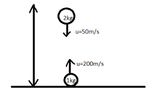
 

Attachments

  • 44cc05c3-6b35-40bf-8bfb-b077e7fecb612288744221610311919.png
    44cc05c3-6b35-40bf-8bfb-b077e7fecb612288744221610311919.png
    2.3 KB · Views: 129
Physics news on Phys.org
sachin said:
while solving I am able to get the initial position and acceleration of the center of mass
The "acceleration" of the center of mass ?
 
the solution what i have from online materials is as follows,they have never given the use of the bodies sticking together,

uA =200m/s
uB =50m/s
Initial distance between them is 90 m.
Now, Height of centre of mass=m1H1+m2H2m1+m2=m1H1+m2H2m1+m2
⇒200×0+90×22+1=1803=60m⇒200×0+90×22+1=1803=60m

Also, Velocity of centre of mass=m1V1+m2V2m1+m2=m1V1+m2V2m1+m2
⇒200×1−50×22+1=1003m/s⇒200×1−50×22+1=1003m/s

Now using the equation of motion,
v2=u2+2asv2=u2+2as
It is already given that:a=g=10m/s2a=g=10m/s2
⇒02=(1003)2−2×10×h⇒02=(1003)2−2×10×h

Since, the final velocity has to be 0 to attain maximum height.
⇒h=100×1009×2×10=55.55m⇒h=100×1009×2×10=55.55m

Thus, the total height obtained by the centre of mass= (60+55.55) m
44cc05c3-6b35-40bf-8bfb-b077e7fecb612288744221610311919.png

The maximum height attained by the centre of mass =115.55 m
 
Before the inelastic collision of A and B, the position of the "center of mass" is irrelevant. Try it by finding out where they collide, first.
 
hmmm27 said:
The "acceleration" of the center of mass ?
acceleration of center of mass will be g, as using formulae a of c m = (m1a1 + m2a2)/(m1 + m2), a1 = a2= g (both fall freely under gravity), plugging in the formulae we will get a of c m = g.
 
hmmm27 said:
Before the inelastic collision of A and B, the position of the "center of mass" is irrelevant. Try it by finding out where they collide, first.
This is irrelevant to the question.

sachin said:
the solution what i have from online materials is as follows,they have never given the use of the bodies sticking together
That would be because the sticking together is a red herring. The center of mass motion is unaffected by the internal forces of a system.
 
sachin said:
Now, Height of centre of mass=m1H1+m2H2m1+m2=m1H1+m2H2m1+m2
⇒200×0+90×22+1=1803=60m⇒200×0+90×22+1=1803=60m

Also, Velocity of centre of mass=m1V1+m2V2m1+m2=m1V1+m2V2m1+m2
⇒200×1−50×22+1=1003m/s⇒200×1−50×22+1=1003m/s

Now using the equation of motion,
v2=u2+2asv2=u2+2as
It is already given that:a=g=10m/s2a=g=10m/s2
⇒02=(1003)2−2×10×h⇒02=(1003)2−2×10×h

Since, the final velocity has to be 0 to attain maximum height.
⇒h=100×1009×2×10=55.55m⇒h=100×1009×2×10=55.55m
This may be due to your formatting, but the speed of the center of mass of two objects moving along the same line cannot be larger than the speed of both objects. Hence, 1003 m/s cannot be the center of mass speed for two objects with speeds 200 m/s and 50 m/s, respectively.
 
  • #10
Also, again, the point is that the sticking together is irrelevant to the solution of the problem. The collision, whether fully elastic, fully inelastic, or partially elastic, does not change the motion of the center of mass because it only affects the internal forces of the system.
 
  • Informative
  • Like
Likes   Reactions: berkeman and PeroK
  • #11
Orodruin said:
Also, again, the point is that the sticking together is irrelevant to the solution of the problem. The collision, whether fully elastic, fully inelastic, or partially elastic, does not change the motion of the center of mass because it only affects the internal forces of the system.
The one relevance of the balls sticking together is to remove, even before any calculation, the possibility that one ball impacts the ground while the other continues moving upward.

If such were to occur, that would be an unbalanced external force that would alter the velocity of the center of mass and could conceivably cause it to have a new, higher peak.

With an inelastic collision, this possibility is removed. We know that there is no external force until the combined mass impacts on the ground.
 

Similar threads

  • · Replies 9 ·
Replies
9
Views
1K
  • · Replies 3 ·
Replies
3
Views
2K
Replies
5
Views
2K
Replies
5
Views
2K
  • · Replies 2 ·
Replies
2
Views
1K
  • · Replies 3 ·
Replies
3
Views
6K
  • · Replies 5 ·
Replies
5
Views
2K
  • · Replies 9 ·
Replies
9
Views
4K
  • · Replies 5 ·
Replies
5
Views
4K
  • · Replies 4 ·
Replies
4
Views
4K