[Motion Problem] When is displacement equal?

  • Thread starter Thread starter Ticklez_Panda
  • Start date Start date
  • Tags Tags
    Displacement
Click For Summary

Homework Help Overview

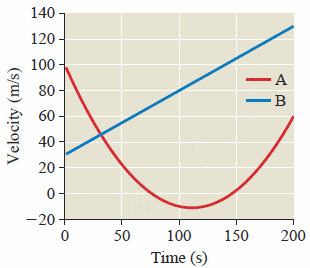
The discussion revolves around a motion problem involving two objects represented by a velocity versus time plot. The original poster seeks to determine if and when the two objects have the same displacement, given their differing velocity profiles.

Discussion Character

  • Exploratory, Conceptual clarification, Mathematical reasoning

Approaches and Questions Raised

  • Participants discuss the relationship between displacement and velocity, with one suggesting the use of integration to find displacement from velocity functions. Others explore the equations representing the velocity curves and question how to accurately derive them.

Discussion Status

The conversation is ongoing, with participants offering guidance on using fundamental relationships in motion. There is an exploration of different mathematical representations for the velocity curves, and some participants are attempting to derive equations for the curves based on the graph.

Contextual Notes

There is mention of needing specific functional forms for the velocity curves to proceed with calculations, and some participants express uncertainty about the parameters involved in these equations.

Ticklez_Panda
Messages
6
Reaction score
0
The figure below shows a velocity versus time plot for two objects; they are at the same point at
t = 0.
3-p-005.gif


Homework Statement


Do the objects ever have the same displacement? If so, when does that happen?


Homework Equations


Δd = ((velocityi+ velocityf) / 2) Δt
acceleration = change in velocity / change in time
Δd(A) = 100Δt + 0.5 (accel. Δt^2)
Δd(B) = 30Δt + 0.5 (accel. Δt^2)

The Attempt at a Solution


Looking at the graph, I can tell that line:B has a constantly changing velocity and therefore a constant acceleration. Line:A is different, it resembles a quadratic and displays the characteristic of a non-constant (time dependent acceleration). I know that the displacement between the two lines will be the same when the sum of initial and final velocity are equal given by my displacement equation.

Could someone please help to guide me towards this solution? It seems incredibly simple but I just can't grasp it. :(
 
Last edited:
Physics news on Phys.org
You need to use the more fundamental relationship between distance and speed: in this case,
d(t) = ∫v(t)dt. Use that for both curves.

To get a precise numerical answer you have to know what vA(t) is. Looks like a parabola to me, so derive the equation for the A curve. The B curve is obvioulsy a straight line, as you said.

Otherwise you can try to approximate the answer graphically. Not easily, though.
 
Representing the lines in equations

So I know that the line:B can be graphed with y = mx + b, which I resolved to equal y = 0.5x + 30. For line:A, I am having trouble representing it in an equation form. It appears to be quadratic, therefore it should be represented with y = ax^2 + bx + c. Where c = 100, I equated a to equal 1.6 using the first 50 seconds as a basis. I can't seem to find the solution to the second equation but I can estimate the x-int to be about 75 and 145, with a y-int of 100. What am I doing wrong here?
 
A parabola would be v-v0 = k(t - t0)^2. Try that.
v0 = -10 is pretty obvious but t0 less so. k somewhere around 0.01, t0 around 110 s.
 

Similar threads

  • · Replies 9 ·
Replies
9
Views
3K
Replies
8
Views
2K
  • · Replies 11 ·
Replies
11
Views
3K
  • · Replies 15 ·
Replies
15
Views
3K
  • · Replies 8 ·
Replies
8
Views
2K
  • · Replies 8 ·
Replies
8
Views
6K
  • · Replies 9 ·
Replies
9
Views
2K
  • · Replies 13 ·
Replies
13
Views
2K
  • · Replies 4 ·
Replies
4
Views
3K
  • · Replies 9 ·
Replies
9
Views
2K