Solve Motional EMF Problem: Total Resistance, V(ind), I(ind), and Fnet Explained

  • Thread starter Thread starter SpectraPhy09
  • Start date Start date
  • Tags Tags
    Emf Motional emf
Click For Summary
SUMMARY

The discussion focuses on solving the motional electromotive force (EMF) problem involving total resistance, induced voltage (V(ind)), induced current (I(ind)), and net force (Fnet). The equations presented include total resistance as R + 2λx, V(ind) as vBd, and I(ind) as vBd/(R + 2λx). The participants clarify the correct formulation of the net force, concluding that the applied force F is represented as F = iBd + 2λi²m(R+2λx)/B²d², correcting earlier misconceptions about the signs in the equations.

PREREQUISITES
  • Understanding of electromotive force (EMF) principles
  • Familiarity with Lenz's law and its implications on force direction
  • Knowledge of basic mechanics, particularly Newton's laws
  • Ability to manipulate algebraic equations involving forces and currents
NEXT STEPS
  • Study the principles of Lenz's law in depth
  • Learn about the relationship between current, magnetic fields, and forces in electromagnetic systems
  • Explore advanced topics in electromagnetism, such as Faraday's law of induction
  • Investigate the applications of motional EMF in real-world scenarios, such as electric generators
USEFUL FOR

Physics students, electrical engineers, and anyone interested in understanding the dynamics of motional EMF and its applications in electromagnetic systems.

SpectraPhy09
Messages
23
Reaction score
3
Homework Statement
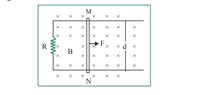
Two long Horizontal rails, a distance d apart and each having a resistanc λ per unit length are joined one end by a resistance R. A perfectly conducting rod MN of mass m is free to slide along the rails without friction v(I have attached the file for the diagram plz check) . There is a uniform magnetic field of induction B Normal to the plane of the paper and directed into the paper. Variable Force F is applied to the rod MN such that, as the rod moves, a constant current i and flows through R.
(i) Find the applied force F as function of distance x of the rod from R.
Relevant Equations
Force due to a current carrying wire = iBl
Where i = current
B = Magnetic field
L = length of the wire
E.M.F induced due to a rod of length l moving with Velocity V in Magnetic field B = VBl
Its applicable only when V, B and I are mutually perpendicular to each other
I request please go through my solution

Total Resistance = R + 2λx
V(ind) = vBd
I(ind)= vBd/(R + 2λx )
v = i(R + 2λx )/Bd

If force on the wire due to induced current is iBl then
Fnet = iBd - F ...(i)
or Fnet = F - iBd ...(ii)
Fnet = v(dv/dx)
v(dv/dx) = iBd - F

By solving we get
Fnet by (i) is iBd - 2λi²m(R+2λx)/B²d²
(ii)is 2λi²m(R+2λx)/B²d² - iBd

Which one of this is correct ? Or both are correct ? Did I made any mistake in the solution

 
Physics news on Phys.org
Hello @SpectraPhy09,
:welcome: ##\qquad## !​

I have attached the file for the diagram please check
I checked -- didn't see a thing !

What I see is two answers, one the opposite of the other ?

##\ ##
 
SpectraPhy09 said:
If force on the wire due to induced current is iBl then
Fnet = iBd - F ...(i)
or Fnet = F - iBd ...(ii)

I don't see the file for the diagram that you said you attached. It's not clear in which direction the rod is being pushed.

SpectraPhy09 said:
Fnet = v(dv/dx)
v(dv/dx) = iBd - F

Should the mass of the rod appear somewhere in the equations above?

SpectraPhy09 said:
By solving we get
Fnet by (i) is iBd - 2λi²m(R+2λx)/B²d²
(ii)is 2λi²m(R+2λx)/B²d² - iBd
Do these expressions represent Fnet or the applied force F?
 
I'm really sorry there's a mistake in my soln
Ya m should appear, i.e Fnet = mv(dv/dx)
mv(dv/dx) = iBd - F
The force Is not Fnet it is the applied Varying force F
i.e. F = iBd - 2λi²m(R+2λx)/B²d². ...(i)
Or. F = 2λi²m(R+2λx)/B²d² - iBd ...(ii)

My doubt was which of the equation among (i) or (ii) is correct ?
Or both are correct ? I have attached the figure please check
 

Attachments

  • Screenshot_2021-10-30-23-43-20-600.jpeg
    Screenshot_2021-10-30-23-43-20-600.jpeg
    8 KB · Views: 114
SpectraPhy09 said:
mv(dv/dx) = iBd - F
The force Is not Fnet it is the applied Varying force F
i.e. F = iBd - 2λi²m(R+2λx)/B²d². ...(i)
Or. F = 2λi²m(R+2λx)/B²d² - iBd ...(ii)

My doubt was which of the equation among (i) or (ii) is correct ?
Or both are correct ?
Hi @SpectraPhy09. Both equations can't be correct. For example -5 is not equal to +5. In fact neither equation is correct! See if this helps.

We are taking +x as being ’to the right’. And from the question we deduce the rod moves to the right.

In 1-dimension, vectors in the positive direction are represented positive values and vectors in the negative direction by negative values

The applied force, F, acts to the right (given in diagram) so it is represented by a positive value.

As the rod moves right, its (positive) velocity must increase to keep the current constant. (Why?) So the direction of acceleration is to the right. Therefore the direction of the net force is to the right. So the net force is represented by a positive value.

The ‘back-force’ has magnitude = iBd and acts to the left (from Lenz’s law). So we assign it the value -iBd.

We are adding two forces by vector addition:

##\overrightarrow {net force} = \overrightarrow {applied force} + \overrightarrow {back force}##

which in 1-dimension gives
##F_{net} = F + (-iBd)##

Does that make sense?

Neither of your answers:
F = iBd - 2λi²m(R+2λx)/B²d². ...(i)
F = 2λi²m(R+2λx)/B²d² - iBd ...(ii)
are correct. But you are very close!
 
@Steve4Physics
Oh is there a +ve instead of -ve ..?
F = iBd + 2λi²m(R+2λx)/B²d²
 
  • Like
Likes   Reactions: Steve4Physics
SpectraPhy09 said:
@Steve4Physics
Oh is there a +ve instead of -ve ..?
F = iBd + 2λi²m(R+2λx)/B²d²
Yes, that's what I get too. Well done!
 
  • Like
Likes   Reactions: SpectraPhy09

Similar threads

  • · Replies 5 ·
Replies
5
Views
3K
Replies
11
Views
3K
  • · Replies 8 ·
Replies
8
Views
3K
  • · Replies 22 ·
Replies
22
Views
4K
Replies
3
Views
3K
Replies
1
Views
8K
Replies
9
Views
2K
  • · Replies 8 ·
Replies
8
Views
2K
  • · Replies 17 ·
Replies
17
Views
4K
  • · Replies 11 ·
Replies
11
Views
20K