Motor Torque Calculation for Amusement Ride

Click For Summary
SUMMARY

The discussion focuses on calculating the torque requirements for a motor to rotate a 3-meter diameter amusement ride at approximately 35 RPM, with a total mass of 750 kg. Key formulas mentioned include P=Tω and T=Iα, emphasizing the importance of considering startup torque rather than just constant speed torque. The reduction ratio for gearing down from an 1800 RPM motor to 35 RPM is approximately 50:1, meaning the motor must provide at least 1/50th of the required torque before reduction. Participants stress the need to calculate maximum torque based on the moment of inertia and angular acceleration for accurate motor selection.

PREREQUISITES
  • Understanding of torque calculations in mechanical systems
  • Familiarity with moment of inertia concepts
  • Knowledge of gear reduction ratios
  • Basic principles of angular acceleration
NEXT STEPS
  • Research the calculation of moment of inertia for various shapes, particularly discs
  • Learn about gear reduction systems and their impact on motor torque
  • Explore motor selection criteria based on torque and RPM requirements
  • Study angular acceleration calculations and their applications in mechanical design
USEFUL FOR

Mechanical engineers, amusement ride designers, and anyone involved in motor selection and torque calculations for rotating systems.

skella
Messages
1
Reaction score
0
Hi

I'm looking for some info and advice. I've looked across the Internet and forums looking at different formulas for working out the torque requirements for a motor but can't find anything that helps me.

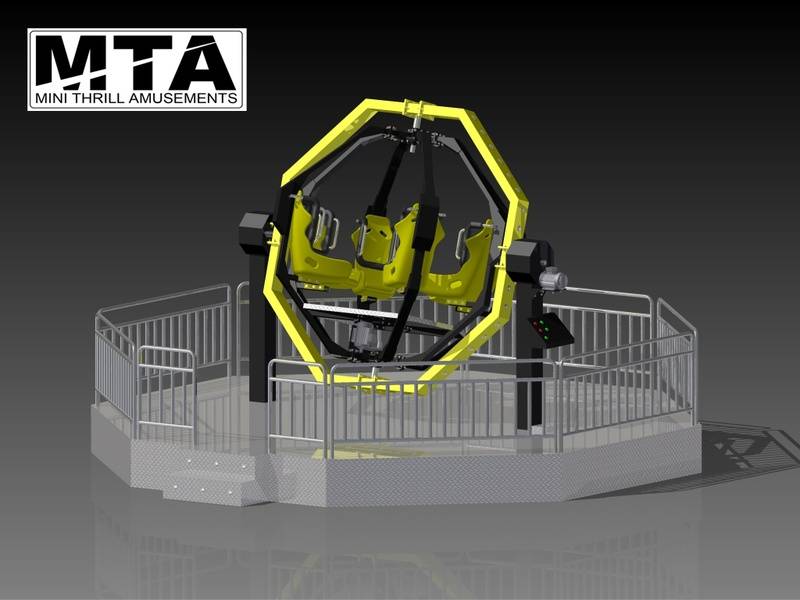
I have designed a small amusement ride. Please see pic below.
2657.jpg


The outer ring (yellow) needs to rotate at approx 35rpm.

The mass of the ring and everything inside it is approx 750kg.

The diameter of the ring is 3m

How do I work out the torque required to spin the disc? And does adding in a gear box effect the torque needed at the motor? It's hard for me to select a suitable motor without knowing the power required. But let's say for example the motor is 1800rpm. For me to gear that down to 35rpm how does that effect the torque needed by the motor?

Any help and advice appreciated.
 
Engineering news on Phys.org
Excuse my bluntness but if you don't have the engineering skills to spec a motor how have you managed to do the structural design?

As for motor selection, are you familiar with these?
P=Tω
T=Iα

At constant speed motor torque has to only overcome friction, and will probably be a small fraction of the torque required for a reasonable start up acceleration. In other words, design for start up, not constant speed.
 
  • Like
Likes   Reactions: Rx7man
I agree with everything billy_joule said...

anyhow, first figure out your reduction ratio.. 1800/35 = ~50:1, so whatever torque you require to spin the ride, the motor needs to provide at least 1/50th of that before reduction.

It seems to be designed so that it's relatively balanced, or should I say the center of mass is close to the rotating axis? You need to find out what the maximum torque is due to the that, and then add in any acceleration over and above that... from there you can choose a motor that will provide that kind of torque..
 
+2

Torque = Moment of Inertia * angular acceleration.

If you know how fast it must spin up you can calculate the angular acceleration. Depending on how accurate you need the answer you might approximate the moment of inertia to that of a disc...

https://en.wikipedia.org/wiki/List_of_moments_of_inertia
 

Similar threads

  • · Replies 2 ·
Replies
2
Views
4K
Replies
9
Views
2K
  • · Replies 17 ·
Replies
17
Views
4K
Replies
2
Views
3K
Replies
3
Views
5K
  • · Replies 5 ·
Replies
5
Views
2K
  • · Replies 2 ·
Replies
2
Views
5K
  • · Replies 10 ·
Replies
10
Views
2K
  • · Replies 5 ·
Replies
5
Views
5K
Replies
24
Views
3K