Motor Torque to Stabilize Inverted Pendulum

Click For Summary

Discussion Overview

The discussion revolves around the challenge of converting a force value, derived from a digital controller, into a torque value for a motor in the context of stabilizing an inverted pendulum system. The focus is on the mechanical and electrical engineering principles involved in this conversion, with participants exploring the necessary calculations and assumptions.

Discussion Character

  • Technical explanation
  • Mathematical reasoning
  • Debate/contested

Main Points Raised

  • One participant describes a system where the output from a digital controller is a force value in Newtons that needs to be converted to torque for the motor.
  • Another participant suggests that to calculate torque, the coefficient of friction is needed and proposes a formula involving the force and the radius of the pulley.
  • Some participants question the necessity of considering the force on the lower side of the pulley in the torque calculation.
  • There is a contention regarding whether the torque should simply be the force multiplied by the radius of the pulley, especially under the assumption of negligible friction.

Areas of Agreement / Disagreement

Participants express differing views on the factors that should be included in the torque calculation, particularly regarding the role of friction and the interpretation of forces acting on the pulley. The discussion remains unresolved with multiple competing perspectives on the correct approach.

Contextual Notes

Participants have not reached a consensus on the assumptions regarding friction and the forces involved in the torque calculation, which may affect the accuracy of their proposed methods.

NeuralNet
Messages
24
Reaction score
0
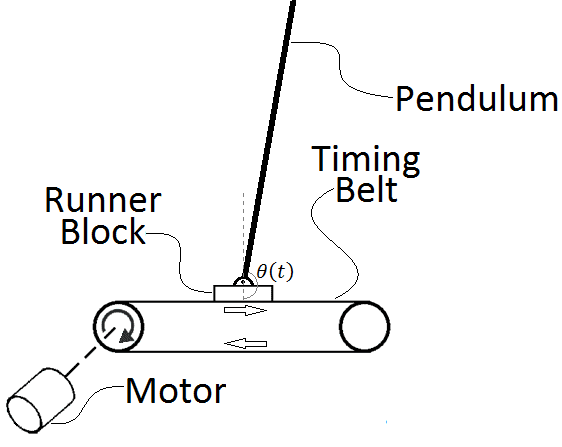
I am trying to stabilize an inverted pendulum with a physical system as follows:
2dtb0as.png


The measured values of the pendlums angle and the cart (runner block) position are sent to a digital controller. The digital controller then outputs a value that is sent to the motor to turn the belt pulley system which in turn moves the cart.

The problem I am having is my equations are such that the value coming out of the controller is the force (in Newtons) that needs to be applied to the cart to move it. I need to convert the force value to the torque value at the motor.

How do I do that?

I am an EE major, and don't know too much about ME stuff. Any help is much appreciated.
 
Last edited:
Engineering news on Phys.org
Here is a more detailed image:
olie8.png


ADC = Analog to Digital Converter
DAC = Digital to Analog Controller
There is an amplifier after the DAC that is not show.

That u(t) value is currently the force (in Newtons) that needs be applied to the cart (not shown in the figure), I need to convert this to the torque value of the motor (as seen in the diagram).

How do I do that?
 
Last edited:
For that , I will need value of coefficient of friction. Assuming angle of contact to be 180 degrees, I can calculate torque = (force - force on lower side) * radius of pulley.
 
We are modelling with coefficient of friction to be negligible.

When you say:
torque = (force - force on lower side) * radius of pulley

What are you referring to when you say 'force on lower side'?
 
Last edited:
NeuralNet said:
We are modelling with coefficient of friction to be negligible.

When you say:
torque = (force - force on lower side) * radius of pulley

What are you referring to when you say 'force on lower side'?
isn't the torque just equal to the force require times the radius of the pulley? assuming if you are only operating one of the pulley?
 
Last edited:

Similar threads

  • · Replies 1 ·
Replies
1
Views
3K
Replies
4
Views
2K
  • · Replies 2 ·
Replies
2
Views
4K
  • · Replies 10 ·
Replies
10
Views
2K
Replies
3
Views
5K
Replies
9
Views
2K
  • · Replies 9 ·
Replies
9
Views
2K
  • · Replies 6 ·
Replies
6
Views
2K
Replies
1
Views
3K
  • · Replies 2 ·
Replies
2
Views
5K