Motorcycle blown off-track by crosswinds!

  • Thread starter Thread starter DannoXYZ
  • Start date Start date
Click For Summary

Discussion Overview

The discussion revolves around the effects of crosswinds on the path of a motorcycle, focusing on the dynamics of balance, steering, and the forces involved when a motorcycle encounters lateral wind. Participants explore theoretical models, personal experiences, and the implications of rider reactions in high-wind scenarios.

Discussion Character

  • Exploratory
  • Technical explanation
  • Debate/contested
  • Personal experience

Main Points Raised

  • One participant proposes a model separating crosswind into longitudinal and lateral forces, suggesting that the longitudinal component slows the bike without changing direction, while the lateral force alters its path.
  • Another participant challenges the vector addition approach, emphasizing the importance of balance and the feedback mechanisms in motorcycle steering.
  • Some participants describe the necessity for riders to lean into the wind to maintain a straight path, detailing the instinctive corrections made by experienced riders in response to gusts.
  • Concerns are raised about the impact of tire friction and the potential for sliding when lateral forces exceed static friction, with personal anecdotes illustrating the challenges faced in strong winds.
  • Discussion includes the effect of crosswinds on the motorcycle's leaning angle and the resultant steering dynamics, with references to the relationship between the center of pressure and center of gravity.
  • Participants share personal experiences of riding in crosswinds, noting the varying effects of wind on stability and control, including the influence of luggage and vehicle design.
  • There is a mention of differing opinions on whether to speed up or slow down in response to crosswinds, indicating a lack of consensus on the best approach.

Areas of Agreement / Disagreement

Participants express a range of views on the dynamics of motorcycle handling in crosswinds, with no clear consensus on the best model or approach to understanding the effects of lateral forces. The discussion remains unresolved regarding the optimal rider response to crosswinds.

Contextual Notes

The discussion highlights various assumptions about rider behavior, the influence of motorcycle design, and the conditions under which crosswinds affect stability. Limitations include the lack of detailed mathematical modeling and the dependence on individual experiences and interpretations.

Who May Find This Useful

Motorcycle enthusiasts, riders interested in safety and handling in adverse weather conditions, and those studying dynamics related to vehicle control may find this discussion relevant.

DannoXYZ
Messages
69
Reaction score
16
TL;DR
At last trackday at Attesa Podium Club, huge gust of wind blew one bike off track. Yet not others. Would like to model change in bike's trajectory from crosswinds. Along with steering corrections needed to maintain original path.
So I'm trying to develop model of what happens to motorcycle's path when it gets hit by crosswind.

initial velocity = 100mph
crosswind direction = 45 degrees towards bike
crosswind speed = 60mph

Now I was thinking to separate crosswind into longitudinal and lateral forces. Longitudinal component pushes bike back and slows it down, but doesn't change its direction.

Lateral force does change bike's direction. Depending upon bike+rider cross-sectional area, it would catch certain amount of wind. Can determine lateral pushing force based upon velocity of wind sideways normal to bike and air-density.

So then it is just vector addition of original velocity of bike, minus longitudinal force of crosswind (headwind) along with lateral force of crosswind pushing bike sideways?

I'm also thinking there's some sort of friction component from tyres on ground somehow, but not sure how that ties in.

Thanks
 
Engineering news on Phys.org
DannoXYZ said:
So then it is just vector addition of original velocity of bike, minus longitudinal force of crosswind (headwind) along with lateral force of crosswind pushing bike sideways?
No. You should take a look at the way bikes and bicycles maintains balance.
Not the gyro-effect but the negative feedback of changes in direction of the first wheel, in connection with the effect of leaning angle.
 
DannoXYZ said:
Lateral force does change bike's direction. Depending upon bike+rider cross-sectional area, it would catch certain amount of wind. Can determine lateral pushing force based upon velocity of wind sideways normal to bike and air-density.
One rider did not react quickly enough to the gust. The bike and rider must lean into the gust, to continue in a straight line. That means the rider must, steer quickly downwind, then lean the bike into the wind, and so counter the side pressure of the wind with the rider's mass and gravity.
The other riders were awake and so made the required overcorrection, quickly, instinctively and correctly.
 
  • Like
Likes   Reactions: DeBangis21, berkeman, russ_watters and 2 others
DannoXYZ said:
So then it is just vector addition of original velocity of bike, minus longitudinal force of crosswind (headwind) along with lateral force of crosswind pushing bike sideways?
Why would you add a velocity with a force?
 
If the rider reacted properly; then, the lateral force of the gust was big enough to reach the static friction threshold for that particular motorcycle (cold or worn tires probably).

Once that happened, the tires were sliding sideways under kinetic friction (while simultaneously rolling), and because of that, steering was greatly reduced and the rider could not stay on the track.

It has happened to me with a 70 mph gust coming at 90 degrees from the left.
I only managed to stay on the road because the gust did not last long enough.
 
  • Like
  • Wow
Likes   Reactions: hutchphd and DannoXYZ
Rive said:
No. You should take a look at the way bikes and bicycles maintains balance.
Not the gyro-effect but the negative feedback of changes in direction of the first wheel, in connection with the effect of leaning angle.
So wind would affect trail and self-centering effect of front wheel?

Racing rules dictated that front wheels could not be enclosed by fairings. Which would expose front wheel to wind gusts from side. Hmm... force acting on wheel may make it turn and cause change in direction. Although there's equal anounts of wheel surface area ahead and behind fork tube, so there wouldn't be any twisting force to turn fork? There's also significant momentum behind front wheel to drive its self-centering action.

I'm thinking crosswind imparts more force on bodywork and rider's body than front wheel?
 
DannoXYZ said:
So wind would affect trail and self-centering effect of front wheel?
No, it'll affect the leaning angle of the careless (or just unfortunate) driver. Then the angle will mess up the things with the front wheel.
@Baluncore wrote it right.
 
So crosswind makes bike lean away from vertical which causes it to turn away from straight path! Then it's like case of parked bike being lifted off kickstand and being flipped to other side.

So lateral force acting sideways on bike & rider is sine function of crosswind angle. Direct crosswind has strongest effect for any wind velocity. This tips bike over certain number of degrees and rider must lean bike into wind same number of degrees quickly to keep going in straight line.

But there's lateral offset from original path depending upon how long it takes rider to make correction.
 
Last edited:
  • #10
DannoXYZ said:
But there's lateral offset from original path depending upon how long it takes rider to make correction.
Yes, if you get surprised by a strong gust from the side, it can push you off your line until/unless you correct for it.

I was riding a track day at Laguna Seca in Monterey one time when the wind was very strong. It was not too bad on most of the places on the track, but at the top of the hill between turns 6 and 7 there was a section of the track where the side hill dropped away and the wind was howling across the track left-to-right. I had to lean my sportbike pretty hard to the left to stay on line to set up for the corkscrew -- it was a very strange sensation (especially at 80+mph at that part of the track).

1692884574204.png

https://en.wikipedia.org/wiki/Laguna_Seca

Also a strange sensation is when you are riding the street with a very strong crosswind, and you go through a tunnel or even an underpass. You snap from leaned over to straight up and back to leaned over to be able to track straight in your lane.

And just to add to the traction issue that @Lnewqban mentioned -- one of my scariest rides was an early morning commute in the dark and heavy rain over a bridge here in Silicon Valley (Dumbarton Bridge), where the sidewind was probably gusting to 40mph and there was enough water on the roadway that I was starting to hydroplane. With cages all around me, that was a dicey couple minutes of my ride...
 
  • Like
Likes   Reactions: DeBangis21, DannoXYZ, PeroK and 1 other person
  • #11
I wrote this a day ago but forgot to hit the Post Reply button; anyhow here it is.

Not exactly an answer, but just an observation from experience:

Having ridden with gusty crosswinds, I've found that when touring with luggage piled on the rack at the rear of the bike, a side gust will steer the bike (somewhat) into the wind. Very helpful when doing 60mph on a freeway, especially when you don't want to argue with a Large truck in the next lane!

Must have something to do with all that sail area behind the rear tire.

Cheers,
Tom

p.s. As a note similar to the post by @berkeman: The only time I was on the Golden Gate Bridge in San Francisco, there was a pretty good cross wind. Had to slow WAY down to avoid having both my wife and me going for a swim!

Keep the shiny side up!
 
  • Like
Likes   Reactions: DannoXYZ
  • #12
Tom.G said:
Must have something to do with all that sail area behind the rear tire.
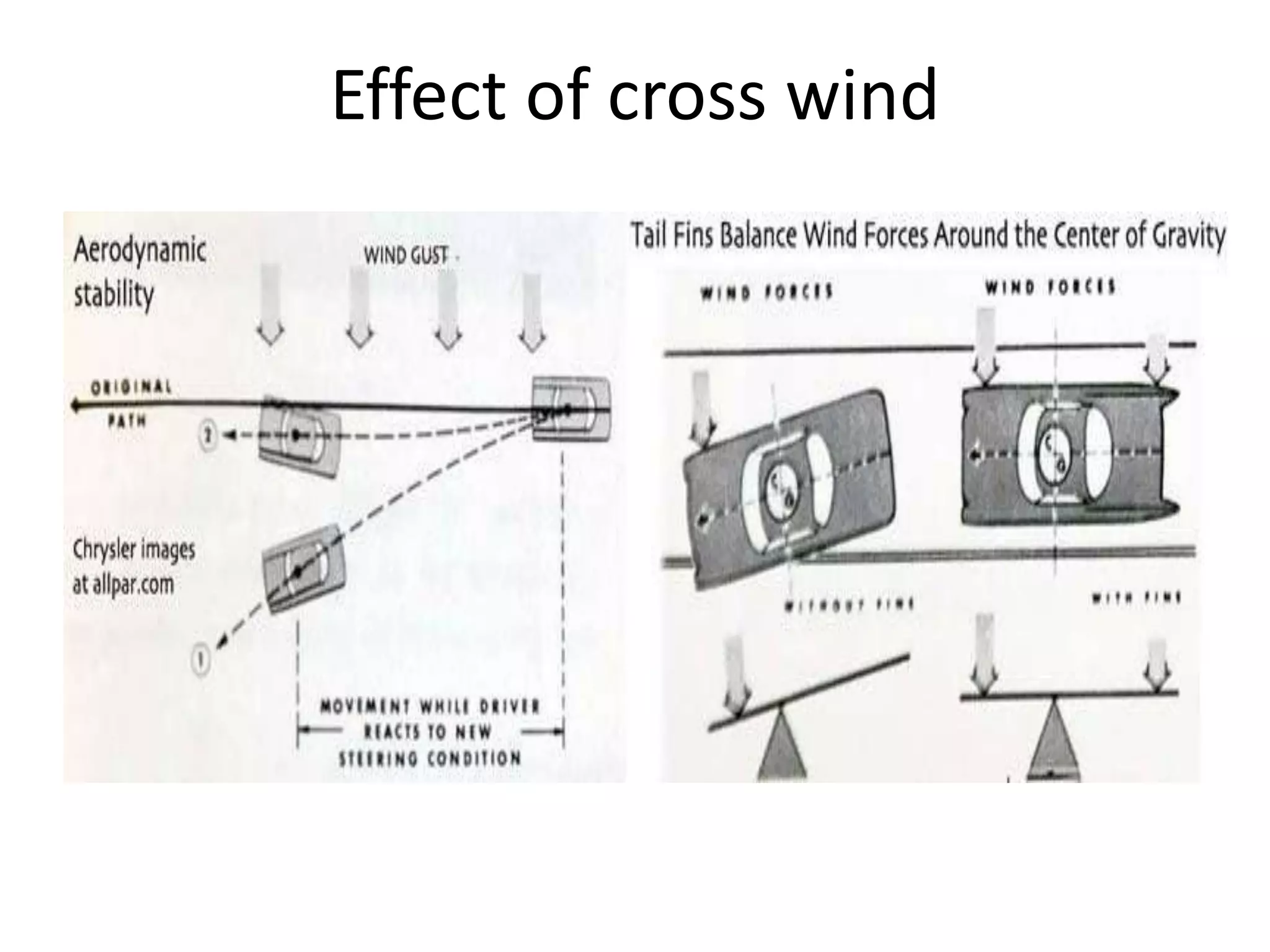
Yes, it does. It has to do with the position of the Center of Pressure (CoP) vs the center of Gravity (CoG). When the CoP is behind the CoG, the vehicle steers into the wind, correcting itself automatically, thus making the car very stable. When in front, it steers away from the wind, making the vehicle very sensitive to side winds.

With side winds, of course, the side view area is the important factor, not the frontal area. That is why race cars have these large tail fins at the rear.

7fb9966614d06216b40f9e67219b99e56ea7037b_2_621x407.png

toyota-rake.png

pressure-centre4.png

This effect was also confirmed with cars with large tail fins in the 50's:

fc87093e4e953aab09996be05877ff4d.jpg

vehicle-aerodynamics-effects-of-side-winds-22-2048.jpg
 
  • Like
Likes   Reactions: DannoXYZ, Tom.G and Lnewqban
  • #13
Tom.G said:
p.s. As a note similar to the post by @berkeman: The only time I was on the Golden Gate Bridge in San Francisco, there was a pretty good cross wind. Had to slow WAY down to avoid having both my wife and me going for a swim!

Keep the shiny side up!
Interesting. I've heard suggestions both ways: speed up or slow down. How does speed affect bike's response to same crosswind? I assume lateral component of crosswind would hit bike exactly same way regardless of bike's speed?

So difference has to with bike's behavior at different speeds? The self-correcting torque from trail on front tyre would be larger at higher speeds?
 
  • #14
The advantage of lower speed is your reflexes have time to correct before disaster strikes.
 
  • #15
Tom.G said:
The advantage of lower speed is your reflexes have time to correct before disaster strikes.
You must avoid exceeding the "ride envelope parameters". With lower speeds, you also lean less into corners, retaining a greater margin of "two wheel" safety.
DannoXYZ said:
Interesting. I've heard suggestions both ways: speed up or slow down. How does speed affect bike's response to same crosswind?
The force applied by the wind, to the bike and rider, is proportional to the square of the wind velocity. The rider must transfer their weight into the wind to counter that force. The only way to do that is to steer the bike aggressively downwind, while leaning into the wind and into the correction curve needed to return to the original line on the road. Once recovered, if you are riding in a straight line, there will be a comfortable compromise between body lean and bike lean.

As you turned downwind to catch your balance, the side-wind component was reduced, reducing the side force, and giving you a momentary false sense of security. As you start to regain your line on the road, the virtual side-wind velocity is increased, beyond the original gust.

In a boat, or on a bike, it is necessary to have "steerage way". The rate the wind gust can be countered is the product of the bike speed and the steering angle. You need sufficient speed to recover, but not too much. Too much speed, and you will leave the road before you can react sufficiently to recover. Riding fast, in case you need to counter a side gust, just means the accident will happen faster. Damage and injuries in an accident will be proportional to the square of your speed.

Wind forces, proportional to the square of the wind velocity, can be greater than the force due to gravity. Notice the power lines along the road. In high cross-winds, they hang more sideways than downwards. It is possible, there will be a wind so strong, that you cannot lean and ride the bike, you must stop. That effect is compounded when you come to a corner, turning into the wind. The faster you are riding, the more you will need to lean further into the wind. Ride cautiously in strong winds to reduce the possibility of dropping the bike on the road.

Above all, stay awake. With experience, you can ride instinctively when tired, but when a gust hits, you must deliberately overcorrect to recover. An instinctive reaction to a gust, while you are tired, will probably see you being blown off the road.
 
  • Like
Likes   Reactions: DeBangis21

Similar threads

  • · Replies 65 ·
3
Replies
65
Views
8K
  • · Replies 3 ·
Replies
3
Views
6K
  • · Replies 11 ·
Replies
11
Views
9K
Replies
11
Views
5K
  • · Replies 22 ·
Replies
22
Views
21K
  • · Replies 30 ·
2
Replies
30
Views
5K
Replies
3
Views
5K
  • · Replies 1 ·
Replies
1
Views
3K
  • · Replies 6 ·
Replies
6
Views
6K
  • · Replies 2 ·
Replies
2
Views
11K