s1c0
- 6
- 0
...?
Last edited:
Acut said:@nismaratwork: That's exactly my point.
Although I'm still puzzled by the expression "movement through time" - I haven't studied much relativity, so I don't know if that is a valid wording.
s1c0's post makes no sense to me.
Acut said:@nismaratwork: That's exactly my point.
Although I'm still puzzled by the expression "movement through time" - I haven't studied much relativity, so I don't know if that is a valid wording.
s1c0's post makes no sense to me.
nismaratwork said:Consider a particle's 4-velocity in Minkowski space... it's moving not just in 3 spatial dimensions, but a temporal dimension. This is the reason that the world-line for a regularly orbiting body is helical, and not circular. We're always moving through time.
s1c0 said:Just a thought about particels that only appeare to exist for a few seconds. could this be because they only move through space and not through time. Almost like we were traveling past them.
My idea to test this would be to have two identical particle accelerators, one in space and one on earth. My variable would be time, which would be very slightly slower at Earth because of its mass.
If the particles traveled through time and space at the standard rate then in time T they would both travel the same distance D because V would be the same. (to an observer in space the particle would be slower on earth)

http://en.wikipedia.org/wiki/Muon"
When a cosmic ray proton impacts atomic nuclei of air atoms in the upper atmosphere, pions are created. These decay within a relatively short distance (meters) into muons (the pion's preferred decay product), and neutrinos. The muons from these high energy cosmic rays, generally continuing essentially in the same direction as the original proton, do so at very high velocities. Although their lifetime without relativistic effects would allow a half-survival distance of only about 0.66 km (660 meters) at most, the time dilation effect of special relativity allows cosmic ray secondary muons to survive the flight to the Earth's surface. Indeed, since muons are unusually penetrative of ordinary matter, like neutrinos, they are also detectable deep underground (700 meters in the illustration above) and underwater, where they form a major part of the natural background ionizing radiation. Like cosmic rays, as noted, this secondary muon radiation is also directional.
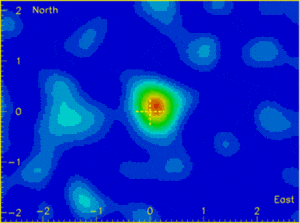
The Moon's cosmic ray shadow
s1c0 said:I gues I should leave the thinking for you smart guys :P

s1c0 said:sorry for the bad spelling I am dyslexic, google search "did you mean" can only help me so much. :( sorry about the post since its already been done. just thought since I am not going to uni it could be something for someone to think about. I gues I should leave the thinking for you smart guys :P
s1c0 said:... then in 1 second in space1"normal time" the particle could travel x meters.
 ?
?
 )
)s1c0 said:sorry about any non- physicsy phrases " time dialated space " I am not sure how to word some of the stuff.