MTW Ex 21.23 Poynting Flux Vector 'out of the air'

  • Thread starter Thread starter TerryW
  • Start date Start date
  • Tags Tags
    Air Flux Vector
Click For Summary
SUMMARY

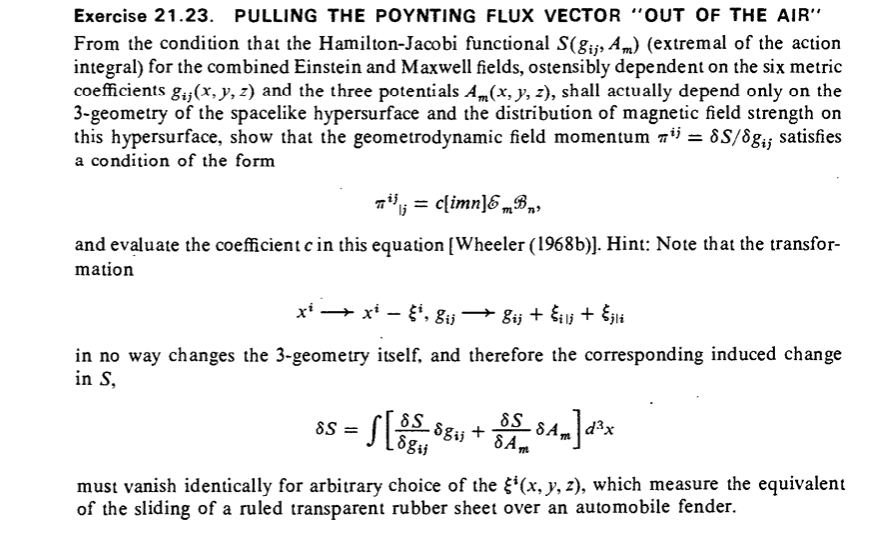
The discussion centers on the application of the Lagrangian Density from MTW (21.100) to derive the Poynting Flux Vector in the context of Hamilton-Jacobi functional S(g_{ij}, A_m). The participant confirms that MTW (21.100) is indeed the appropriate functional for this problem. They successfully identify the key to solving the problem, indicating a clear path forward in their calculations.

PREREQUISITES
  • Understanding of Lagrangian Density in theoretical physics
  • Familiarity with Hamilton-Jacobi formalism
  • Knowledge of electromagnetic field tensors
  • Proficiency in tensor calculus and general relativity concepts
NEXT STEPS
  • Study the derivation of the Poynting Flux Vector in electromagnetic theory
  • Explore advanced applications of the Hamilton-Jacobi equation
  • Review the mathematical framework of MTW (Gravitation) for deeper insights
  • Investigate the relationship between Lagrangian and Hamiltonian mechanics
USEFUL FOR

The discussion is beneficial for theoretical physicists, graduate students in physics, and researchers focusing on electromagnetic theory and general relativity.

TerryW
Gold Member
Messages
229
Reaction score
21
Homework Statement
I'm just looking for a bit of guidance with this, to check if I am on the right track
Relevant Equations
MTW (21.100) See Below
##4\pi\mathcal L = -\mathcal e \frac{\partial A_i }{\partial t} - \phi\mathcal E^i{}_{,i} -\frac{1}{2}N\gamma^{\frac{1}{2}}g_{ij}(\mathcal E^i \mathcal E^j +\mathcal B^i\mathcal B^j) +N^i [ijk]\mathcal E^i\mathcal B^j## MTW (21.100)

I'm trying to produce the result required by the problem below by using the Lagrangian Density above as the Hamilton-Jacobi functional ##(S(g_{ij},A_m)## referred to below. So far, I haven't been able to see a way forward which might end up with the required result.

At this stage, I'm just asking if MTW (21.100) is the appropriate functional and if it isn't, what should I be using?
MTW 21.23.png
 
Physics news on Phys.org
The answer to my question is yes. I found the key to the solution.:smile:
 

Similar threads

  • · Replies 1 ·
Replies
1
Views
3K
  • · Replies 1 ·
Replies
1
Views
2K
  • · Replies 1 ·
Replies
1
Views
2K
  • · Replies 12 ·
Replies
12
Views
3K
  • · Replies 1 ·
Replies
1
Views
2K
  • · Replies 27 ·
Replies
27
Views
3K
  • · Replies 5 ·
Replies
5
Views
2K
  • · Replies 7 ·
Replies
7
Views
3K
Replies
5
Views
4K
  • · Replies 1 ·
Replies
1
Views
2K