Mult Variate Calc: Proof for N(t) vector

  • Thread starter Thread starter opus
  • Start date Start date
  • Tags Tags
    Proof Vector
Click For Summary
SUMMARY

The discussion focuses on proving the vector equation for the normal vector, specifically $$\vec{N}(t) = \frac{\vec{a}_{v\perp}}{|\vec{a}_{v\perp}|}$$, where $$\vec{a}_{v\perp}$$ represents the component of acceleration orthogonal to the velocity vector. Key definitions include the unit tangent vector $$\vec{T}(t) = \frac{\vec{v}(t)}{v(t)}$$ and the unit normal vector $$\vec{N}(t) = \frac{\vec{T}'(t)}{|\vec{T}'(t)|}$$. The discussion emphasizes the relationship between these vectors and the acceleration, clarifying that $$\vec{a}_{v\perp}$$ is derived from the total acceleration minus the tangential component, which is defined as $$\vec{a}_{v} = v'(t)\vec{T}(t)$$.

PREREQUISITES
  • Understanding of vector calculus, specifically unit vectors.
  • Familiarity with the concepts of tangential and normal acceleration.
  • Knowledge of the Frenet-Serret formulas for space curves.
  • Proficiency in using dot products to determine vector relationships.
NEXT STEPS
  • Study the derivation and application of the Frenet-Serret frames in space curves.
  • Learn about the geometric interpretation of tangential and normal components of acceleration.
  • Explore advanced vector calculus techniques, particularly in relation to motion in three dimensions.
  • Investigate the implications of $$\vec{T}'(t)$$ in the context of curvature and motion dynamics.
USEFUL FOR

Students and professionals in physics, mathematics, and engineering who are working on problems involving motion dynamics, particularly those involving vector calculus and the analysis of curves in space.

opus
Gold Member
Messages
717
Reaction score
131
Homework Statement
Part (d):
Use parts (a), (b), and (c) to argue that $$\vec{N}(t) = \frac{\vec{a}_{v\perp}}{|\vec{a}_{v\perp}|}$$
Relevant Equations
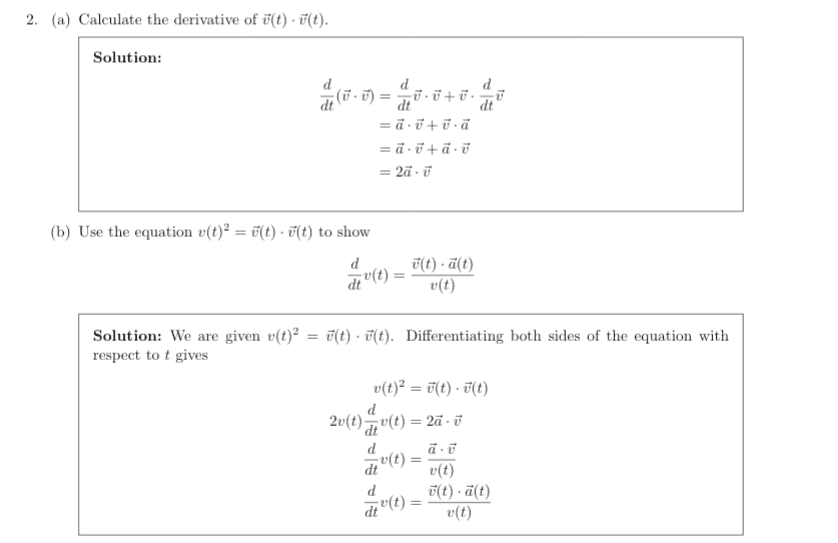
$$\frac{d}{dt}(\vec{v}\cdot\vec{v}) = 2\vec{a} \cdot \vec{v}$$
$$\frac{d}{dt}v(t) = \frac{\vec{v}\cdot\vec{a}}{v(t)}$$
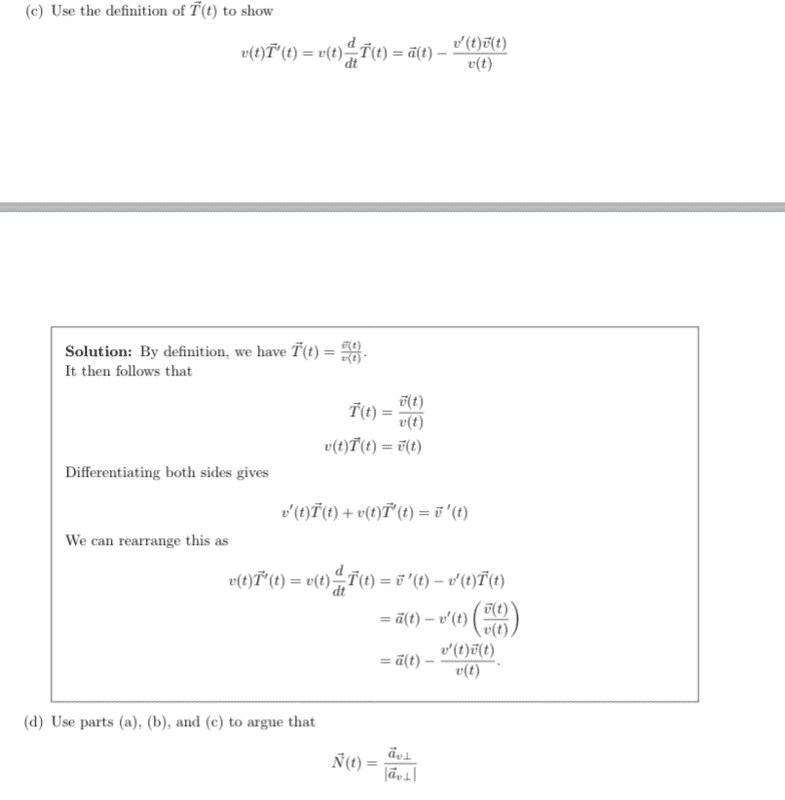
$$v(t)\vec{T'}(t) = \vec{a}(t) - \frac{v'(t)\vec{v'}(t)}{v(t)}$$
I need to prove this using the given equations.
$$\vec{N}(t) = \frac{\vec{a}_{v\perp}}{|\vec{a}_{v\perp}|}$$

Here is the entirety of my work up to this point. So far I've wanted to use what I have to find something that is perpendicular to the velocity vector and maybe show that with the dot product but no luck so far and I'm pretty stuck. Any hints to get me started?
Screen Shot 2020-01-25 at 9.51.31 PM.png
Screen Shot 2020-01-25 at 9.51.40 PM.png
 
Physics news on Phys.org
It will be easier to help with this if some context is provided. Presumably ##t## is time and ##\vec a(t),\vec v(t)## are the acceleration and velocity of a particle, but what do ##\vec T(t), \vec N(t),\vec a_{v\bot}## and the scalar ##v(t)## represent?
 
Ok so ##\vec{T}(t)##, ##\vec{N}(t)##, and ##\vec{a}_{v\perp}## arent ever mentioned in any previous problem for this homework, but in the text they are given as:

##\vec{T}(t) = \frac{\vec{v}(t)}{v(t)}## so a unit vector in the direction of the velocity vector.

##\vec{N}(t) = \frac{\vec{T}'(t)}{|\vec{T}'(t)|}## which I'm a little unclear on but I think its a unit vector perpendicular to the plane created by the velocity and acceleration vectors.

##v(t)## is just the speed or magnitude of the velocity vector ##\vec{v}(t)##.

And I THINK ##\vec{a}_{v\perp}## is a vector perpendicular to the velocity and acceleration vectors but the homework nor the book goes over this.
 
opus said:
Ok so ##\vec{T}(t)##, ##\vec{N}(t)##, and ##\vec{a}_{v\perp}## arent ever mentioned in any previous problem for this homework, but in the text they are given as:

##\vec{T}(t) = \frac{\vec{v}(t)}{v(t)}## so a unit vector in the direction of the velocity vector.
AKA the unit tangent vector, thus the name T.
opus said:
##\vec{N}(t) = \frac{\vec{T}'(t)}{|\vec{T}'(t)|}## which I'm a little unclear on but I think its a unit vector perpendicular to the plane created by the velocity and acceleration vectors.
The unit normal vector, thus the name N. The N vector is perpendicular to the tangent plane at a particular point. The acceleration could be in the same direction as the velocity vector, so it (acceleration) doesn't necessarily define a normal vector.
opus said:
##v(t)## is just the speed or magnitude of the velocity vector ##\vec{v}(t)##.

And I THINK ##\vec{a}_{v\perp}## is a vector perpendicular to the velocity and acceleration vectors but the homework nor the book goes over this.
Maybe or maybe not, as the acceleration and velocity could be in the same direction.
 
Thanks Mark that is more clear! Going to keep plugging at this to see what I can get
 
opus said:
And I THINK →av⊥a→v⊥\vec{a}_{v\perp} is a vector perpendicular to the velocity and acceleration vectors but the homework nor the book goes over this.
It is the component of acceleration orthogonal to the velocity. In other words, the acceleration minus any component aceleration has in the velocity direction.
 
It seems like it may be a setup for the Frenet-Serret frames for space curves? Any chance they are mentioned on this or upcoming chapters ( maybe check the index?)?
 
You may notice from it's definition that ##\vec{N}## is in the direction of ##\vec{T'}##. So you just have to figure out the magnitude of ##\vec{T'}## and combine it with the third formula you derived.

So analyze the third formula. Notice that ##\vec{a}_{v\perp}## is the component of acceleration that is perpendicular to velocity, as Orodruin pointed out. So this component is just full acceleration minus the component of acceleration that is tangential to velocity(usually called tangential acceleration).

Now tangential acceleration has magnitude ##v'(t)##, because it is the component that actually varies the magnitude of velocity, while the perpendicular component changes its direction. So we have that:
$$\vec{a}_{v\perp} = \vec{a} - \vec{a}_{v}$$
$$\vec{a}_{v} = v'(t)\vec{T}(t)$$
in your notation.
Compare this to the formulas you have, and the solution should be pretty obvious.
 

Similar threads

Replies
26
Views
2K
  • · Replies 9 ·
Replies
9
Views
2K
  • · Replies 24 ·
Replies
24
Views
4K
  • · Replies 7 ·
Replies
7
Views
1K
  • · Replies 17 ·
Replies
17
Views
2K
  • · Replies 4 ·
Replies
4
Views
2K
  • · Replies 6 ·
Replies
6
Views
2K
  • · Replies 35 ·
2
Replies
35
Views
4K
  • · Replies 12 ·
Replies
12
Views
3K
  • · Replies 5 ·
Replies
5
Views
4K