Multivariable Differentiation - Component Functions ....

Click For Summary

Discussion Overview

The discussion centers around the proof of Proposition 2.2.9 from "Multidimensional Real Analysis I: Differentiation" by J. J. Duistermaat and J. A. C. Kolk, specifically regarding the differentiability of component functions of a multivariable function. Participants explore the implications of differentiability, the relationship between total differentiability and the differentiability of component functions, and seek clarification on specific mathematical statements.

Discussion Character

  • Technical explanation
  • Conceptual clarification
  • Debate/contested

Main Points Raised

  • Some participants explain that differentiability of a function involves a limit condition, and that the differentiability of the overall function implies the differentiability of its component functions.
  • Others note that Proposition 2.2.9 pertains specifically to component functions and not to partial derivatives, highlighting the differences in implications between total differentiability and partial differentiability.
  • A participant seeks clarification on the assertion that the linearity of the derivative of the overall function implies the linearity of the derivatives of the component functions.
  • Another participant responds by explaining that a linear map can be represented in coordinates as a matrix, and that each row corresponds to a linear map for the component functions.

Areas of Agreement / Disagreement

Participants generally agree on the definitions and implications of differentiability, but there are points of clarification and exploration regarding the relationships between total differentiability and the differentiability of component functions, indicating that some aspects of the discussion remain contested or unresolved.

Contextual Notes

Participants express uncertainty about the implications of certain mathematical statements and the relationships between differentiability concepts, which may depend on specific definitions and assumptions not fully articulated in the discussion.

Math Amateur
Gold Member
MHB
Messages
3,920
Reaction score
48
I am reading "Multidimensional Real Analysis I: Differentiation" by J. J. Duistermaat and J. A. C. Kolk ...

I am focused on Chapter 2: Differentiation ... ...

I need help with the proof of Proposition 2.2.9 ... ...

Duistermaat and Kolk's Proposition 2.2.9 read as follows:
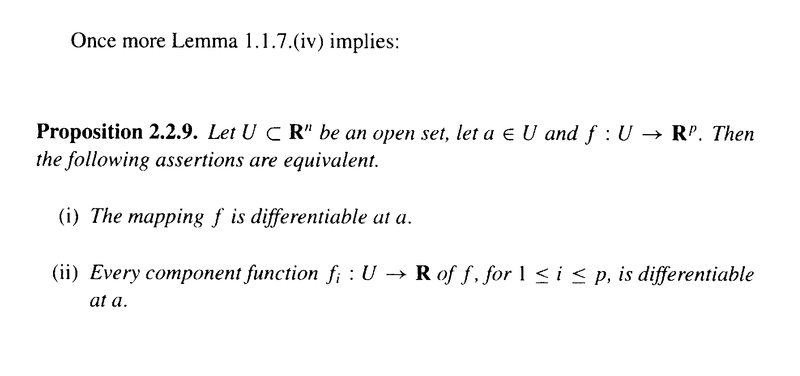
D&K - 1 - Proposition 2.2.9 ...  .... PART 1 ... .png

In the above text D&K state that Lemma 1.1.7 (iv) implies Proposition 2.2.9 ...

Can someone please indicate how/why ths is the case ...

Peter
===========================================================================================The above post mentions Lemma 1.1.7 ... so I am providing the text of the same ... as follows:
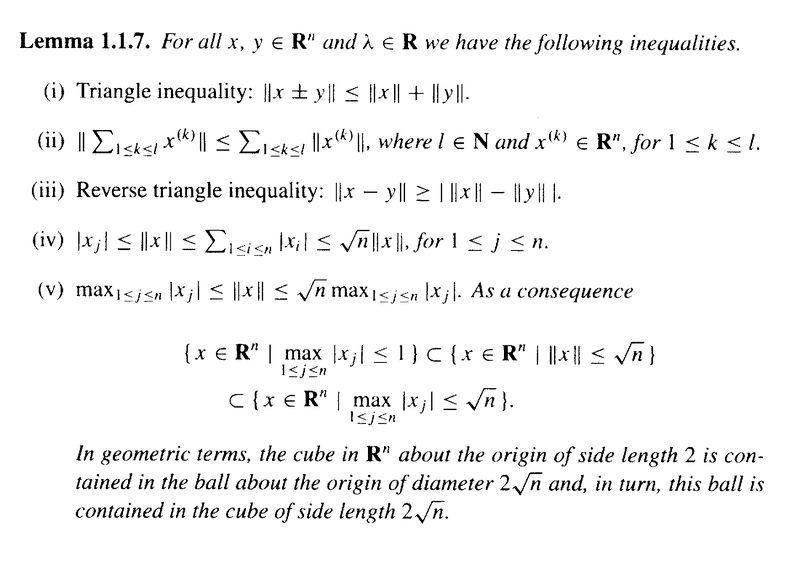
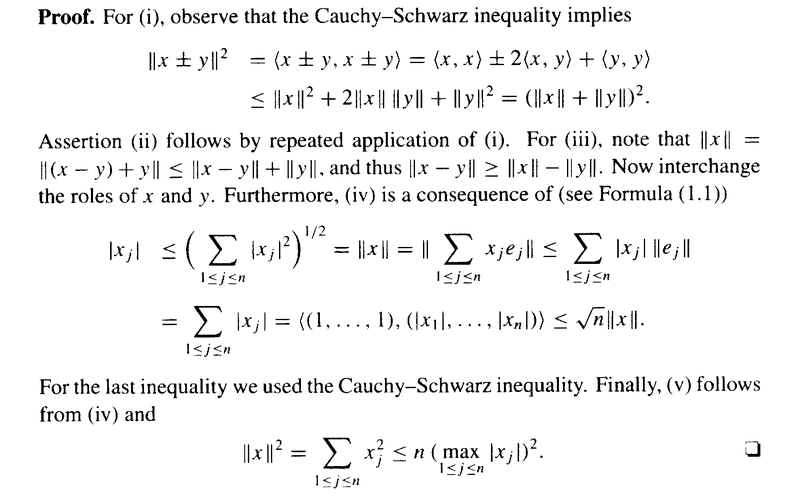
D&K - 1 -  Lemma 1.1.7 ... PART 1 ... .png

D&K - 2 -  Lemma 1.1.7 ... PART 2 ... . .png
 

Attachments

  • D&K - 1 - Proposition 2.2.9 ...  .... PART 1 ... .png
    D&K - 1 - Proposition 2.2.9 ... .... PART 1 ... .png
    12.8 KB · Views: 563
  • D&K - 1 -  Lemma 1.1.7 ... PART 1 ... .png
    D&K - 1 - Lemma 1.1.7 ... PART 1 ... .png
    30.3 KB · Views: 563
  • D&K - 2 -  Lemma 1.1.7 ... PART 2 ... . .png
    D&K - 2 - Lemma 1.1.7 ... PART 2 ... . .png
    29.9 KB · Views: 654
Physics news on Phys.org
Differentiability of a function ##g(x)## means: ##g(a+v)-g(a)-((D_a)(g))(v) = \varepsilon_a(v)## with ##\lim_{v \to 0}\dfrac{\varepsilon_a(v)}{||\varepsilon_a(v)||}=0\,.##
Now ##D_a(f_i)## are all linear iff ##D_a(f)## is. With the lemma we get
$$
|f_i(a+v)-f_i(a)-((D_a)(f_i))(v)| \leq \sqrt{n}\cdot ||f(a+v)-f(a)-((D_a)(f))(v)|| = \sqrt{n} \cdot ||\varepsilon_a(v)|| =: || \psi_a(v)||
$$
with ##\psi_a = \sqrt{n}\cdot \varepsilon_a## and ##\lim_{v\to 0}\dfrac{\psi_a(v)}{||\psi_a(v)||} = 0##, i.e. the differentiability of ##f## gives the differentiability of the component functions ##f_i\,.## The other inequality ##||y|| \leq |\sum_{i=1}^n\,y_i|## gives the other estimation ##||f(a+v)-f(a)-((D_a)(f))(v)|| \leq \sum \ldots ## with ##\varepsilon_a(v)= \sum (\varepsilon_i)_a (v_i)\,.##

As an important note here: Proposition 2.2.9 is about the component functions of ##f##, not the partial derivatives, i.e. not about the components of ##x##. The situation with partial derivatives is less strong:
  • Total differentiability implies continuity.
  • Total differentiability implies partial differentiability in all coordinates.
  • Partial differentiability does not imply continuity and thus not total differentiability.
  • Continuous partial differentiability, i.e. functions with continuous partial derivatives are also continuous total differentiable.
 
  • Like
Likes   Reactions: Math Amateur
fresh_42 said:
Differentiability of a function ##g(x)## means: ##g(a+v)-g(a)-((D_a)(g))(v) = \varepsilon_a(v)## with ##\lim_{v \to 0}\dfrac{\varepsilon_a(v)}{||\varepsilon_a(v)||}=0\,.##
Now ##D_a(f_i)## are all linear iff ##D_a(f)## is. With the lemma we get
$$
|f_i(a+v)-f_i(a)-((D_a)(f_i))(v)| \leq \sqrt{n}\cdot ||f(a+v)-f(a)-((D_a)(f))(v)|| = \sqrt{n} \cdot ||\varepsilon_a(v)|| =: || \psi_a(v)||
$$
with ##\psi_a = \sqrt{n}\cdot \varepsilon_a## and ##\lim_{v\to 0}\dfrac{\psi_a(v)}{||\psi_a(v)||} = 0##, i.e. the differentiability of ##f## gives the differentiability of the component functions ##f_i\,.## The other inequality ##||y|| \leq |\sum_{i=1}^n\,y_i|## gives the other estimation ##||f(a+v)-f(a)-((D_a)(f))(v)|| \leq \sum \ldots ## with ##\varepsilon_a(v)= \sum (\varepsilon_i)_a (v_i)\,.##

As an important note here: Proposition 2.2.9 is about the component functions of ##f##, not the partial derivatives, i.e. not about the components of ##x##. The situation with partial derivatives is less strong:
  • Total differentiability implies continuity.
  • Total differentiability implies partial differentiability in all coordinates.
  • Partial differentiability does not imply continuity and thus not total differentiability.
  • Continuous partial differentiability, i.e. functions with continuous partial derivatives are also continuous total differentiable.
Thanks fresh_42 ... for such a clear explanation ...

Just a point of clarification ... ...

You write:

" ... ... Now ##D_a(f_i)## are all linear iff ##D_a(f)## is. ... ... "Can you explain how we know this is true ...

Peter
 
If we have a linear map ##D_a(f)## then this is in coordinates a matrix. And each row ##D_a(f_i)## defines a linear map ##v \mapsto D_a(f_i) \cdot v^\tau = \langle D_a(f_i),v\rangle\,.## And this goes back in the other direction the same way: If we have ##p## linear maps ##D_a(f_i) \, : \, \mathbb{R}^n \longrightarrow \mathbb{R}^1## then they can always be written as ##D_a(f_i)(v)=v_i\cdot v^\tau = \langle v_i,v \rangle## and the ##v_i## give us the rows for ##D_a(f)##. (Here vectors ##w## are rows and ##w^\tau## columns.)
 
  • Like
Likes   Reactions: Math Amateur
Thanks fresh_42 ... appreciate the help ...

Reflecting on what you have written ...

Thanks again ...

Peter
 

Similar threads

Replies
1
Views
1K
Replies
1
Views
2K
Replies
4
Views
2K
  • · Replies 2 ·
Replies
2
Views
2K
  • · Replies 3 ·
Replies
3
Views
2K
Replies
1
Views
2K
  • · Replies 2 ·
Replies
2
Views
1K
  • · Replies 1 ·
Replies
1
Views
2K
  • · Replies 2 ·
Replies
2
Views
1K
  • · Replies 5 ·
Replies
5
Views
2K