NASA's Black Hole Visualization/Explanation

  • Context: Undergrad 
  • Thread starter Thread starter BillTre
  • Start date Start date
  • Tags Tags
    Black hole Hole
Click For Summary
SUMMARY

The forum discussion centers on NASA's black hole visualization, specifically the first-ever photograph of a supermassive black hole released by the Event Horizon Telescope Collaboration (EHT) on April 10, 2019. The EHT team was awarded a $3 million Breakthrough Prize for this achievement, which involved 347 scientists. Participants in the discussion raised questions about the accuracy of the visual representation, particularly regarding the speed of matter in the accretion disk and the implications of redshift and blueshift in the image. The conversation highlights the complexities of black hole physics and the importance of critical analysis of scientific visuals.

PREREQUISITES
  • Understanding of black hole physics, including supermassive black holes
  • Familiarity with concepts of redshift and blueshift in astrophysics
  • Knowledge of the Event Horizon Telescope and its imaging techniques
  • Basic principles of gravity and orbital mechanics
NEXT STEPS
  • Research the Event Horizon Telescope imaging techniques and their significance in astrophysics
  • Explore the physics of accretion disks around black holes
  • Study the effects of redshift and blueshift on astronomical observations
  • Learn about the criteria for classifying black holes, including mass and spin
USEFUL FOR

Astronomy enthusiasts, astrophysicists, educators, and students interested in black hole research and visualization techniques will benefit from this discussion.
BillTre
Science Advisor
Gold Member
Messages
2,736
Reaction score
11,957
TL;DR
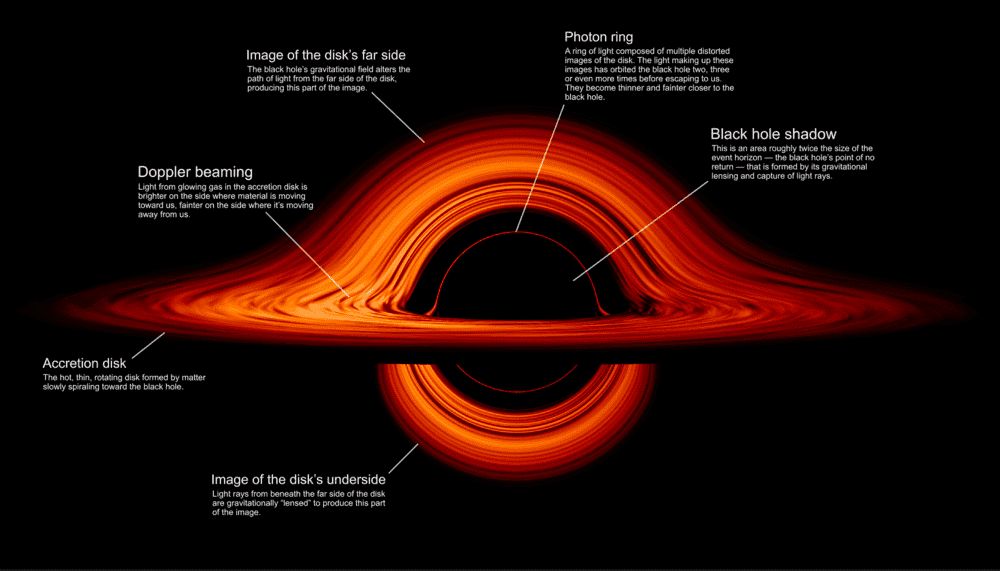
NASA's video and annotated image of a black hole simulation.
NASA's website has a video and annotated image of a black hole simulation.
It is here.

I found the explanations of some aspects of the weirdness of black hole images interesting, but I'm no expert on these things.

Screen Shot 2019-09-26 at 9.42.01 AM.png
 
  • Like
Likes   Reactions: cobalt124, DifferentialGalois, .Scott and 3 others
Astronomy news on Phys.org
I found this:

The Team Behind The First Black Hole Image Was Just Awarded $3 Million Prize
BI-logo-50x50.gif

ARIA BENDIX, BUSINESS INSIDER
6 SEP 2019
The heart of every major galaxy is thought to contain a supermassive black hole – a place where gravity is so strong that anything, including light, gets devoured.
Like all black holes, supermassive ones form when stars collapse in on themselves at the end of their life cycles. On average, they're millions of times more massive than the Sun.
[. . . ]
But on April 10, a group of scientists from the international Event Horizon Telescope Collaboration released the first-ever photograph of a supermassive black hole to the public. Though the image was fuzzy, it signified a major milestone for space research.
The accomplishment has now earned the team a 2020 Breakthrough Prize, which was awarded on September 5. The prize was started eight years ago by a team of investors including Sergey Brin and Mark Zuckerberg, and is often referred to as the "Oscars of Science".
The Event Horizon Telescope Collaboration (EHT) team will collectively receive US$3 million, but the money will be divided equally among the group's 347 scientists, giving each person around US$8,600.
[. . .]
https://www.sciencealert.com/the-fi...am-were-just-awarded-a-3-million-dollar-prize
p.s. I'm going to move over in a few days. My husband finally bought me my own computer. I'm typing on his right now. Please be quite because I don't want him to find me out. :biggrin:
 
  • Like
Likes   Reactions: neilparker62
Mary Conrads Sanburn said:
Please be quite because I don't want him to find me out.
$$ ➡ 🤏🤐

Lol. . . JK

.
 
Last edited:
  • Like
Likes   Reactions: jedishrfu
Mary Conrads Sanburn said:
p.s. I'm going to move over in a few days. My husband finally bought me my own computer. I'm typing on his right now. Please be quite because I don't want him to find me out. :biggrin:

Just tell him you're studying an important event that's on the horizon :wink:
 
  • Like
  • Haha
Likes   Reactions: Comeback City, pinball1970, jedishrfu and 1 other person
There are a couple things that seem a little misleading, first is the speed of rotation of the matter on the accretion disk (if the supermassive Black hole's EH is ~20 million mile in diameter, it looks like the matter is rotating at well over 150 times the speed of light), and the second is the huge amount of "stuff" that appears to be violently rotating so near to the event horizon.

I know this is done for illustration purposes only, but most people will take stuff coming out of NASA at face value and consider it officially true.
 
Staticboson said:
it looks like the matter is rotating at well over 150 times the speed of light),
How do you figure that?
 
  • Like
Likes   Reactions: BillTre
Assuming 30 million mile EH in diameter for a relatively small supermassive black hole (or 94 million mile circumference) and roughly timing the period of stuff rotating around the BH in the movie clip at 4 seconds, gives me about 24,000,000 miles/sec.
 
Last edited:
  • Like
Likes   Reactions: Dale
Staticboson said:
in the movie clip
Ah, I didn’t see the movie, I was just looking at the still picture.
 
  • #10
No one wants to watch this animation drawn out over a day. Alternatively, we can say it is an intermediate mass black hole.
Staticboson said:
and the second is the huge amount of "stuff" that appears to be violently rotating so near to the event horizon
Compared to what? How much stuff is there, how much stuff do you expect?
 
  • #11
mfb said:
No one wants to watch this animation drawn out over a day. Alternatively, we can say it is an intermediate mass black hole.Compared to what? How much stuff is there, how much stuff do you expect?

My bad, I thought I read supermassive black hole somewhere, but I went back to the article and found no such reference. Assuming the matter in the disk is rotating at nearly the speed of light like the article mentions, working it backwards I get a black hole of around 150,000 miles in diameter, so it is a small one.

My understanding on supermassive black holes is that there is very little matter rotating comparatively close to the BH, that it is relatively quiet nearby (comparing black hole size with accretion disc size), but since it is not a supermassive BH, then I don't know.

I wonder though, instead of being brighter as the picture indicates, wouldn't the portion of the stream moving away from us be significantly redshifted, and the portion moving towards us significantly blueshifted, considering it is moving at nearly the speed of light?
 
  • Like
Likes   Reactions: BillTre
  • #12
They don't give a mass, but it shouldn't matter as the accretion disk should be roughly scale-invariant if we scale the time accordingly.
There is no absolute scale for the amount of matter either, we just see it is enough to form a nice accretion disk.
Staticboson said:
I wonder though, instead of being brighter as the picture indicates, wouldn't the portion of the stream moving away from us be significantly redshifted, and the portion moving towards us significantly blueshifted, considering it is moving at nearly the speed of light?
The part moving towards us (left) is brighter than the part moving away (right). As it is a false color image you don't see red/blueshift directly.
 
  • #13
Why is this:
Staticboson said:
My understanding on supermassive black holes is that there is very little matter rotating comparatively close to the BH, that it is relatively quiet nearby (comparing black hole size with accretion disc size), but since it is not a supermassive BH, then I don't know.
Is this because it would take super-c speeds to orbit near a large enough black hole?
Thinking geometrically (I'm only a biologist), the orbit speed would have to increase to orbit a larger black hole. A larger black hole's orbit would have less curvature, so an orbiting object would have to go faster to make up for rate of fall from gravity.
Does this make sense?

Also, regardless of the orbiting matter, it seems like a lot of the light given off by the orbiting stuff (as shown by the orbiting lite-up blobs) would fall into the black hole, decreasing the total amount substance in orbit.
 
  • #14
The ratio of innermost stable orbit to the Schwarzschild radius, and also the speed of the innermost stable orbit, are independent of the mass of the black hole. They depend on the spin to mass ratio only. This black hole here has zero spin.
 

Similar threads

  • · Replies 20 ·
Replies
20
Views
3K
  • · Replies 5 ·
Replies
5
Views
3K
  • · Replies 9 ·
Replies
9
Views
2K
  • · Replies 17 ·
Replies
17
Views
5K
  • · Replies 27 ·
Replies
27
Views
5K
  • · Replies 5 ·
Replies
5
Views
2K
  • · Replies 4 ·
Replies
4
Views
2K
  • · Replies 6 ·
Replies
6
Views
2K
  • · Replies 11 ·
Replies
11
Views
3K
  • · Replies 10 ·
Replies
10
Views
2K