Maty
- 26
- 0
Hi. I'm building a small automated robot that will only work with 2 motor, 2 wheels, and 2 sensors. My goal here is for this little robot to make through a track without falling off. Here's a little sketch I drew on Paint to help understand what I'm saying.
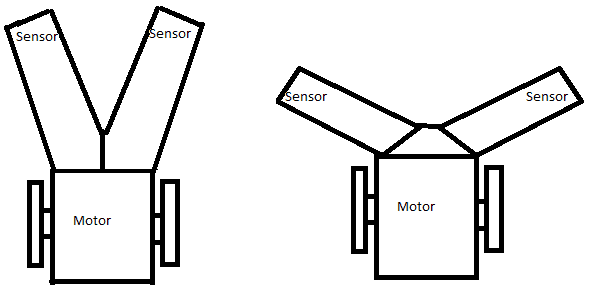
Each sensor will be connected to a motor. So the sensor on the left connects to the right wheel/motor, so when the sensor goes out of bound, the right wheel stops and the bot turns right. The sensor are just "clickers." The track is off ground so when the sensor is pressed down, the wheels move, when the sensor goes out of bound it click itself off and the wheel stops. But this is not the important part.
My question is at what angle and how long should the arms holding sensor should be? The width of the entire base is just about 10 cm, so it is not very big. And the track is about 3 times the with, a little more.
Now the track consists of some 90 degree turns. And a wavy zigzag portion where it goes from left turns to right turns very quickly but the turns aren't 90 degrees, it's a smooth turn.
My theory is that if the arms are closer together (less angle) then it will be able to detect the corners quicker and turn before hand, but once you hit the wavy zigzag turns, one of the wheel falls behind. But if the sensors are very wide (right picture) then it will turn much more efficient but it won't be very good at those 90 degree turns. And then I have no idea of whether the arms should be very long or short. Probably a medium size is good. Too long and the wheels will follow too far behind, but too close and it might just overrun a corner.
So if anyone can help me, i'd really appreciate it.
What is a good angle to put the sensors apart?
How long should the arms be?
Each sensor will be connected to a motor. So the sensor on the left connects to the right wheel/motor, so when the sensor goes out of bound, the right wheel stops and the bot turns right. The sensor are just "clickers." The track is off ground so when the sensor is pressed down, the wheels move, when the sensor goes out of bound it click itself off and the wheel stops. But this is not the important part.
My question is at what angle and how long should the arms holding sensor should be? The width of the entire base is just about 10 cm, so it is not very big. And the track is about 3 times the with, a little more.
Now the track consists of some 90 degree turns. And a wavy zigzag portion where it goes from left turns to right turns very quickly but the turns aren't 90 degrees, it's a smooth turn.
My theory is that if the arms are closer together (less angle) then it will be able to detect the corners quicker and turn before hand, but once you hit the wavy zigzag turns, one of the wheel falls behind. But if the sensors are very wide (right picture) then it will turn much more efficient but it won't be very good at those 90 degree turns. And then I have no idea of whether the arms should be very long or short. Probably a medium size is good. Too long and the wheels will follow too far behind, but too close and it might just overrun a corner.
So if anyone can help me, i'd really appreciate it.
What is a good angle to put the sensors apart?
How long should the arms be?