Need help calculating Shear on a 5/8 square key

  • Thread starter Thread starter vwmeche94
  • Start date Start date
  • Tags Tags
    Shear Square
Click For Summary
SUMMARY

This discussion focuses on calculating the shear stress on a 5/8" x 5/8" x 3-1/2" standard shaft key when subjected to a load of 20,000 lbs from a 40" diameter tire. The calculation involves determining the maximum shear force (F_shaft) applied to the key using the relationship between torque and force, where torque equals force times distance. The shear stress is calculated using the formula shear_stress = F_shaft / A_shear, with A_shear defined as 5/8" x 3.5". It is recommended to limit the calculated shear stress to 40% of the yield stress of the shaft key to ensure safe design.

PREREQUISITES
  • Understanding of shear stress and shear force concepts
  • Familiarity with torque calculations
  • Knowledge of material yield stress
  • Basic geometry of shaft keys and their dimensions
NEXT STEPS
  • Research the yield stress values for common materials used in shaft keys
  • Learn about torque calculations in mechanical systems
  • Explore shear stress analysis techniques in engineering
  • Investigate safety factors in mechanical design
USEFUL FOR

Mechanical engineers, design engineers, and anyone involved in the design and analysis of mechanical systems that utilize shaft keys and experience shear forces.

vwmeche94
Messages
10
Reaction score
0
Need help calculating Shear on a 5/8" square key

PF,

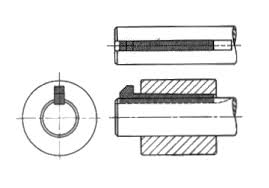
I am trying to figure out how to calculate the shear on a 5/8" x 5/8" x 3-1/2"L standard shaft key, when the OD of the shaft it fits into is 3". A tire of ~40" dia rides on the shaft and at any given time, let's say a load of 20,000lbs is applied to put a bending moment on the shaft at the surface of the tire. If I assume the shaft is fixed for brief moment in time,
what is the maximum shear I can apply to the key before it gives (breaks)?
images?q=tbn:ANd9GcTL_kFl547fuomTeDcoE1ll-H6eooum7nRPj0uLDfjtfveeqxXulQ.jpg
 
Engineering news on Phys.org


A simple approach is as follows:

For the shaft to be "fixed for a brief moment" the net torque must equal zero:

So torque = F X Distance = F_tire X radius_tire = F_shaft X radius_shaft

Solve for F_shaft.

Now F_shaft will be applied in shear to your shaft key. The area in shear is : A_shear = 5/8" X 3.5 ".

And the shear stress is now:

shear_stress = F_shaft / A_shear.

When shear_stress is greater then the tensile shear stress of the shaft key, it will break (in principle).

For design, it is better to limit the calculated shear stress to about 40% of the yield stress.
 

Similar threads

Replies
2
Views
3K
Replies
17
Views
15K
  • · Replies 2 ·
Replies
2
Views
2K
  • · Replies 4 ·
Replies
4
Views
3K
  • · Replies 5 ·
Replies
5
Views
6K
Replies
8
Views
6K
Replies
12
Views
2K
  • · Replies 3 ·
Replies
3
Views
6K
  • · Replies 3 ·
Replies
3
Views
4K
  • · Replies 5 ·
Replies
5
Views
6K