How High Should the Cable Be Anchored for Equilibrium?

Click For Summary
SUMMARY

The discussion centers on calculating the minimum height for anchoring a cable to ensure equilibrium for a sign and rod system. The system consists of a 65 kg sign and a 9.8 kg rod, with a maximum cable tension of 760 N. The key equation derived involves balancing the torques around the pivot point, leading to the formula: (Force of sign)(Radius of sign) + (Force of rod)(Radius of rod) - (vertical component of Tension) * distance = 0. Participants emphasize the importance of considering only the vertical component of tension for torque calculations.

PREREQUISITES
  • Understanding of torque and equilibrium principles in physics
  • Knowledge of forces and their components, specifically vertical and horizontal
  • Familiarity with basic mechanics equations, including tension and weight calculations
  • Ability to set up and solve equations involving multiple forces and distances
NEXT STEPS
  • Study the concept of torque and its application in static equilibrium problems
  • Learn how to resolve forces into their vertical and horizontal components
  • Explore the principles of tension in cables and their limits in structural applications
  • Practice solving similar problems involving multiple forces and pivot points
USEFUL FOR

Students and professionals in physics, engineering, or architecture who are involved in structural analysis and equilibrium calculations will benefit from this discussion.

jtulibarri
Messages
2
Reaction score
0
a 65 kg sign hung centered from a uniform rod of mass 9.8 kg and length 2.3 m. At one end(left) the rod is attached to the wall by a pivot; at the other end(right) it's supported by a cable that can withstand a maximum tension of 760 N. What is the minimum height h above the pivot for anchoring the cable to the wall?
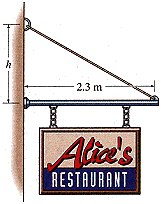
14-49.gif


i need help on setting up an equation to solve...
what i have so far i don't know how wrong or right it is.


(Force of sign)(Radius of sign)+(Force of rod)(Radius of rod)-(Tension)=0
(637N)(1.15m)+(96.04N)(1.15m)-m*g*sin(angle away from wall)=0

? i don't really know exactly where I am going with this
 
Physics news on Phys.org
jtulibarri said:
(Force of sign)(Radius of sign)+(Force of rod)(Radius of rod)-(Tension)=0
(637N)(1.15m)+(96.04N)(1.15m)-m*g*sin(angle away from wall)=0

? i don't really know exactly where I am going with this

you need the torque about that point to be zero... so you need:

(Force of sign)(Radius of sign)+(Force of rod)(Radius of rod)-(vertical component of Tension)*distance=0

(since horizontal component of tension exerts 0 torque about the pivot)

what is the vertical component of Tension in terms of the total tension T... what is the distance here?
 

Similar threads

  • · Replies 7 ·
Replies
7
Views
3K
Replies
6
Views
2K
  • · Replies 2 ·
Replies
2
Views
1K
Replies
1
Views
4K
  • · Replies 7 ·
Replies
7
Views
4K
  • · Replies 6 ·
Replies
6
Views
2K
Replies
13
Views
2K
  • · Replies 6 ·
Replies
6
Views
4K
  • · Replies 18 ·
Replies
18
Views
3K
  • · Replies 5 ·
Replies
5
Views
3K