Need help understanding proof that continuous functions are integrable

Click For Summary
SUMMARY

The discussion centers on the proof that uniformly continuous functions are Riemann integrable, specifically referencing Theorem 3.29 from the lecturer's notes. Participants clarify that the definition of L is the infimum of upper Riemann sums for various partitions, not the set of all upper sums. The conversation also addresses the derivation of inequalities in the proof, emphasizing the importance of both upper and lower bounds to establish convergence to zero. The confusion surrounding the proof's structure and the role of partitions is a common challenge among students.

PREREQUISITES
  • Understanding of Riemann sums and partitions in calculus
  • Familiarity with the concept of uniform continuity
  • Knowledge of supremum and infimum in mathematical analysis
  • Basic principles of inequalities in mathematical proofs
NEXT STEPS
  • Study the definition and properties of Riemann integrability
  • Learn about the implications of uniform continuity on function behavior
  • Explore the concept of partitions and their refinements in calculus
  • Investigate the role of inequalities in establishing convergence in proofs
USEFUL FOR

Students of calculus and real analysis, particularly those grappling with the concepts of Riemann integrability and uniform continuity, as well as educators seeking to clarify these topics in their teaching.

chipotleaway
Messages
174
Reaction score
0
Actually, the theorem is that functions that are uniformly continuous are Riemann integrable, but not enough room in the title!

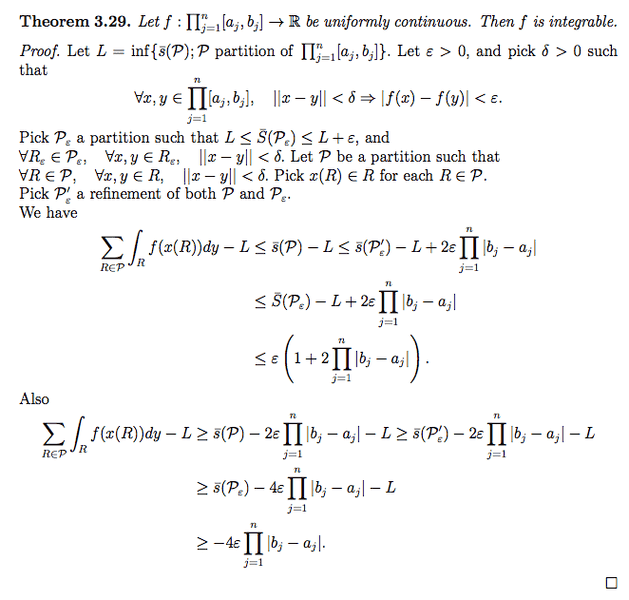
I'm failing to see the motivation behind proof given in my lecturer's notes (page 35, Theorem 3.29) and also do not understand the steps.
18m0t5.jpg


1) First thing I'm not sure I understand is in the first line of the proof - the definition of L. I think this is the set of all upper Riemann sums corresponding to different partitions, because for a given partition P, isn't the upper Riemann sum of f over P unique?
Then taking the infimum of the set would be taking the smallest upper Riemann sum.

2) I have no idea how the chain of inequalities come about, not even the first one.

3) Isn't the proof done by line 3 of the inequalities (before 'Also')? What do the last 3 lines show?

Any help is much appreciated - these proofs are doing my head in.
 
Physics news on Phys.org
chipotleaway said:
Actually, the theorem is that functions that are uniformly continuous are Riemann integrable, but not enough room in the title!

I'm failing to see the motivation behind proof given in my lecturer's notes (page 35, Theorem 3.29) and also do not understand the steps.

18m0t5.jpg

I'm going to assume that all instances of ##\bar S## are typos and should have been ##\bar s##.

1) First thing I'm not sure I understand is in the first line of the proof - the definition of L. I think this is the set of all upper Riemann sums corresponding to different partitions, because for a given partition P, isn't the upper Riemann sum of f over P unique?
Then taking the infimum of the set would be taking the smallest upper Riemann sum.

##L## is not the set of all upper sums. Rather it is the infimum of that set.

Given a partition ##\mathcal{P}##, ##\bar s(\mathcal{P})## is a number. It's the supremum (you can prove it's actually the max) of all Riemann sums with sample points chosen according to the partition. I personally wouldn't use the word "unique" to describe a number. Maybe "well-defined" ...

2) I have no idea how the chain of inequalities come about, not even the first one.

The first inequality follows from the fact that ##\bar s(\mathcal{P})## is the max of all Riemann sums with sample points chosen according to ##\mathcal{P}##.

I have not worked out the details, but the second inequality almost certainly follows from the uniform continuity condition and the fact that ##\mathcal{P}_{\epsilon}'## is a refinement of ##\mathcal{P}##. While ##\bar s(\mathcal{P}_\epsilon ')\leq\bar s(\mathcal{P})## (a refinement results in a smaller upper sum), ##2\epsilon\Pi|b_j-a_j|## is (supposedly ... again I haven't checked the details) enough of a buffer to get the given inequality.

The third inequality follows from the fact that ##\bar s(\mathcal{P}_\epsilon ')\leq\bar s(\mathcal{P}_\epsilon )##, which is true because ... I'll let you figure that out. Hint: I already gave you the answer.

The last inequality is true because ##\bar s(\mathcal{P}_\epsilon)-L\leq\epsilon## from the definition of ##\mathcal{P}_\epsilon##.

3) Isn't the proof done by line 3 of the inequalities (before 'Also')? What do the last 3 lines show?


The first round of inequalities establishes an upper bound on ##\sum_{R\in\mathcal{P}}f(x(R))\int_R\ dy-L##. The second batch gives a lower bound. You need both to establish ##\sum_{R\in\mathcal{P}}f(x(R))\int_R\ dy-L\rightarrow 0##.
 
  • Like
Likes   Reactions: 1 person
Thanks a lot gopher, think I get it now. I'd thought the partition P had to be the one that gave the smallest Riemann sum and this was one of things that was making it confusing. By the way, the 2ε∏|b-a| term results from the previous lemma in the notes.

I still don't see how he came up with the proof though that applies for the majority of calculus/analysis proofs I work through - it's all stuff I could never come up with (proofs in linear algebra at this level, I find much more doable).
 

Similar threads

  • · Replies 4 ·
Replies
4
Views
2K
  • · Replies 3 ·
Replies
3
Views
2K
  • · Replies 7 ·
Replies
7
Views
3K
  • · Replies 6 ·
Replies
6
Views
4K
  • · Replies 5 ·
Replies
5
Views
2K
  • · Replies 3 ·
Replies
3
Views
3K
  • · Replies 23 ·
Replies
23
Views
4K
  • · Replies 11 ·
Replies
11
Views
7K
  • · Replies 7 ·
Replies
7
Views
2K
  • · Replies 11 ·
Replies
11
Views
2K