MHB Need Support? Discover How to Get Help!

  • Thread starter Thread starter jaychay
  • Start date Start date
  • Tags Tags
    Support
Click For Summary
The discussion revolves around evaluating the limit of a mathematical expression involving factorials and polynomial terms as k approaches infinity. The key focus is on simplifying the given limit and understanding its implications for a positive termed series. Participants are encouraged to analyze the behavior of the terms in the limit to draw conclusions about convergence or divergence. The mention of absolute values suggests a clarification that they may be unnecessary in this context. Ultimately, the goal is to determine the limit's value and its significance in the context of series evaluation.
jaychay
Messages
58
Reaction score
0
q4.png


Please help me
Thank you in advance
 
Physics news on Phys.org
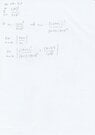
IMG_20210824_0002.jpg

This is my work
I am struggle at this point
 
\[ \lim_{k \to \infty} \left| \frac{[3(k+1)]!}{(k+1)(k+2)} \cdot \frac{k(k+1)}{(3k)!} \right| \]

\[ \lim_{k \to \infty} \left| \frac{k(3k+3)(3k+2)(3k+1)}{(k+2)}\right| \]

evaluate the limit ... what can you conclude?
 
Also, keep in mind it's a positive termed series, so the absolute values (while not incorrect) are unnecessary.
 
We all know the definition of n-dimensional topological manifold uses open sets and homeomorphisms onto the image as open set in ##\mathbb R^n##. It should be possible to reformulate the definition of n-dimensional topological manifold using closed sets on the manifold's topology and on ##\mathbb R^n## ? I'm positive for this. Perhaps the definition of smooth manifold would be problematic, though.

Similar threads

  • · Replies 11 ·
Replies
11
Views
2K
  • · Replies 12 ·
Replies
12
Views
2K
Replies
3
Views
2K
  • · Replies 2 ·
Replies
2
Views
2K
  • · Replies 6 ·
Replies
6
Views
2K
  • · Replies 2 ·
Replies
2
Views
1K
Replies
3
Views
2K
Replies
4
Views
2K
Replies
4
Views
2K
Replies
9
Views
3K