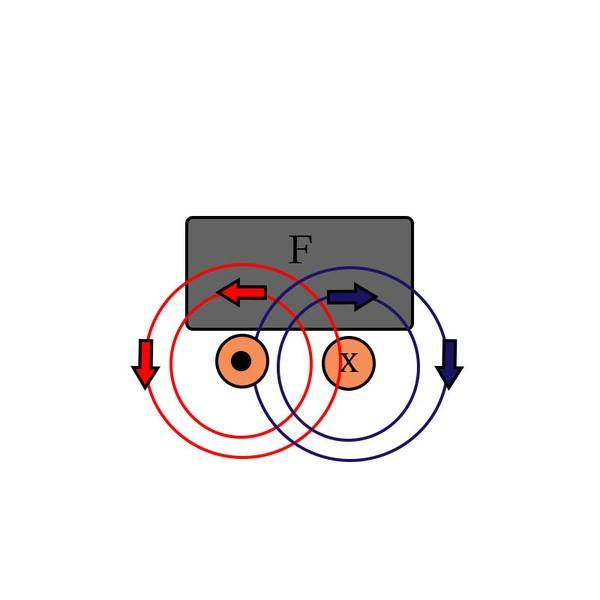
Net magnetization with opposing magnetic fields?

Click For Summary
SUMMARY

The discussion centers on the complexities of determining net magnetization in a ferromagnetic object subjected to opposing magnetic fields generated by two parallel wires carrying equal but opposite currents (I1 = I2). The non-uniform nature of the magnetic fields complicates predictions of magnetization behavior, as opposed to uniform fields where cancellation can be assumed. The analysis emphasizes the importance of the hysteresis curve for the specific ferromagnetic material, which reveals non-linear responses to magnetic fields and is crucial for understanding the material's behavior in such scenarios.

PREREQUISITES
  • Understanding of ferromagnetic materials and their properties
  • Familiarity with hysteresis curves and their significance in magnetization
  • Knowledge of magnetic field interactions from current-carrying wires
  • Basic principles of electromagnetism and magnetic field theory
NEXT STEPS
  • Study the hysteresis curve of specific ferromagnetic materials to understand their magnetization behavior
  • Explore the effects of non-uniform magnetic fields on ferromagnetic materials
  • Learn about the mathematical modeling of magnetic fields generated by current-carrying conductors
  • Investigate experimental methods for measuring magnetization in non-uniform fields
USEFUL FOR

Physicists, electrical engineers, materials scientists, and anyone involved in the study of magnetism and magnetic materials will benefit from this discussion.

PhiowPhi
Messages
203
Reaction score
8
Given this diagram:
Y9KUqjN.jpg

Two wires, having parallel and opposing current flows( Where ## I_1 = I_2 ##), creating opposing and equal magnetic fields near a ferromagnetic object(##F##), since the magnetic field of each wire is not uniform, I'm not really certain how to figure out the magnetization of the material, how would I work it out?
If the fields we're uniform I could say that it's zero, since they cancel out(not sure).
 
Physics news on Phys.org
The problem of ferromagnetic samples in a uniform magnetic field such as inside a current carrying solenoid is already reasonably complex, but can be determined by looking at the (measured) hysteresis curve for the particular ferromagnetic material. The typical hysteresis curve for a ferromagnetic material displays considerable non-linear behavior, and it would be difficult to assess how the sample would respond to the uniform magnetic field without such a graph. The scenario that you have with a very non-uniform applied magnetic field created by the electrical current in two wires is far more complicated, and it would be difficult to make any good predictions on how the system might respond. Perhaps other readers will have a better answer, but this is my best assessment.
 
  • Like
Likes   Reactions: PhiowPhi
From the hysteresis curve
image006.jpg
It's quite easy for me to "assume" that the net-magnetization would be zero, if there are two uniformly opposing magnetic fields(of equal strength). However, in this case... i think the right side of the ferromagnet(and it's domains) will magnetize in the direction of the blue field lines, the same would happen for the left side magnetizing in the direction of the red field lines. While the center will be upwards? But that's just a simple assumption.
 
Last edited:

Similar threads

  • · Replies 8 ·
Replies
8
Views
2K
  • · Replies 5 ·
Replies
5
Views
1K
  • · Replies 5 ·
Replies
5
Views
622
  • · Replies 1 ·
Replies
1
Views
2K
  • · Replies 7 ·
Replies
7
Views
2K
  • · Replies 6 ·
Replies
6
Views
2K
  • · Replies 8 ·
Replies
8
Views
2K
  • · Replies 0 ·
Replies
0
Views
1K
  • · Replies 2 ·
Replies
2
Views
1K
  • · Replies 7 ·
Replies
7
Views
7K