Graduate Neutron star mass-radius relation plot

Click For Summary
SUMMARY

The discussion centers on the mass-radius (M-R) relation plot for neutron stars (NS), highlighting the behavior of equations of state (EOS) at the extremes of the plot. It is established that neutron stars cannot exist below a certain mass threshold, leading to white dwarfs instead. The plot indicates that while neutron stars of the same radius can have varying masses, this is due to differences in central density. Additionally, exceeding the maximum mass results in collapse to a black hole, and the lower right section of the plot is deemed physically invalid due to rotation constraints.

PREREQUISITES
  • Understanding of neutron star physics
  • Familiarity with equations of state (EOS)
  • Knowledge of general relativity (GR) principles
  • Basic concepts of stellar evolution and remnant classifications
NEXT STEPS
  • Research the implications of different equations of state on neutron star properties
  • Study the effects of rotation on neutron star stability and mass limits
  • Explore the relationship between central density and mass in neutron stars
  • Investigate the characteristics and limitations of white dwarfs in the mass-radius context
USEFUL FOR

Astronomers, astrophysicists, and students studying stellar evolution, particularly those focused on neutron star characteristics and the implications of mass-radius relationships.

silly_sheep
Hi there...

I have a question about the tipical mass-radius relation plot for a neutron star, something that looks like this for different equations of state:
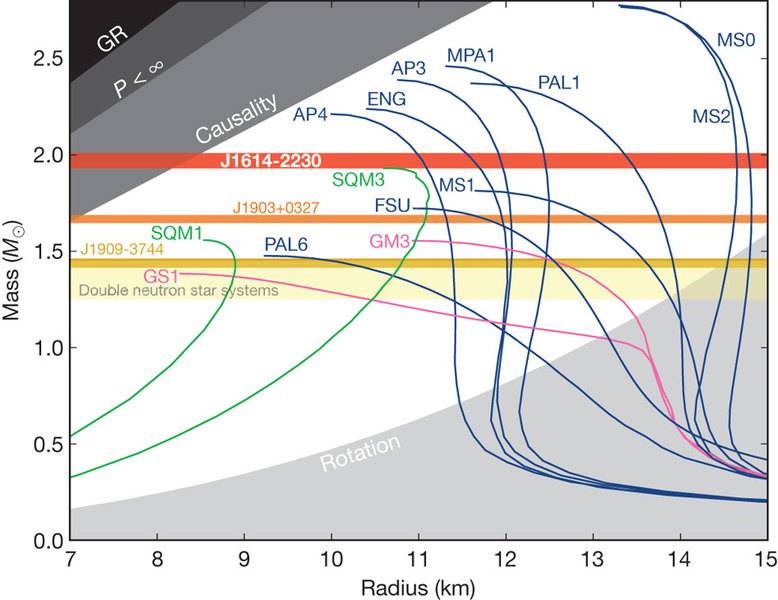
c4Iry.jpg


My question is, what is exactly happening at the ends of the EOS lines? I know that after passing the maximum mass the curve starts to spiral if you would go further, and on the other end we have something with big radius and very few mass? I am not sure I understand the plot. Also, do we expect that all NSs have the same radius? Regardless of their mass? What is the EOS actually representing? Shouldn't then each NS that we measure lie on the EOS line in M-R diagram? Well, hope to et some clarifications :-/
 
Astronomy news on Phys.org
If you try to increase the mass beyond the end of the lines, the object collapses to a black hole (or at least this particular model breaks down).
silly_sheep said:
and on the other end we have something with big radius and very few mass?
If the object is too light, it cannot be a neutron star, and you get a white dwarf - low mass, extremely large radius (on this scale).
silly_sheep said:
Also, do we expect that all NSs have the same radius? Regardless of their mass?
That would correspond to an exactly vertical line, and none of the models has that.
silly_sheep said:
Shouldn't then each NS that we measure lie on the EOS line in M-R diagram?
At least approximately. Mass, temperature and spin should be the only things that differ notably between neutron stars in the universe, and mass should have the largest impact on the size.
 
  • Like
Likes silly_sheep
If the object is too light, it cannot be a neutron star, and you get a white dwarf - low mass, extremely large radius (on this scale).
The WD comment I don't understand, you do have large radius, but from this plot they should have masses that are very low (and they can have masses that are up to 8 solar masses?) Is it valid to say that the lower right part of the panel is not physically valid since these objects can not exist cause of the rotation constraint?

So, how is it possible that a NS of same radius can have different masses? Would that mean that the central density of the star is higher, if the mass is higher?

Also, could you clarify me some of the constraints on the plot? As much as I know, GR is constraint from general relativity, which means that for the masses that high you would have a black hole. Causality should be limit for compactness of the star? Or the fact that the velocity can not be higher then c? What is P< infinity? The rotation I know that comes from the fact that the NS would be teared apart if its spin frequency would be above some value. Usually there are also these lines of "constant radiation radius? R_inf?

And why do strange quark model stars start from the left side? :P Many questions xD Tnx for you answer!
 
silly_sheep said:
The WD comment I don't understand, you do have large radius, but from this plot they should have masses that are very low
They are the low-mass extension of the mass/radius relationship, yes. The models in the plot don't include white dwarfs, they are not designed to model them.
silly_sheep said:
(and they can have masses that are up to 8 solar masses?)
They cannot. You are probably thinking about the original star mass, not the mass of the stellar remnant.
silly_sheep said:
Is it valid to say that the lower right part of the panel is not physically valid since these objects can not exist cause of the rotation constraint?
The rotation constraints only applies to very fast rotating neutron stars. There are objects to the right of this. Every star for example.
silly_sheep said:
So, how is it possible that a NS of same radius can have different masses? Would that mean that the central density of the star is higher, if the mass is higher?
Sure.

The source of the plot should have explanations of the different features in it.

Models starting from the lower left have a high density even at small overall masses.
 
  • Like
Likes silly_sheep

Similar threads

Replies
12
Views
3K
  • · Replies 48 ·
2
Replies
48
Views
6K
  • · Replies 1 ·
Replies
1
Views
2K
  • · Replies 2 ·
Replies
2
Views
2K
  • · Replies 26 ·
Replies
26
Views
5K
  • · Replies 8 ·
Replies
8
Views
3K
  • · Replies 3 ·
Replies
3
Views
3K
  • · Replies 12 ·
Replies
12
Views
3K
  • · Replies 14 ·
Replies
14
Views
2K
  • · Replies 5 ·
Replies
5
Views
3K