Attempted Part I & II Problems

  • Thread starter Thread starter theredbarronmvr
  • Start date Start date
Click For Summary
SUMMARY

The discussion centers on solving a two-part physics problem involving projectile motion. The primary challenge arises in part ii, where the absence of an air resistance term complicates the attainment of the x value derived in part i. Participants clarify that without air resistance, the problem simplifies to basic projectile motion principles. Additionally, it is emphasized that the constant term, ##c_2##, must be set to zero before integration to ensure valid solutions.

PREREQUISITES
  • Understanding of basic projectile motion principles
  • Knowledge of integral calculus
  • Familiarity with constants in differential equations
  • Ability to evaluate integrals with boundary conditions
NEXT STEPS
  • Review the fundamentals of projectile motion without air resistance
  • Study techniques for evaluating integrals in physics problems
  • Learn about the role of constants in differential equations
  • Practice solving multi-part physics problems involving integration
USEFUL FOR

Students and educators in physics, particularly those tackling projectile motion problems, as well as anyone interested in the application of calculus in physical scenarios.

theredbarronmvr
Messages
2
Reaction score
0
Homework Statement
A bullet of mass m is shot vertically up with initial speed v0. It is subject to air resistance that is quadratic in speed (constant of proportionality c2).

i. What is the maximum height reached?

ii. What initial speed u0, would be necessary to reach the same maximum height in the absence of air resistance?

Express your answers in terms of c2, g, m, and v0.
Relevant Equations
For part i: m(dv/dt) = -c2(v^2) - mg
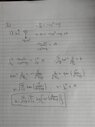
I have an attempted solution to part i here. I'm primarily having trouble with part ii since I don't see how the x found in part i can be attained if there's no air resistance term.
 

Attachments

  • pf2.jpg
    pf2.jpg
    29.4 KB · Views: 129
Physics news on Phys.org
theredbarronmvr said:
I'm primarily having trouble with part ii since I don't see how the x found in part i can be attained if there's no air resistance term.
If there is no air resistance, then it's a simple projectile motion problem.
 
  • Like
Likes   Reactions: theredbarronmvr
PeroK said:
If there is no air resistance, then it's a simple projectile motion problem.
Ahh of course, thank you! I was definitely overthinking it.
 
theredbarronmvr said:
I have an attempted solution to part i here. I'm primarily having trouble with part ii since I don't see how the x found in part i can be attained if there's no air resistance term.
In case you're wondering, when you evaluated the integral, you assumed ##c_2 \ne 0##, so it isn't valid to set ##c_2=0## in the expression you derived. (I assume that's the difficulty you were running into.) You have to set ##c_2## to 0 before you integrate.
 
  • Like
Likes   Reactions: theredbarronmvr

Similar threads

  • · Replies 9 ·
Replies
9
Views
596
  • · Replies 22 ·
Replies
22
Views
3K
Replies
3
Views
1K
Replies
9
Views
1K
  • · Replies 1 ·
Replies
1
Views
606
  • · Replies 5 ·
Replies
5
Views
1K
  • · Replies 2 ·
Replies
2
Views
2K
Replies
2
Views
4K
  • · Replies 17 ·
Replies
17
Views
1K
Replies
7
Views
1K