Newton's Law of Gravitation problem

Click For Summary

Homework Help Overview

The discussion revolves around a problem involving Newton's Law of Gravitation, specifically calculating the net gravitational force acting on a central sphere due to four surrounding spheres with given masses. The problem includes considerations of vector notation and the geometry of the arrangement.

Discussion Character

  • Exploratory, Conceptual clarification, Mathematical reasoning

Approaches and Questions Raised

  • The original poster attempts to simplify the problem by neglecting certain masses and applying gravitational force equations, but encounters difficulties with vector components. Other participants suggest defining unit vectors and reconsidering the geometry of the setup, particularly the relevance of the diagonal of the square.

Discussion Status

Participants are actively engaging with the problem, offering guidance on vector definitions and the implications of the square's geometry. There is a recognition of different approaches to the problem, but no explicit consensus has been reached on a single method.

Contextual Notes

There are indications of confusion regarding the application of trigonometric functions and the necessity of certain mathematical elements, such as the square root of 2, which relates to the geometry of the problem. The discussion reflects a mix of understanding and uncertainty about the setup and calculations involved.

Shadow Cloud
Messages
13
Reaction score
0
In Figure 13-34, a square of edge length 22.0 cm is formed by four spheres of masses m1 = 7.00 g, m2 = 3.50 g, m3 = 1.50 g, and m4 = 7.00 g. In unit-vector notation, what is the net gravitational force from them on a central sphere with mass m5 = 2.30 g?
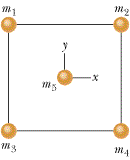
hrw7_13-34.gif


Okay this is what I did so far.
Since m4 and m1 are equal, they can be neglected. This leaves...

F = Gm5(m2-m3) / r^2

I then tried to multiply it by cos 45 degrees to get the i component and sin 45 degrees to get the y component, but this isn't working. Why is that?
 
Physics news on Phys.org
try defining your own unit vector r in the direction from m3 straight to m5.
then R= rr. Finding r is easy. The force will also be along r, so now the problem is really easy because you won't need trig functions.
If you were explicitly told to use x, y unit vectors then you'll have to change it back.
 
Last edited:
What is rr in the equation of R = rr that you gave?
 
R is the vector from m3 to m5. -R would be the vetor from m2 to m5. r is the unit vector in the direction of R.
r is the magnitude of R and is given by √(x²+y²).
r is found the same way, using the magnitudes of the unit vectors.
just be careful where you put the √2 in the unit vectors.
you want to have the r unit vector. remember what it means to be a unit vector.
 
I'm kind of following this, but why is the root 2 necessary and where would I put it?
 
Shadow Cloud said:
I'm kind of following this, but why is the root 2 necessary and where would I put it?

a simpler way seen as m1 and m4 cancel may be to work out the 2 forces sepetately using the formula you have already put at the top of the page

seen as they are opposite simply subtract one magnitude from the other (larger - smaller to stop any sign problems) then from that you will have the force and the direction of the line of action of the force, then express this in vector form

sorry if this isn't the way you have been taught but first time i have tried to post a solution on this forum :)
 
Oh nevermind, I finally figure out the necessity of the root 2. It's pertains to the length of a diagonal of a square.
 
that's right, it's from the diagonal of the square.

and it's the same thing you'd get if you did trig, but this is, in my opinion, easier and makes more sense.
not only that the ability to perform transformations by means of unit vectors is a very important thing.
/s
 

Similar threads

  • · Replies 2 ·
Replies
2
Views
2K
  • · Replies 3 ·
Replies
3
Views
4K
Replies
2
Views
3K
  • · Replies 3 ·
Replies
3
Views
2K
Replies
2
Views
2K
  • · Replies 4 ·
Replies
4
Views
3K
  • · Replies 2 ·
Replies
2
Views
1K
Replies
4
Views
2K
  • · Replies 7 ·
Replies
7
Views
5K
  • · Replies 21 ·
Replies
21
Views
11K