Newton's law problem: Pushing 2 stacked blocks on a horizontal table

Click For Summary

Homework Help Overview

The problem involves two stacked blocks, A and B, where block A rests on top of block B. The scenario is set on a frictionless table, but there is friction between the two blocks. Block B has a mass of 6.00 kg and block A has a mass of 2.00 kg. A horizontal force of 12.0 N is applied to block B, resulting in an acceleration of 1.80 m/s² for block B. The question posed is about determining the acceleration of block A.

Discussion Character

  • Exploratory, Assumption checking, Conceptual clarification

Approaches and Questions Raised

  • Participants discuss the application of Newton's second law and the forces acting on the blocks. There are attempts to relate the forces and accelerations of both blocks, with some questioning the need for the coefficient of friction to solve for block A's acceleration. Others suggest drawing free body diagrams to clarify the forces at play.

Discussion Status

Some participants have provided guidance on considering the forces acting on block A and B, while others have reiterated the importance of drawing free body diagrams. There is an ongoing exploration of how the frictional force affects the acceleration of block A in relation to block B.

Contextual Notes

Participants note that the problem may involve complexities due to the frictional force between the blocks and the absence of friction with the table. There is also mention of homework guidelines that participants are encouraged to follow.

JMAMA
Messages
18
Reaction score
0
Homework Statement
solve for acceleration of block A
Relevant Equations
f = ma
Would anyone be able to help with this Newtons law problem
Block A rests on top of block B as shown in (Figure 1). The table is frictionless but there is friction (a horizontal force) between blocks A and B. Block B has mass 6.00 kg and block A has mass 2.00 kg. If the horizontal pull applied to block B equals 12.0 N, then block B has an acceleration of 1.80 m/s2. What is the acceleration of block A

So my understanding is that from F = ma we can determine for block B that F = (6 kg)(1.80 ms2) = 10.80 N we can then say that block A is experiencing the same force yielding F - F(friction) = m a or 10.8 N - (2.0kg)(g)u = (2kg)(a). However i do not know how to solve for acceleration of A without the coefficient of friction
 

Attachments
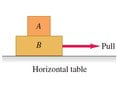
  • YoungFreedman_15e_4.34.jpg
    YoungFreedman_15e_4.34.jpg
    5.2 KB · Views: 167
Last edited:
Physics news on Phys.org
So my understanding is that from F = ma we can determine for block B that F = (6 kg)(1.80 ms2) = 10.80 N we can then say that block A is experiencing the same force yielding F - F(friction) = m a or 10.8 N - (2.0kg)(g)u = (2kg)(a). However i do not know how to solve for acceleration of A without the coefficient of friction
 
It would help if you posted the figure that goes with this problem. Use the link button "Attach files" on the lower left.
 
kuruman said:
It would help if you posted the figure that goes with this problem. Use the link button "Attach files" on the lower left.
attached in edit
 
Thanks. Now consider this. How many forces act on the top block and what object(s) exert(s) them on it?
 
kuruman said:
Thanks. Now consider this. How many forces act on the top block and what object(s) exert(s) them on it?
there is the gravitational force, the applied force, and the frictional force the applied force is applied by the bottom block
 
Last edited:
JMAMA said:
So my understanding is that from F = ma we can determine for block B that F = (6 kg)(1.80 ms2) = 10.80 N we can then say that block A is experiencing the same force yielding F - F(friction) = m a or 10.8 N - (2.0kg)(g)u = (2kg)(a). However i do not know how to solve for acceleration of A without the coefficient of friction
Welcome, @JMAMA !

You don’t need to calculate that force of friction in this case.
That pulling force is able to accelerate a mass of 6.66 kg at the given rate.
Therefore, it is simultaneously accelerating block B at that rate, and block A at a different rate.
 
Draw the free body diagram for B. The method for solving the problem should then be apparent.
 
  • #10
Lnewqban said:
Welcome, @JMAMA !

You don’t need to calculate that force of friction in this case.
That pulling force is able to accelerate a mass of 6.66 kg at the given rate.
Therefore, it is simultaneously accelerating block B at that rate, and block A at a different rate.
what would the equation be for that the 0 friction is throwing me off. would it just be 6 m/s2 from 12N = 2kg a??
 
  • #11
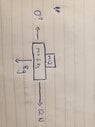
Cutter Ketch said:
Draw the free body diagram for B. The method for solving the problem should then be apparent.
 

Attachments

  • zzzz.jpg
    zzzz.jpg
    22 KB · Views: 130
  • #12
Well, sort of. A) What is that force to the left? Where does it come from. B) it’s not F=ma as you indicated for relevant equations, it’s
##\sum F## = ma so what should you do with that free body diagram?
 
  • #13
Outline:

1) Draw a FBD for block A

2) Write Newtons Second Law for block A

3) Draw FBD for Block B

4) Write Newtons Second Law for block B

5) Combine the two equations, solve for the acceleration of block ##A##

Where you might get stuck...the frictional force acting between blocks A and B. If it necessarily acts on block ##A## in a certain direction, in which way does it act on block ##B##?
 
  • #14
JMAMA said:
what would the equation be for that the 0 friction is throwing me off. would it just be 6 m/s2 from 12N = 2kg a??
Can you visualize block A accelerating at a lower rate than block B and falling behind?

If no friction existed between A and B, block A would not move respect to the ground, and our force of 12.0 N would induce a greater acceleration than 1.8 m/s2 to block B 9only one experiencing that force then).

If blocks A and B were solidly linked together, both blocks would move respect to the ground with identical acceleration, and our force of 12.0 N would induce a lower acceleration than 1.8 m/s2 to the A-B block system of mass 8.0 kg.
 

Similar threads

Replies
8
Views
4K
Replies
16
Views
3K
  • · Replies 47 ·
2
Replies
47
Views
3K
Replies
17
Views
4K
Replies
1
Views
2K
Replies
23
Views
2K
Replies
15
Views
3K
Replies
7
Views
3K
  • · Replies 23 ·
Replies
23
Views
3K
  • · Replies 3 ·
Replies
3
Views
7K